We’ve seen this grinders vs romantics debate forever (I’m team hard working romantic, if you ask).
But what’s new to me, now that new features are basically free to build, is that it takes more discipline than ever to think about direction and priorities
The fallacy of this is that more creates more. More hours, more hiring, more something.
And it is true in a sense. If you put in more work, more work will happen. But I think for most startups, the leverage is really in how differently you approach the problem, how well you cultivate your team, and the strategy.
Any large company can outspend you on hours. They have thousands or tens of thousands more people, spending more hours. If hours worked were the metric, every large company and government organization would always win and do the best work. More hours, better output.
This thinking is often representative of younger founders, where the startup becomes their identity and life. They have a hard time doing anything else, and cannot understand that your work is not the person that is you. But activities outside of work can grow you as a person too and make you do better work.
I’ve never worked this way. As a designer, I always saw the need to take a step back, to take a break. At times, I might work 12 hours or 16 hours, or whatever amount was needed, but it wasn’t the norm. You just can't grind design, you need inspiration. But taking that step away from the work, would give me more perspective, inspiration and I could approach the problem differently or I could just see the solution.
Grinding is never good for any creative problem, and startups or creating new products are often mostly about creative problem solving. Grinding works ok for email jobs, or where you just executing on very clear playbook.
With Linear, we’ve never worked this way. We work reasonable hours, 5 days a week. All of us founders have families. Many of our employees have families. I personally stop every evening, spend time with the family, cook dinner for the family, eat dinner together, and focus on things outside of work. Sometimes I work in the late evenings or weekends, but to me the pride is that I don’t need to. Company should be succesful without it.
My goal is to build a company that is sustainable in the long term, and doesn’t require heroics or personal sacrifices every single day.
There are times when our team is heroic. Launches, incidents, some other work that just needs to be done. They will work late into the night because they know it is the right thing. But we don’t require that every day or every week, and the more this happens, the more I think it is a failure of our company and leadership. The team and the leaders should always keep a reserve to use when something is needed.
Our thinking was also that quality, which we value, doesn’t emerge from working more or stressing people more. It emerges when you create the conditions for it to emerge. Often it is the appreciation, space, time, and how the person feels. A person who is rested will do better work.
I wouldn’t attribute much of our success to working a lot. The success came from having clear thinking, ideas, and focus to do the right things.
I sometimes wish we could move the culture more toward a Zen master.
Real mastery is not exerting the most effort. It is achieving the outcome with the least necessary effort.
Introducing Open Collider: an open-source engine that mechanically improves LLM creativity.
It generates non-trivial, high-quality ideas at scale, for any ideation problem.
LLMs collapse on the same ideas. Sample the same brief 100 times → most outputs land in the same place. Researchers call it the Artificial Hivemind (Jiang et al., 2025).
"Be more creative" moves the LLM's output by ~0.04 in embedding space.
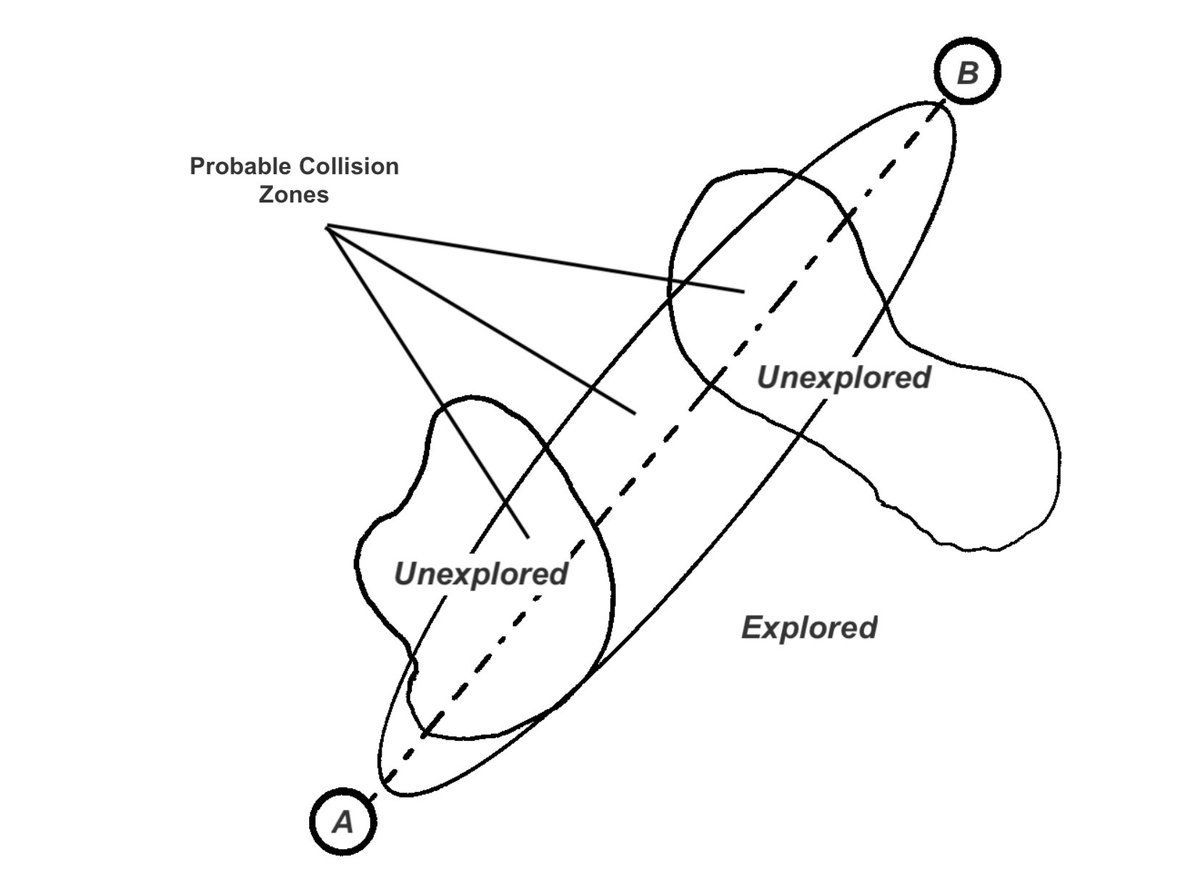
Forcing structurally distant domain collisions moves it by ~0.28.
7× more. Same model, same brief.
So I built Open Collider: a pipeline based on the theory of bisociations (Koestler 1964), the same model that drives human creativity.
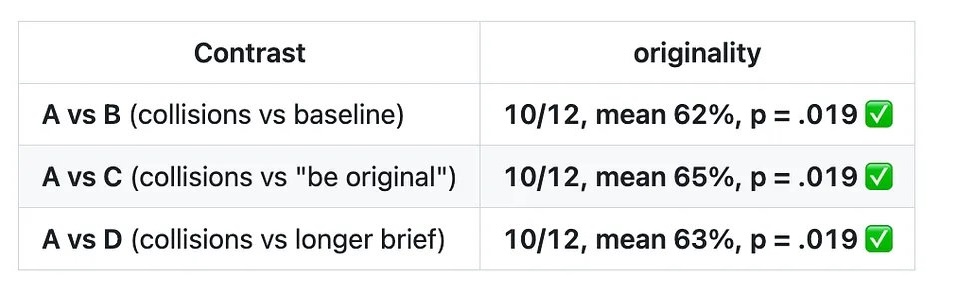
📊 Across 12 real-world ideation problems:
• 12/12 sign-test wins on embedding distance (p = .0002)
• 60%+ originality wins on 4,320 blind LLM-judge verdicts
• 4–13× further from the default cloud than "be original" prompts or longer context
• Idea relevance holds (win rate >50% on overall quality)
💻 Engine: first reply 👇
📝 Launch study: pinned tweet
Try it, Break it, Tell me what you find!
@sama@basedjensen For me it’s just currently having something I know works (cc) and not knowing if codex really works as well. But seeing so many people say it outperforms cc makes me want to try it again
@nicbstme I’d argue that here the creativity was in the prompt, in associating 2 things that are not usually seen together (car & dolphin) and that were worth associating. My experience on that is that LLMs are terrible (yet) at finding new associations worth trying
Yes! Lots of OS flagship models are still text only (e.g GLM). Multimodal is actually very important for knowledge worker agents. Still using Gemini at @onboxmail because of that
What I would love to see from Deepseek is not a flash model but a multimodal with good vision capabilities like GLM and Kimi!
But anyway, the team is cooking 🧑🍳
Post seed funding, the pursuit of sales and fundraising over learning and delivering great product to customers is the biggest midwit tarpit for most founders.
pre-seed investing is simple:
do you believe this founder will figure it out?
if yes = write the check. if no = pass.
all the traction analysis at this stage is just insecurity dressed up as diligence.