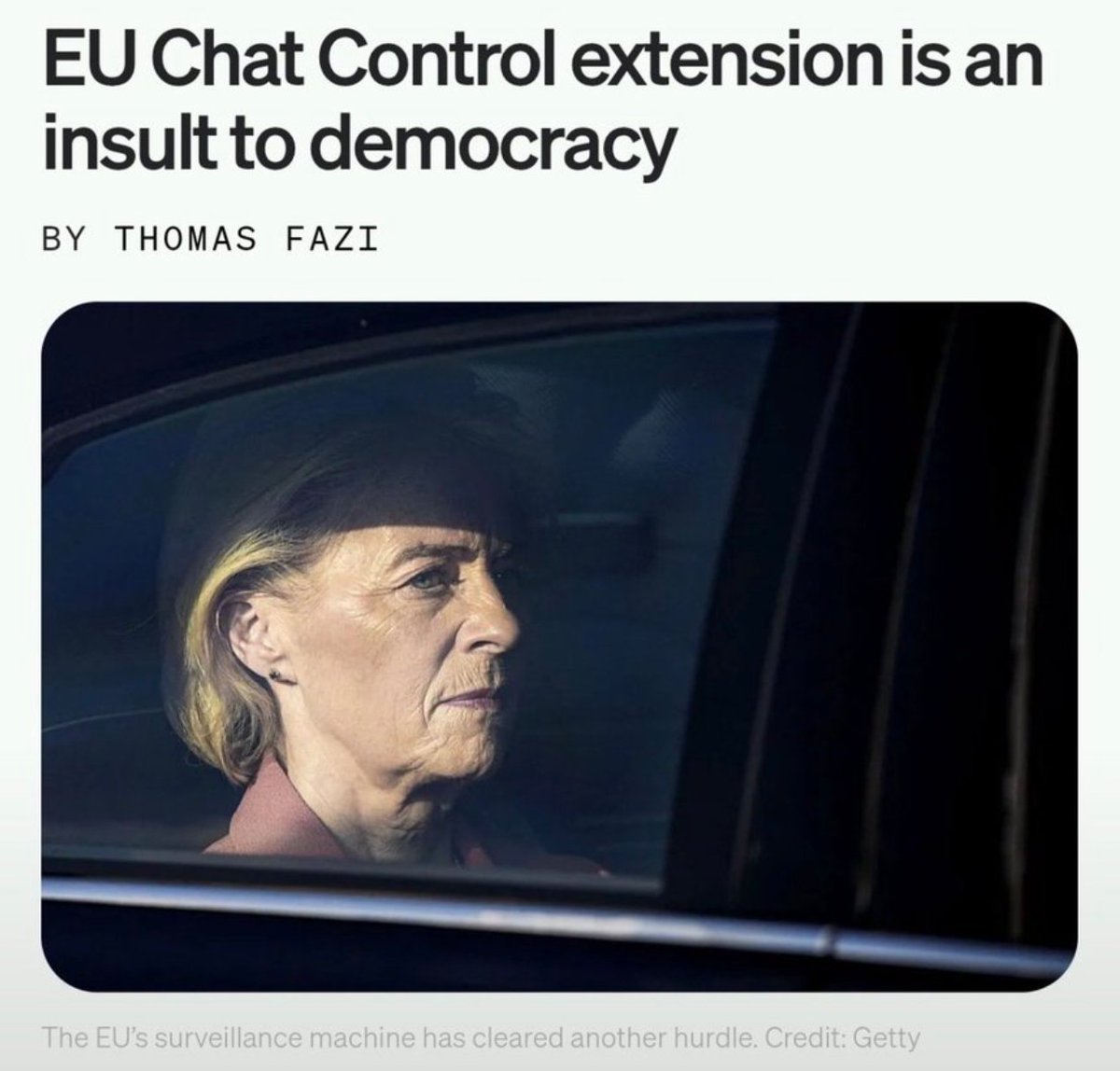
The way Chat Control has been rammed through under the cover of procedural games is a disgrace and an insult to the very idea of democracy.
Let's be clear: the European Parliament had already rejected this proposal twice.
This week, however, the rules were manipulated through an
"urgent procedure"
A simple majority of the MEPs present was no longer enough to stop it.
Instead, blocking the procedure required an absolute majority of the entire Parliament,a virtually impossible hurdle when many MEPs had already left for the summer recess.
The result speaks for itself: a majority of the MEPs who were present voted against the measure once again.
Yet because this artificially inflated threshold was not reached, the urgent procedure was approved anyway, allowing Chat Control to be rushed forward despite the expressed will of the majority in the chamber.
When the majority votes "no", but that vote is neutralized by procedural engineering, calling the outcome democratic stretches the word beyond recognition.
If this is how the European Union chooses to advance one of the most controversial surveillance proposals in its history, it has no credibility left when it lectures others about democratic values.
ALICE WEIDEL NUKES URSULA VON DER LEYEN🔥
Hey, @vonderleyen, show us your texts once you enforce Chat Control! 👋
“Total control in your chats – that's how they want to keep citizens in check, while Ursula von der Leyen DELETED her PFIZER DEALS via text messages.” - @Alice_Weidel
We must leave the EU. 🇪🇺
The EU used a procedural trick on the last day before recess to ram through mass scanning of private messages, even after the majority said no.
This is how bureaucrats override the people when the vote doesn’t go their way.
You simply don’t have rights in Europe, only privileges the administrative state can revoke whenever it wants.
That is what they call their “democracy.”
BREASTMILK
She thought she was studying milk.
What she uncovered was a conversation.
In 2008, evolutionary anthropologist Katie Hinde was working in a primate research lab in California, analyzing breast milk from rhesus macaque mothers. She had hundreds of samples and thousands of data points. Everything looked ordinary—until one pattern refused to go away.
Mothers raising sons produced milk richer in fat and protein.
Mothers raising daughters produced a larger volume with different nutrient balances.
It was consistent. Repeatable. And deeply uncomfortable for the scientific consensus.
Colleagues suggested error. Noise. Statistical coincidence.
But Katie trusted the data.
And the data pointed to a radical idea.
Milk is not just nutrition.
It is information.
For decades, biology treated breast milk as simple fuel. Calories in. Growth out. But if milk were only calories, why would it change depending on the sex of the baby?
Katie kept digging.
Across more than 250 mothers and over 700 sampling events, the story grew more complex. Younger, first-time mothers produced milk with fewer calories but significantly higher levels of cortisol—the stress hormone.
The babies who drank it grew faster.
They were also more alert, more cautious, more anxious.
Milk wasn’t just building bodies.
It was shaping behavior.
Then came the discovery that changed everything.
When a baby nurses, microscopic amounts of saliva flow back into the breast. That saliva carries biological signals about the infant’s immune system. If the baby is getting sick, the mother’s body detects it.
Within hours, the milk changes.
White blood cells surge.
Macrophages multiply.
Targeted antibodies appear.
When the baby recovers, the milk returns to baseline.
This was not coincidence.
It was call and response.
A biological dialogue refined over millions of years. Invisible—until someone thought to listen.
As Katie reviewed existing research, she noticed something unsettling. There were twice as many scientific studies on erectile dysfunction as on breast milk composition.
The first food every human consumes.
The substance that shaped our species.
Largely ignored.
So she did something bold.
She launched a blog with a deliberately provocative name: Mammals Suck Milk.
It exploded. Over a million readers in its first year. Parents. Doctors. Scientists. People asking questions research had skipped.
The discoveries kept coming.
Milk changes by time of day.
Foremilk differs from hindmilk.
Human milk contains over 200 oligosaccharides babies can’t digest—because they exist to feed beneficial gut bacteria.
Every mother’s milk is biologically unique.
In 2017, Katie brought this work to a TED stage. In 2020, it reached a global audience through Netflix’s Babies. Today, at Arizona State University’s Comparative Lactation Lab, she continues reshaping how medicine understands infant development, neonatal care, formula design, and public health.
The implications are staggering.
Milk has been evolving for more than 200 million years—longer than dinosaurs walked the Earth. What we once dismissed as simple nourishment is one of the most sophisticated communication systems biology has ever produced.
Katie Hinde didn’t just study milk.
She revealed that nourishment is intelligence.
A living, responsive system shaping who we become before we ever speak.
All because one scientist refused to accept that half the story was “measurement error.”
Sometimes the biggest revolutions begin by listening to what everyone else ignores.
Climate crash:
Swedish youth losing interest in climate
Dropped from their top issue in 2019 to bottom half of 23 concerns, behind health, education, and safety
h/t @RogerPielkeJr, read his amazing newsletter: https://t.co/sHoYwi9tGW
2025: https://t.co/Wzlm6iUss3
2019: https://t.co/I5n2KUAdfc
"Say no right now."
Former vice president at Pfizer, Dr. Mike Yeadon, urges you to reject digital ID, CBDCs, and UN Agenda 2030.
"By 2030... you will not be able to leave [the country]... you will not own private transport, you will have a digital ID to do everything, and you will only have electronic money with which to transact."
"I would say, at that point, you are a slave."
"And because you can see them coming, you should say no. Say no right now."