@HarryStebbings@gradypb I was at this event and that was not the founding story as told by one of the founders. They all knew each other before and new LLMs are coming. Hope they release the recording some day -> https://t.co/cG2BxMDhYG
Baselines matter because version chaos is real. Every engineering team hits the same moment: “Wait… which version did we sign off on?”
Teams need a snapshot of requirements at every milestone.
https://t.co/9h9RCIzUh1 handles that flow with zero friction.
@IBM DOORS was built for a world where China’s economy was 2 percent of what it is today.
In the early nineties, engineers wrote requirements while saving files on floppy disks and flipping through paper binders.
People could light a cigarette mid-flight.
Pagers were considered cutting edge.
The internet was a quiet corner of academia.
That is the era when DOORS took shape.
A world that moved slower, built simpler things, and faced nowhere near the scale of complexity we live with today.
China’s economy was a tiny fraction of what it is now.
Products had thousands of requirements, not millions.
Specs did not change for years.
Fast forward to today.
AI is entering the physical world.
Every modern product is a mix of software, sensors, safety logic, compliance layers, and partners spread across continents.
Factories are coordinating millions of micro decisions every day.
Western manufacturing is under pressure, trying to compete in a landscape where complexity is no longer avoidable. It is the norm.
And yet, countless teams still rely on tools built for that slower, smaller, almost analog world.
The issue is not that DOORS is old.
It is that it was never created for what engineering looks like now:
• Specs that evolve daily
• Hardware that changes behavior after OTA software update
• Cross functional systems that change with every small decision
• AI models that need clean causal chains
• Products that require traceability across time, not just documents
Trying to stretch a decades old system across this new world forces teams to fight complexity instead of using it. It locks companies into maintenance mode instead of moving them forward.
We need a system built for the conditions of today.
Not a rework of the past.
This is where @tracedotspace comes in.
We build an AI driven coordination layer for the R&D of complex products.
A layer that:
• Traces every chain across people, process, technology, and product
• Turns complexity from something overwhelming into something useful
• Helps companies catch up without wiping out their past work
• Keeps agility alive as they scale
• Lets engineers design with ambition instead of fear of breaking things
Complexity is no longer a liability. It is leverage.
@tracedotspace is built for the world as it is now, not for the world of floppy disks, cigar smoke filled cabins, and static specs frozen in time, and for leaders who refuse to let legacy systems slow them down.
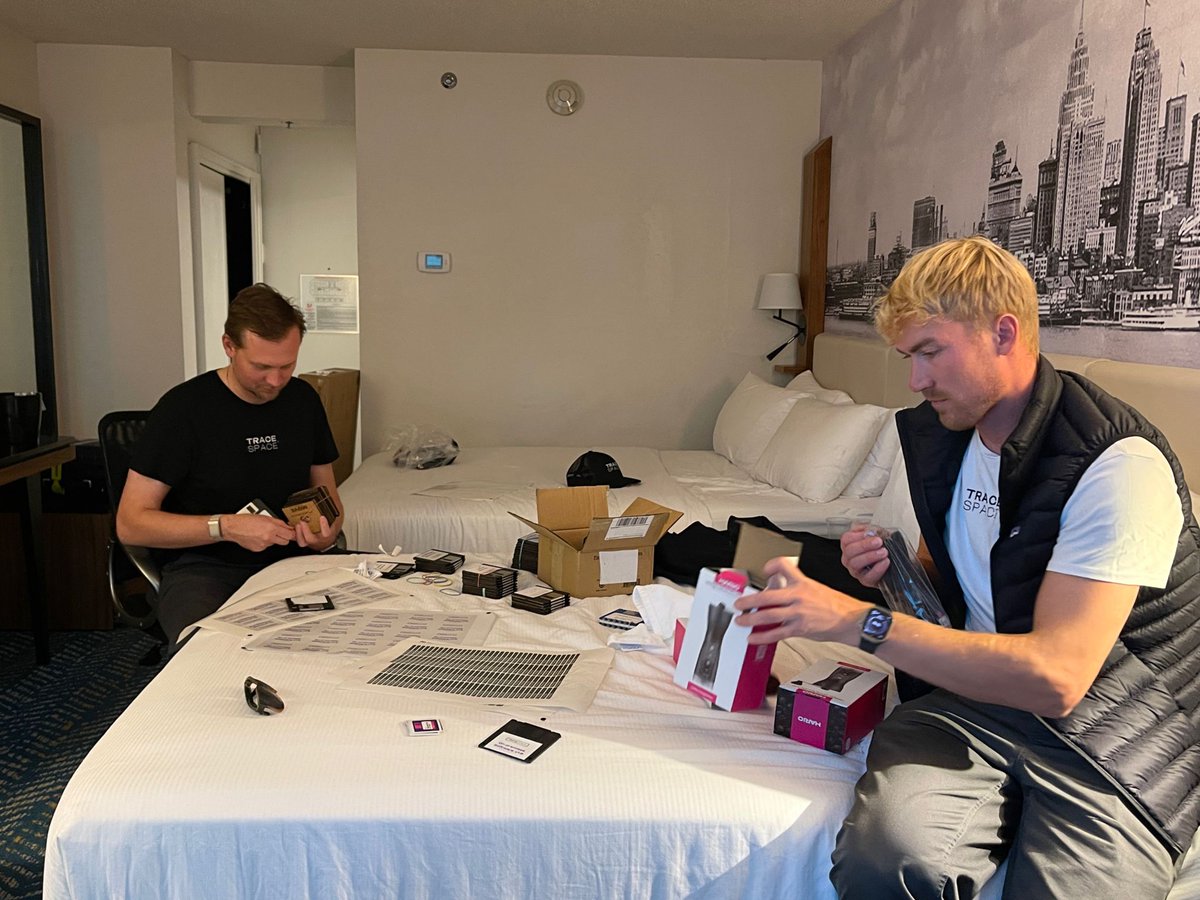
What do you think Janis and Mikus were doing late at night in a hotel room?
We bet you’re not guessing they were manually labeling floppy disks – turning them into https://t.co/9h9RCIzUh1 swag.
2 hours. 100 floppies.
Do you remember labeling your floppy disks back in the day?
Q: "How fast can I start working in https://t.co/9h9RCIzUh1?"
A: YES
The real answer is as little as a few seconds.
Import a file, and https://t.co/9h9RCIzUh1 instantly breaks it into items, so you can start working on it right away.
Ready to shut the Door to the past?
Moving complexity from liability to leverage.
Did this line raise a question? Good, it should've.
Most companies still fight complexity, trying to reorganize it, reduce it, or hide it in more layers of process.
But the harder you push against it, the more it pushes back.
The old way of thinking about R&D was simple: avoid complexity, simplify, and standardize the process.
That worked when products had a few thousand parts.
Today, they have millions, each with its own dependencies, standards, and risks.
You cannot flatten that mountain of complexity. You need a new way to climb it.
In Brazilian jiu-jitsu, I learned this the hard way. 🥋
The more you resist, the faster you gas out.
The only way to win is to use pressure as momentum and let force work for you, not against you.
More on this tomorrow.
Complexity is not liability, it’s leverage.
Another Monday morning in Haight-Ashbury. Building https://t.co/qnX65NbZ18 from SF and helping hardware engineering teams harness complexity using AI.
I am HIRING Forward Deployed Systems Engineering and sales roles! If you want to work with the best engineers in the world, DM me or @tracedotspace
Many think AI = cloud, but for sensitive projects it’s AI inside secure boundaries.
AI in engineering is great. Until you realize you can’t send your specs outside your network.
So we built https://t.co/9h9RCIzmrt to run AI on-prem.
Meet Matīss – our first employee and one of the masterminds behind our frontend magic.
From choosing the right libraries to building our Editor from scratch, he’s shaped how https://t.co/9h9RCIzUh1 feels – intuitive and built with care.
We couldn’t have done it without him.
Halloween didn’t scare us – though we might’ve spotted a few ghosts of features past.
What's new?
▪️Give user groups access to resources faster
▪️Refactored comments
▪️Add comments to entire items – works in reviews
▪️View full past review revisions, not just individual items
Glad to share that @labsoflatvia has listed https://t.co/9h9RCIzmrt among the startups shaping Latvia’s tech scene.
Behind every startup are the people who make it happen – Janis Vavere, Mik Krams, and Karlis Broders. Different paths, same goal.
https://t.co/fL0rij301e
“Your on-prem is dead.” That’s what many say.
But #OnPrem never died – it stayed mission-critical.
Aerospace. Defense. Automotive.
Data-sensitive. Regulated. Non-negotiable.
https://t.co/9h9RCIzUh1 runs where you need it – cloud, on-prem, or hybrid.
💾Something big is loading.
Last year, our CEO Janis Vavere joined @TechChill networking event in Kyiv. “Those people are unbreakable,” he said.
This year https://t.co/9h9RCIzmrt is there in spirit (and swag😉)
To the founders shaping Ukraine’s startup future – your energy moves us! 🇺🇦🇱🇻
#TechChillKyiv
🇱🇻 https://t.co/RIdntLOn9a secured a $4 million seed investment in February 2025. At @TechChill , we met @JanisVavere, co-founder and CEO to discuss the key takeaways from this experience 👇
https://t.co/WZdKcmT8TE
Selling to engineers? Ditch the steak dinner & invest in understanding their unique problems. https://t.co/BKkvCl7xGq founders share how they raised $1.5M pre-seed by validating a powerful idea & leveraging their Lokalise backgrounds👇#StartupTips
https://t.co/1u25PfhaNU
#TaxStories podkāsta Ep.74 - @mikuskrams par startapiem. Mikus Krams palīdzējis piesaistīt desmitiem milj., bet tagad izveidojis savu biznesu - https://t.co/0nOu3TSLvL. Mikus mācījies Nīderlandē, Ķīnā, ASV, Šveicē.. bet vislabāk viņam patīk Austrālijā.
https://t.co/KxSXkBZW8W
We have raised a $4M seed round from @cherryventures to accelerate the future AI-enhanced requirements management. Headlines around Western manufacturing focus on layoffs, factory closures, and products that fail to meet customer expectations. Say no more!
https://t.co/L8c6b0qbfI
Something is cooking. Great pitching between Latvian startups and American partners and investors at Silicon Valley. Many ideas and projects. Sincere thanks to Paul Holland and Linda Yates for being wonderful hosts and @akberzins and @TechChill for putting this event together.