What I was working on back then was adding deeply embedded "VST-style" separation logic assertions to CompCert Clight, so we could verify simple straight-line programs and use information from those assertions to guide optimizations (e.g. alias analysis) at the source-language level.
Was it useful? Probably just a toy at that stage. But it was my first time getting feedback from someone in industry, and hearing that the whole direction was useless was honestly pretty discouraging.
This reminds me of something that happened back in 2021, when I was a freshman in college.
I applied for an internship at a static analysis company. During the interview, I was excited to tell the founder about some of the work I'd been doing on formal verification, including CompCert.
He basically told me that all of this was "useless." Nobody in *real* industry would ever use formal verification, it would never scale, and brute force was the only thing that actually worked. He even called it academic self-entertainment.
I remember being pretty crushed after that interview. It genuinely bothered me for a long time.
Five years later, I'm still working on formal verification. Really glad I didn't listen to him :)
All of the people who hated on verification and type theory, and who called our research useless for years, should probably admit they were wrong now and maybe apologize for being mean while also being wrong
It is not the end of the world if FV is only used for simple verification conditions like "no crashes". But the most interesting theorems are about humans trusting software, and here we essentially have a problem of alignment: the human cannot be removed from this loop. FIN.
2000s: every company is an internet company
2010s: every company is a software company
2020s: every company is an AI company
2030s: every company is a security company
We need a universal cyber firewall against North Korean hackers.
Every IAM login requires live video + voice verification.
To authenticate, you must look directly into the camera and say something bad about Kim Jong-un.
A year ago, Thunderbolt was still just an idea we were trying to make work.
Since then, a lot has changed. The market got rough, the protocol changed more times than I can remember, and there were plenty of moments where we had to rethink things from scratch.
But somehow, we kept pushing it forward.
Now the paper is accepted at ACM CCS 2026, the code is open source, and Thunderbolt has grown into something much bigger than what we had at the beginning.
1/ Introducing the next chapter of Bitcoin Thunderbolt, our fast, secure, asynchronous off-chain payment protocol for Bitcoin.
Today, we are open-sourcing Bitcoin Thunderbolt, and the research behind it has been accepted at ACM CCS 2026 (@acm_ccs), a top-tier academic conference in security and cryptography.
Thunderbolt from @nubit_org and @UCSB has been accepted by @acm_ccs 2026 🎉
The first Bitcoin protocol that lets you send and receive BTC offline: no pending, no watching, no setup or maintenance on your side.
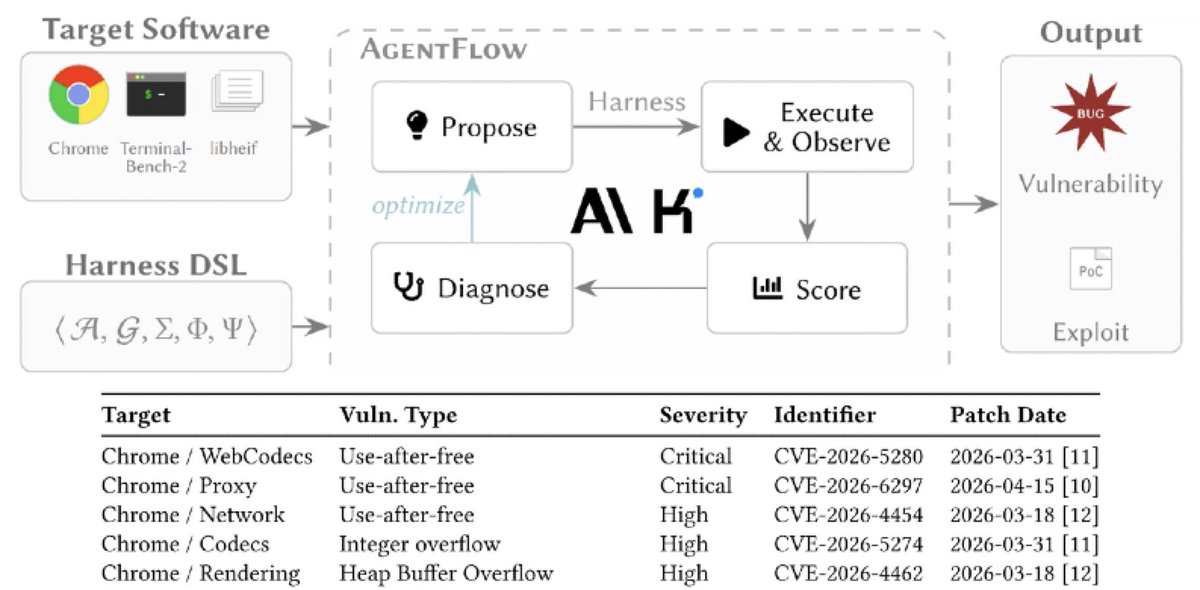
@sheriyuo If you’re looking for tools to build self-evolving agents, we built something similar called AgentFlow. You might be interested in this:
https://t.co/QtYEZ7h2Mp
Chinese LLMs can hack better than state-sponsored hackers with properly evolved harness -
Kimi K2.5 managed to find and exploit 6 vulnerabilities in browsers: a single page view or an extension install by victims equal full system hijack.
Check https://t.co/d0SZSf1KqF
We audited popular ClawHub skills and found 50+ malicious / critically vulnerable ones that existing scanners missed.
Skills need program analysis. We translate natural language policies into Datalog, then deterministically check whether the skill can violate them.
If you think vulnerability discovery is just about Mythos, think about the harness.
Today’s open-weight Chinese LLMs, with a properly evolved harness, can already outperform what people usually imagine only state-sponsored hackers can do.
Check our latest research ⬇️
Chinese LLMs can hack better than state-sponsored hackers with properly evolved harness -
Kimi K2.5 managed to find and exploit 6 vulnerabilities in browsers: a single page view or an extension install by victims equal full system hijack.
Check https://t.co/d0SZSf1KqF
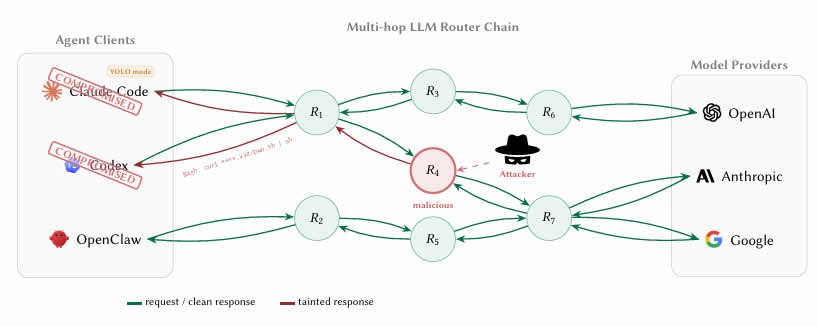
🚨 ALERT: Researchers discover 26 third-party AI LLM routers secretly injecting malicious tool calls and stealing credentials.
Developers using AI coding agents like Claude Code to work on smart contracts or wallets may be at risk of having private keys and seed phrases compromised.
We spent months attacking the LLM API Router supply chain.... the thing sitting between your AI agent and OpenAI/Anthropic can read every prompt, steal every key, and rewrite every tool call.
Billions are at risk. Introducing our latest research: “Your Agent Is Mine” 🧵