𝗔𝗜 𝗶𝗻 𝗳𝗶𝗻𝗮𝗻𝗰𝗲 𝗺𝗮𝗿𝗸𝗲𝘁𝗶𝗻𝗴 𝗶𝘀 𝗻𝗼𝘁 𝗮𝗯𝗼𝘂𝘁 𝗽𝗿𝗼𝗱𝘂𝗰𝗶𝗻𝗴 𝗺𝗼𝗿𝗲 𝗰𝗼𝗻𝘁𝗲𝗻𝘁.
𝗧𝗵𝗲 𝗿𝗲𝗮𝗹 𝘀𝗵𝗶𝗳𝘁 𝗶𝘀 𝗳𝗿𝗼𝗺 𝗰𝗼𝗻𝘁𝗲𝗻𝘁 𝗰𝗿𝗲𝗮𝘁𝗶𝗼𝗻 𝘁𝗼 𝗮𝗰𝗰𝗼𝘂𝗻𝘁𝗮𝗯𝗹𝗲 𝗴𝗿𝗼𝘄𝘁𝗵.
Financial brands operate under strict conditions: every message must balance relevance, accuracy, suitability and trust. That makes AI powerful, but also sensitive.
Used well, AI can connect data, segmentation, activation and measurement into a smarter marketing system. It helps teams understand customer needs earlier, personalize with precision, test faster and measure what creates value.
But the opportunity is not automation alone. It is accountable intelligence.
Part 1 examines how finance marketing can move from a content factory to a system that learns, tests and improves continuously.
How is your team using AI in marketing today: mainly for content creation, or already as part of a broader system for insight, testing and measurement?
Link to the full article in the comments.
#FinanceMarketing #AI #FinancialServices #MarketingStrategy #21X
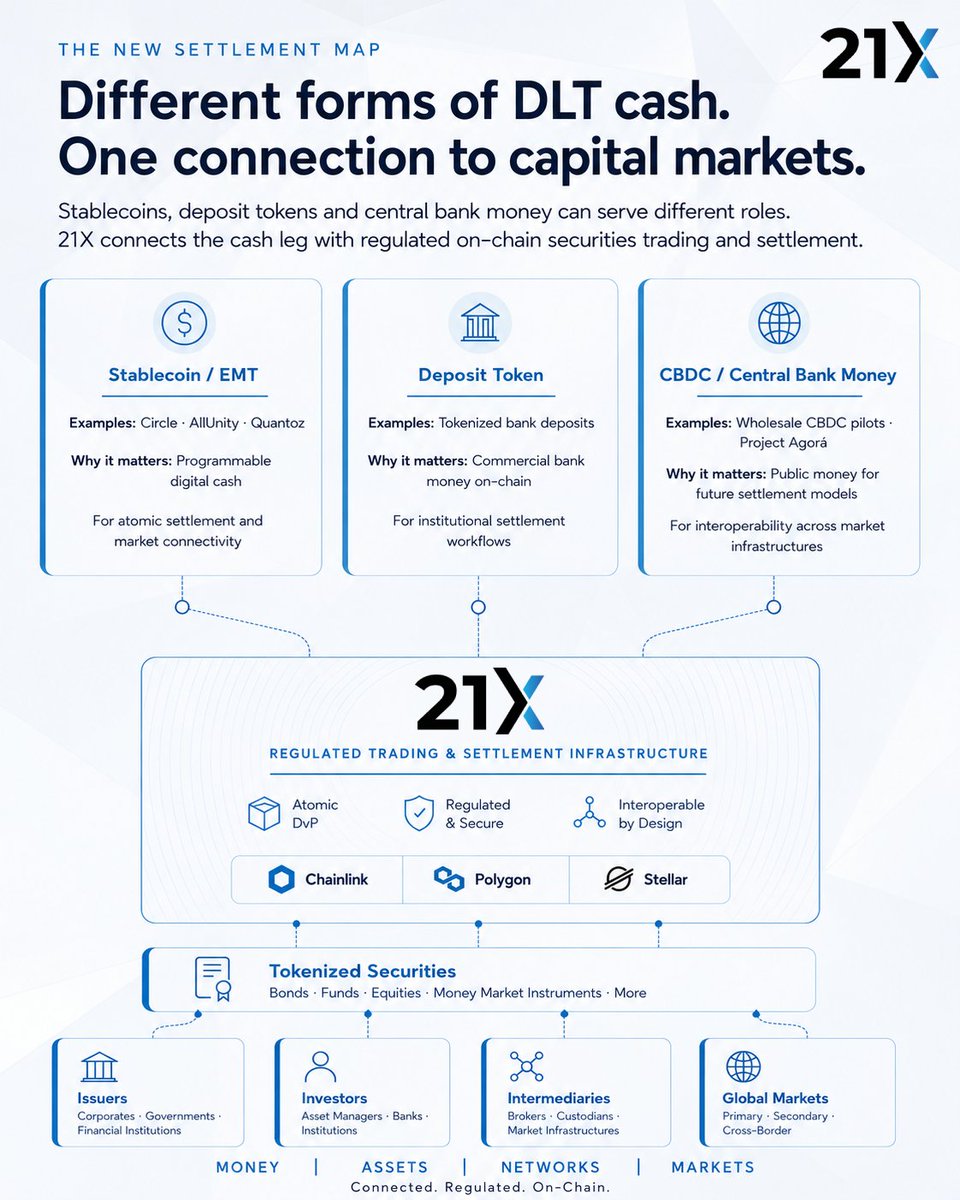
Different forms of DLT cash. One connection to capital markets.
Digital cash is taking multiple shapes.
Stablecoins and e-money tokens. Deposit tokens that put commercial bank money on-chain. Wholesale central bank money and emerging CBDC models.
Each serves a different purpose. For tokenized capital markets, though, the requirement is constant: the cash leg must connect to the asset leg through regulated infrastructure.
That connection is what we are building at #21X.
For settlement today, stablecoins and EMTs provide programmable cash for atomic Delivery versus Payment. USDC from #Circle power atomic settlement on 21X, while our work with #AllUnity and #Quantoz broadens the range of regulated digital cash available to tokenized capital markets.
Deposit tokens could put commercial bank money directly on-chain, creating new options for institutional settlement workflows.
Wholesale central bank money and CBDC initiatives like Project Agorá point to another settlement model, one that matters most where commercial bank money, central bank money and financial market infrastructures need to interoperate.
The point is not that one form of DLT cash will replace the rest.
Capital markets need infrastructure that connects different forms of money with tokenized assets.
That is where the 21X ecosystem comes in.
#Chainlink supports the data and interoperability layer. #Polygon and #Stellar provide public blockchain infrastructure. 21X brings these components together inside regulated trading and settlement infrastructure built for atomic DvP.
Different forms of money. One regulated connection to tokenized capital markets.
Connected. Regulated. On-Chain.
#CapitalMarkets #DigitalAssets #DLT #Stablecoins #OnchainFinance #MarketInfrastructure
𝗢𝗻-𝗰𝗵𝗮𝗶𝗻 𝗰𝗮𝗽𝗶𝘁𝗮𝗹 𝗺𝗮𝗿𝗸𝗲𝘁𝘀 𝘀𝗵𝗼𝘂𝗹𝗱 𝗻𝗼𝘁 𝗯𝗲 𝗹𝗼𝗰𝗸𝗲𝗱 𝗶𝗻𝘁𝗼 𝗼𝗻𝗲 𝘁𝗲𝗰𝗵𝗻𝗶𝗰𝗮𝗹 𝘀𝗶𝗹𝗼.
#21X runs on public permissionless blockchain infrastructure and is designed to extend across additional protocols over time. The important point is not “one chain wins”.
The important point is that regulated market access, trading rules and settlement controls can sit at the smart contract layer.
That creates a powerful combination:
► Public blockchain infrastructure for transparency and interoperability.
► Permissioned access for verified participants.
► Regulated market infrastructure for tokenized financial instruments.
For issuers, that choosing the chain can become an infrastructure decision - not a regulatory reset every time.
Issuers & infrastructure teams - which blockchain would you want your instrument to live on first?
#Multichain #Polygon #Interoperability #Tokenization #stellar
𝗪𝗮𝗹𝗹𝗲𝘁𝘀 𝗮𝗻𝗱 𝘁𝗵𝗲 𝗳𝘂𝘁𝘂𝗿𝗲 𝗼𝗳 𝘁𝗿𝗮𝗱𝗶𝗻𝗴
The reason wallets are so integral to the future of capital markets is because they lay at the heart of settlement.
In conventional markets, a trade and its settlement are two separate events, typically two business days apart under the T+2 cycle still used across the EU, where more than €4 trillion of securities settle through central securities depositories every single day. That gap creates counterparty risk, and it's why the EU, UK and Switzerland are now moving to a faster T+1 cycle by October 2027, following the US, Canada and Mexico's own transition in May 2024.
But wallet-native infrastructure goes further still. When both wallets in a trade are verified by a smart contract in real time, the swap of asset and cash happens as a single, atomic event. Settlement risk doesn't shrink - it disappears. That’s because the trade is the settlement.
This is one reason why forecasts for tokenized markets look so ambitious. Citi's research puts the current tokenized asset market at roughly $17 billion today, but projects a base case of $5.5 trillion by 2030, with a bull case of $8.2 trillion, driven by major infrastructure providers such as DTCC, NYSE and Nasdaq in the US building tokenization directly into core trading systems. Estimates vary widely across banks and consultancies, but the direction of travel is clear: Wallets, custody and smart contracts together are becoming the de facto plumbing for the future capital markets activity.
Read the full article in the comments below.
2#1X | Europe's first fully regulated DLT trading and settlement system
#tokenization #digitalassets #capitalmarkets #DLT #fintech #digitalwallet
𝗖𝗼𝗺𝗽𝗹𝗶𝗮𝗻𝗰𝗲 𝗶𝘀 𝗻𝗼𝘁 𝗮𝗻 𝗲𝘅𝘁𝗿𝗮 𝗹𝗮𝘆𝗲𝗿 𝗼𝗻 𝟮𝟭𝗫.
𝗜𝘁 𝗶𝘀 𝗽𝗮𝗿𝘁 𝗼𝗳 𝘁𝗵𝗲 𝗺𝗮𝗿𝗸𝗲𝘁 𝗶𝗻𝗳𝗿𝗮𝘀𝘁𝗿𝘂𝗰𝘁𝘂𝗿𝗲.
#21X combines a regulated venue model with smart contract-based permissioning. Participants wallets are whitelisted before they can interact with the platform’s trading and settlement functionality.
That means the core question is not whether the blockchain is public or private.
The real question is: who can access the market functions, under which rules, and how is eligibility enforced?
On 21X, the answer is protocol-level control under a regulated framework - with KYC/AML, market access and settlement logic designed into the rails.
Compliance & risk officers - what would protocol-level eligibility change in your workflow?
#Compliance #MiFID #RegTech
🎙️ 𝗧𝗵𝗲 𝗳𝘂𝘁𝘂𝗿𝗲 𝗼𝗳 𝗰𝗮𝗽𝗶𝘁𝗮𝗹 𝗺𝗮𝗿𝗸𝗲𝘁𝘀 𝗶𝘀 𝗯𝗲𝗶𝗻𝗴 𝗯𝘂𝗶𝗹𝘁 𝘁𝗼𝗱𝗮𝘆.
Our Founder and CEO Max J. Heinzle appears in the first English-language episode of the Deloitte Legal Podcast.
Max joins Alireza Siadat discuss how tokenization and distributed ledger technology are transforming financial markets, and what this shift means for issuers, investors, financial institutions, and market infrastructure providers.
The conversation covers:
► The emergence of tokenized securities and digital assets
► The role of DLT-based market infrastructure
► The regulatory developments shaping the market
► The opportunities and challenges facing market participants
► What it will take to move tokenized capital markets toward broader adoption
These questions sit at the core of what we build at 21X: regulated, DLT-based capital markets infrastructure designed to bring trading and settlement of tokenized securities on-chain.
Our thanks to Alireza Siadat for the invitation and the discussion, and to everyone involved in producing this episode.
🎧 Listen in for Max's perspective from the forefront of the transition toward regulated on-chain capital markets.
Find the full episode below in the comments!
#Tokenization #TokenizedSecurities #DigitalAssets #DeloitteLegal
On-chain market access starts with a wallet - but not with anonymous access
On #21X, access is wallet-based and permissioned. Participants can use self-custody or third-party custody models, but only verified and approved wallets can interact with the relevant smart contracts.
That is the important difference:
Not “anyone can trade anything”.
Rather: verified participants can access regulated on-chain market infrastructure through digital wallets, APIs and smart contracts.
This is how on-chain finance starts to fit institutional workflows: direct ownership records, custody choice and compliance controls inside the rails.
Custodians & investors - which access model fits your organization: self-custody, third-party custody or a hybrid?
#WalletInfrastructure #SelfCustody #DigitalAssets #OnChainFinance
Two functions, not one
A wallet performs two different functions at the same time, and it's worth understanding each of them separately.
► The first is the safe deposit box key: The cryptographic proof that establishes and controls ownership, exactly as described above.
► The second is the interface to the blockchain: the software layer through which a user connects to applications, submits instructions, and interacts with smart contracts.
Wallet solutions must secure both functions at the same time. Most retail apps blend them into one screen for ease of use. Regulated infrastructure usually separates them deliberately.
A custody provider might guard the keys through MPC, while distinct interfaces handle connections to trading venues, order books, settlement contracts and access to the respective functionalities.
That split is what lets an institution outsource the vault (custody) while keeping a controlled, policy-governed door (the interface) for specific access to functionality and decentralized financial applications.
Read the full article in the comments below.
#21X | Europe's first fully regulated DLT trading and settlement system
#tokenization #digitalassets #capitalmarkets #DLT #fintech #digitalwallet
𝗢𝗻-𝗰𝗵𝗮𝗶𝗻 𝗺𝗮𝗿𝗸𝗲𝘁𝘀 𝗱𝗼 𝗻𝗼𝘁 𝗵𝗮𝘃𝗲 𝘁𝗼 𝗯𝗲 𝗼𝗽𝗮𝗾𝘂𝗲.
At the heart of #21X is a central limit order book model implemented through smart contracts. Verified participants can submit orders, matching follows transparent rules, and settlement can happen on-chain through the same regulated market infrastructure.
This matters because tokenized securities need more than issuance. They need secondary-market liquidity, market data and reliable execution.
21X is also using the @chainlink data standard to make market data available on-chain on @0xPolygon and @StellarOrg - helping market participants, custody providers, developers and risk systems work with verifiable market information.
Market makers & trading desks - what would you build on a regulated, transparent on-chain order book?
#OrderBook #CLOB #OnChainFinance #Tokenization
Wallets. You've heard the word a hundred times in every tokenization conversation. Do you actually know what one does?
Most people in traditional finance don't, and there's no reason why they should. For decades, owning a bond or a share meant holding a contractual claim with a broker, not something you could point to. Wallets change that relationship entirely.
This is the first in a new #21X series of: A beginner's guide to... Plain-English breakdowns of the infrastructure reshaping capital markets, one concept at a time.
First up we take a look at digital wallets - what they actually are; the two keys that control everything; who guards those keys and how; and why atomic settlement is about to make the old T+2 world look slow to the point of extinction.
Read the full article down below.
https://t.co/SWvRy39jDk
21X | Europe's first fully regulated DLT trading and settlement system
#tokenization #digitalassets #capitalmarkets #DLT #fintech #digitalwallet
𝗗𝗶𝗴𝗶𝘁𝗮𝗹 𝘁𝘄𝗶𝗻𝘀 𝗮𝗻𝗱 𝗳𝘂𝗻𝗱 𝗱𝗶𝘀𝘁𝗿𝗶𝗯𝘂𝘁𝗶𝗼𝗻, 𝗽𝗮𝗿𝘁 𝟲/𝟲
𝗧𝗵𝗲 𝗳𝘂𝘁𝘂𝗿𝗲 𝗶𝘀 𝗱𝘂𝗮𝗹 𝗮𝗿𝗰𝗵𝗶𝘁𝗲𝗰𝘁𝘂𝗿𝗲.
Native tokenization and digital twins solve two distinct issues.
► Native tokenization improves the fund infrastructure.
► Digital twins expand the market interface.
One upgrades the core.
The other opens new access.
That is why the strongest strategy is not necessarily choosing one or the other.
It may be both.
Digital twins can address on-chain demand today.
Native tokenization prepares the fund infrastructure for tomorrow.
The mistake is to assume that one architecture to solve every requirement.
The better question to ask is:
“Which structure serves which market best?” That's the tokenized financial instrument to choose.
Whatever the asset, #21X is building the regulated market layer for tokenized capital markets in Europe.
#tokenization #digitalassets #capitalmarkets #DLT #digitaltwin
𝗦𝗲𝘁𝘁𝗹𝗲𝗺𝗲𝗻𝘁 𝗿𝗶𝘀𝗸 𝗶𝘀 𝗻𝗼𝘁 𝗷𝘂𝘀𝘁 𝗮𝗻 𝗼𝗽𝗲𝗿𝗮𝘁𝗶𝗼𝗻𝗮𝗹 𝗱𝗲𝘁𝗮𝗶𝗹.
It ties up capital, creates reconciliation work and leaves institutions exposed between trade date and settlement date.
Atomic settlement changes that workflow.
On 21X, matching and settlement are smart contract-enabled. The security leg and the digital cash leg can move together in one delivery-versus-payment transaction: either both legs complete, or neither does.
The result is a market workflow built for speed, certainty and operational efficiency - without pushing institutions outside a regulated framework.
Treasury & operations teams - what would settlement in seconds change for your desk?
#AtomicSettlement #DvP #Tokenization
𝗔 𝘁𝗼𝗸𝗲𝗻 𝗮𝗹𝗼𝗻𝗲 𝗱𝗼𝗲𝘀 𝗻𝗼𝘁 𝗰𝗿𝗲𝗮𝘁𝗲 𝗮 𝗺𝗮𝗿𝗸𝗲𝘁.
It does not automatically create liquidity. It does not guarantee price discovery. It does not solve custody. It does not remove compliance. And it does not make an instrument useful as collateral by itself.
This is one of the most important distinctions in tokenized capital markets. The real question starts after issuance:
► Can the instrument be traded?
► Can settlement occur atomically?
► Can payment and asset transfer happen simultaneously?
► Can eligible participants interact under clear rules?
► Can the instrument become part of broader collateral and liquidity workflows?
For tokenized money market funds, this is decisive. It is not just that regulated fund interest can be represented on-chain. Their potential is in a yield-bearing instrument that is transferable, settleable, and usable inside institutional market infrastructure. That requires regulated infrastructure.
#21X provides regulated market infrastructure for tokenized securities, enabling issuers and institutional participants to connect issuance, trading, and settlement in a DLT Trading and Settlement System.
The next phase of tokenized markets will be defined less by tokenization and more by whether the resulting instrument actually functions as something tradable, settleable, and usable as collateral.
Find the full article down in the comments
#Tokenization #DLT #DigitalSecurities #Settlement
# 𝗗𝗶𝗴𝗶𝘁𝗮𝗹 𝘁𝘄𝗶𝗻𝘀 𝗮𝗻𝗱 𝗳𝘂𝗻𝗱 𝗱𝗶𝘀𝘁𝗿𝗶𝗯𝘂𝘁𝗶𝗼𝗻, 𝗽𝗮𝗿𝘁 𝟱/𝟲
𝗗𝗶𝗴𝗶𝘁𝗮𝗹 𝘁𝘄𝗶𝗻𝘀 𝗮𝗿𝗲 𝗮𝗯𝗼𝘂𝘁 𝗱𝗶𝘀𝘁𝗿𝗶𝗯𝘂𝘁𝗶𝗼𝗻.
Digital twins are a product of blockchain and DLT. What's driving their growth is simple: These digital twins - along with other tokenized instruments - are available through an entirely new distribution channel, creating an entirely new financial market.
Traditional fund distribution carries influence but scales slowly. It relies on platforms, intermediaries, local rules and operational processes.
Digital twins establish a separate route: A tokenized instrument sits in a wallet, trades on secondary markets and connects with on-chain financial infrastructure. This reach extends to investors traditional distribution channels miss, including:
► Crypto-native institutions
► Web3 treasuries
► DeFi protocols
► Global on-chain investors
The goal is not to replace traditional distribution. The goal is to add a new layer to capital markets.
Asset managers face a straightforward question: Is your product available as a digital twin - accessible in a decentralized finance market which is experiencing exponential growth around the globe?
And 21X connects that demand to a fully regulated market - for the listing of digital twins, one of a range of financial instruments, from stocks and bonds to fund tokens and real-world assets.
Full article down below in the comments
#FundDistribution #Tokenization #DigitalAssets #RWAs