This trader turned $5k to $100M in 10 years.
He live-streamed the last 3 years, going from $3M to $100M.
I watched every stream and recorded over 1,000 clips of the most valuable and funny moments.
You can watch them all here (for free):
https://t.co/81Clo17qsi
I've seen several posts lately comparing today's market environment to the Panic of 1873, so I thought I'd share some historical context, along with actual stock-price data from the period.
While it's true that overinvestment, excessive leverage, and mounting debt burdens associated with railroad construction created the conditions for the crisis, they were not what immediately triggered it.
The conditions for an investment bust or bear market in stocks and the conditions for a systemic financial crisis are not the same thing. Stocks can crash without triggering a broader financial crisis.
The similarities between today and 1873 are largely centered on the enormous amounts of capital being invested in building out the most promising infrastructure technology of the day, much of it in anticipation of demand that has yet to materialize.
But that's hardly unique to 1873. Similar episodes of overinvestment occurred in the railroad expansion following the Civil War, the industrial expansion surrounding WWI, and the internet and telecommunications boom of the late 1990s. These investments eventually contributed to substantial market declines and economic contractions, but not every investment bust became a systemic banking crisis.
What made 1873 different was the collapse of the credit system supporting the railroad boom.
American railroads had relied heavily on European capital to finance their construction. But as investment conditions deteriorated, culminating in a financial crisis in Vienna in May 1873, European investors increasingly withdrew from American railroad securities. Railroad bonds became difficult to sell, leaving companies dependent on continued financing in an increasingly precarious position.
Jay Cooke & Co., one of America's largest and most prestigious banking houses, was particularly vulnerable.
The firm had committed enormous resources to financing construction of the Northern Pacific Railroad. As construction expenses mounted and bond sales failed to keep pace, Cooke became increasingly dependent on its own financial resources to sustain the project.
On September 18, 1873, Jay Cooke & Co. suspended payments; they could no longer meet their financial obligations to depositors and creditors.
The failure of such a prominent institution immediately raised fears about the solvency of other banks and financial houses. Bank runs spread, credit contracted sharply, and the New York Stock Exchange suspended trading for ten consecutive days beginning September 20, closing less than two hours after the trading day began.
That's what transformed an increasingly troubled investment environment into a full-blown financial panic.
So what were stocks actually doing?
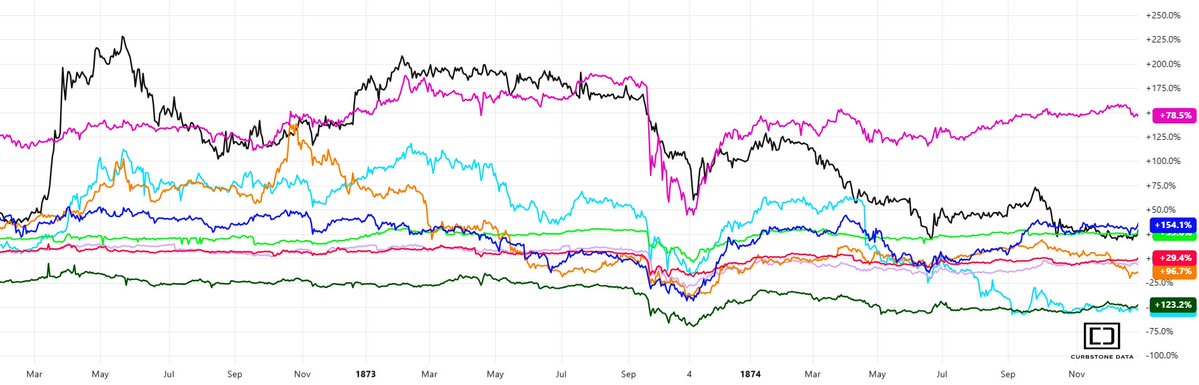
The charts below show a selection of the largest and most actively traded stocks on the NYSE around the time of the panic.
Most of the stocks I've examined fell approximately 25–60% between September 17 and their autumn lows. But what stands out is that many were already well below their 1872 highs or had been trading sideways for an extended period before the panic.
St. Paul had already been declining for years before September 1873.
New York Central had been trading in a relatively broad range since 1869, roughly between $80 and $110. On September 17, 1873, it was trading around $104, just under its all-time high.
Pacific Mail Steamship was among the more actively traded securities, but had already lost approximately 60% of its value from its 1872 high.
Union Pacific was more than 40% below its 1872 high.
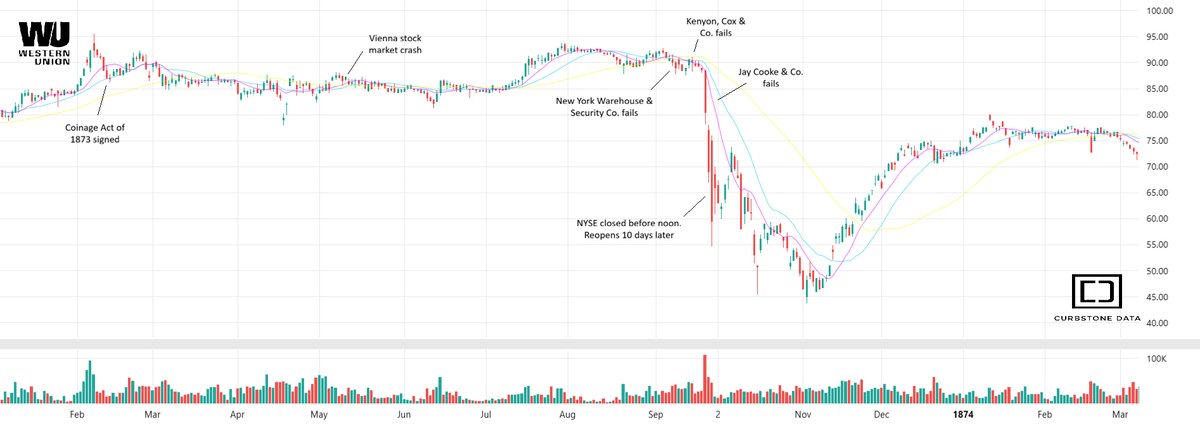
One of the most striking exceptions was Western Union.
Western Union had advanced more than 200% from its 1870 low and was trading only about 6% below its February 1873 all-time high immediately before the panic.
Yet it was among the hardest-hit stocks during the crisis, declining approximately 12% at its intraday low on September 18 and eventually losing about half its value between September 17 and November 1.
The aftermath was equally revealing.
The financial panic affected securities very unevenly. Some railroad companies entered prolonged financial distress, while others recovered relatively quickly. New York Central, for example, experienced a sharp V-shaped recovery and was essentially back near its pre-panic price by the end of January 1874.
This is an important distinction when comparing historical market crises with the present.
The AI infrastructure boom may eventually produce substantial overcapacity, disappointing returns, and significant declines in the shares of companies financing or supplying that infrastructure. That wouldn't be particularly surprising, nor would it be historically unprecedented.
But the Panic of 1873 required something more than excess investment. It involved a breakdown in the financing system itself, followed by failures that transmitted the damage throughout the economy.
And while the modern financial system is certainly not immune to credit crises, an infrastructure investment bust doesn't automatically imply a repeat of 1873.
The more useful historical question isn't simply whether too much infrastructure is being built, but whether the financing arrangements supporting that construction are fragile enough to turn an investment bust into a systemic financial crisis.
I believe a more useful comparison for today’s market is that of the late 1980s or early 1990s, or maybe the early 1960s. But that discussion is for another day.
--------------------------------------------
None of the stocks posted here have been adjusted for dividends. And you can ignore the percentages on the right side of the comparison charts. They are mostly to show the relative difference in the strength of stocks before and after the crash.
@traderCharlieM@IntlSpeculator
Should you let the indices dictate your level of exposure?
The best traders contradict themselves on this constantly — telling you to respect the indices while, at the same time, partially ignoring them.
Here's Gil Morales & Dr. Kacher's take:
1872 may have been the year the modern stock market truly arrived, and Erie Railway was at the center of it.
For most of the market’s first 75 years, stocks were thinly traded, heavily manipulated, and prone to violent boom-and-bust cycles. Even major companies were rarely dependable long-term holdings.
That began to change in the late 1860s.
The transatlantic cable connected New York and London in 1866. The stock ticker followed in 1867 and was improved by Edison in 1871. Information and prices could now move rapidly between financial centers.
Trading itself was modernizing too. The old NYSE relied on scheduled auctions, with securities called one at a time. Its rival, the Open Board of Brokers, used continuous open outcry. The two merged in 1869, and by September 1871 continuous trading had replaced the old auction system.
1872 was the first full year of the modern NYSE structure with continuous trading at specific posts on the floor of the exchange.
Then, beginning in March, exchange volume surged.
The stock at the center of it was Erie Railway.
Erie had fallen from roughly $130 during the Civil War to around $20 by 1870. It carried heavy debt, used an increasingly inconvenient broad-gauge system, and had become synonymous with fraud and manipulation.
During the Erie War, Cornelius Vanderbilt tried to corner the stock and gain control of the railroad. Daniel Drew, Jay Gould, and James Fisk responded by issuing and selling more shares into his buying.
Erie’s common stock grew from about 115,000 shares after its 1861 reorganization to roughly 780,000 by March 1872. Investors had little confidence that anyone knew how many shares existed or how many more insiders might create.
Gould eventually became Erie’s president, and the railroad spent years being treated more like a financial weapon than a transportation company.
Then the story changed.
Erie’s board was divided into three staggered classes, preventing shareholders from replacing the entire board at once. Reformers pushed legislation in Albany that would abolish the structure, force a full election, and clear the way for Gould’s removal.
On March 8, news reached Wall Street that the legislation had cleared an important committee.
Erie exploded higher on enormous volume.
Within days, Gould was removed as president. Rumors then circulated that Erie’s books were in far better condition than investors believed. A financial statement soon suggested the railroad might eventually support a 5% common dividend.
Then Gould resigned from the board, severing his official ties to Erie.
The stock suddenly had a powerful recovery narrative:
Gould was gone. The board could be rebuilt. Finances looked stronger. Erie was considering standardizing its track gauge. Petroleum-rate negotiations reopened. London demand poured into the stock.
Erie more than doubled in less than a month and became one of the most liquid stocks the American market had ever seen.
On one day, total trading may have approached 200,000 shares. At roughly $35 per share, that was about $13 million of Erie stock traded in a single day, equal to the annual wages of roughly 33,000 ordinary workers.
Erie did not create the modern market by itself.
But it became the first great liquid leader of the continuous-trading era and showed what the newly modernized exchange was capable of.
-----------------------------------------
Special thanks to @IntlSpeculator for working on this project with me. If anyone is interested, we are well into the 1880s and should be finishing up the 19th century soon. More historic charts and lore on the way.
If you or your company/university are interested in early access to our historical data, feel free to send a DM to either of us.
"And now it's a waiting game. Remember you don't have to trade every single day. The big money is in the waiting, that's the key. Waiting for those good setups, waiting for those great stocks to trigger."– @Qullamaggie
@plevchen dang. thats sick. maybe bro is one of the few rocket scientists KQ was saying that most of us arent... 😂
u just vibecode this all up? whered u learn abt surfaces