Swing trader, Technical analyst, been trading for 16+ yrs..
Stock posts for information/educational purposes only, please do your due diligence before u invest.
🚨 WARNING: TOMORROW WILL BE THE WORST DAY OF 2026!!
For the first time EVER, something CATASTROPHIC has just happened.
99% of people will lose everything next week.
This won't be "just a normal dip."
If you want to be in the TOP 1%, you MUST read this before November 9.
Stocks will dump hard.
Metals will crash again.
Bitcoin will collapse.
The warning signals are becoming impossible to ignore.
→ China's stocks have crashed more than 40%
→ Japan's stock market just had its WORST week in decades
→ China is now dumping $500 BILLION in U.S. Treasuries
→ Japan is also dumping $5.25 TRILLION in U.S. Treasuries
Meanwhile, the Strait of Hormuz remains CLOSED.
Inflation is spiraling OUT OF CONTROL and the Fed is pumping BILLIONS into the economy to prevent another collapse.
These events are NOT happening independently.
They are interconnected signs exposing the vulnerabilities of the global financial system.
China is selling.
Japan is selling.
And the debt they are selling must be absorbed by someone else.
For new buyers to step in, higher returns must be offered.
This is exactly why Treasury yields are rising.
Investors are demanding more compensation to hold U.S. government debt.
And that is where the domino effect begins:
→ Foreign buyers reduce their exposure to U.S. Treasuries
→ The growing supply of government debt becomes increasingly difficult for the market to absorb
→ Yields climb as the government competes for new buyers
→ Higher yields push U.S. government borrowing costs even higher
→ Expensive borrowing puts massive pressure on stocks, property, crypto, and practically every other risk asset
→ Energy disruptions send oil prices parabolic and accelerate inflation
→ Persistent inflation prevents Treasury yields from falling
Meanwhile, the market crashes in China, Japan, and South Korea are creating another serious threat.
When confidence in Asian markets disappears, investors begin pulling capital out of risk assets.
The damage does NOT stay within national borders.
Selling pressure spreads across international markets, triggering even more liquidations.
And this is happening while the global financial system is already showing serious signs of stress.
Then comes the Fed's intervention.
The Federal Reserve is injecting cash to stabilize the economy and prevent another market collapse.
But printing liquidity does NOT solve inflation.
It creates a dangerous conflict between financial stability and price stability.
More liquidity supports asset prices.
Inflation keeps interest rates elevated.
Higher yields put additional pressure on ALL markets.
This is the financial contradiction most people are completely unaware of.
People will wait for the stock market to collapse before they recognize what's happening.
But the warning signs are already here.
You need to pay attention NOW.
I've spent more than 12 years studying financial markets and calling nearly ALL market tops and bottoms.
If you want to survive the 2026-2027 cycle, follow and turn on notifications.
You need to understand what is coming BEFORE everyone else.
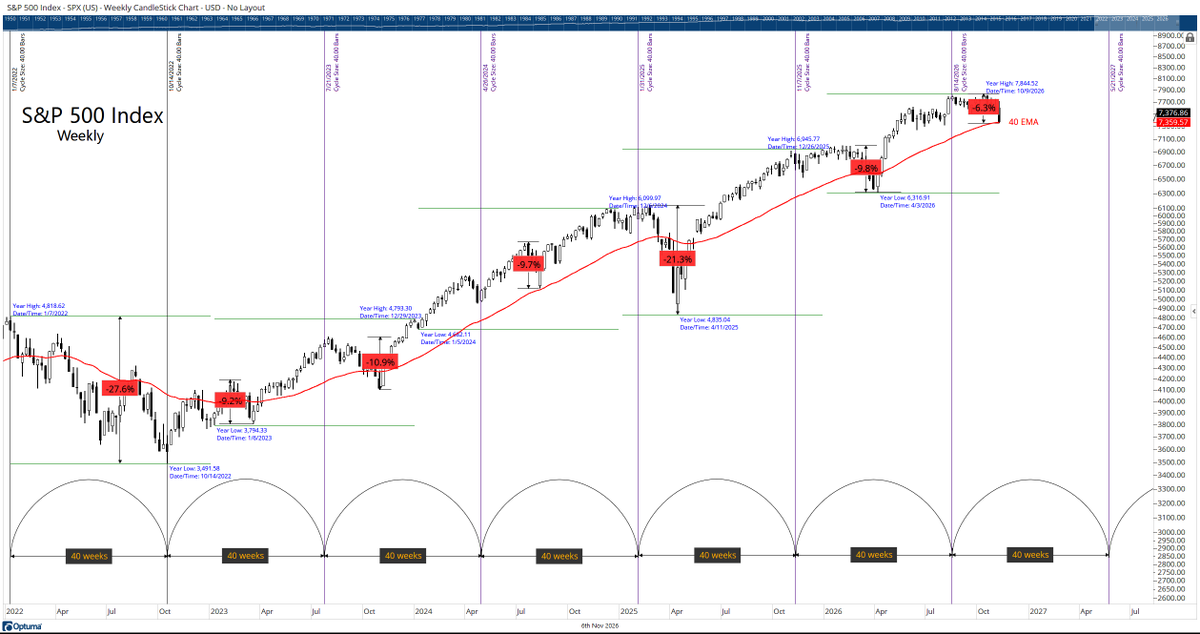
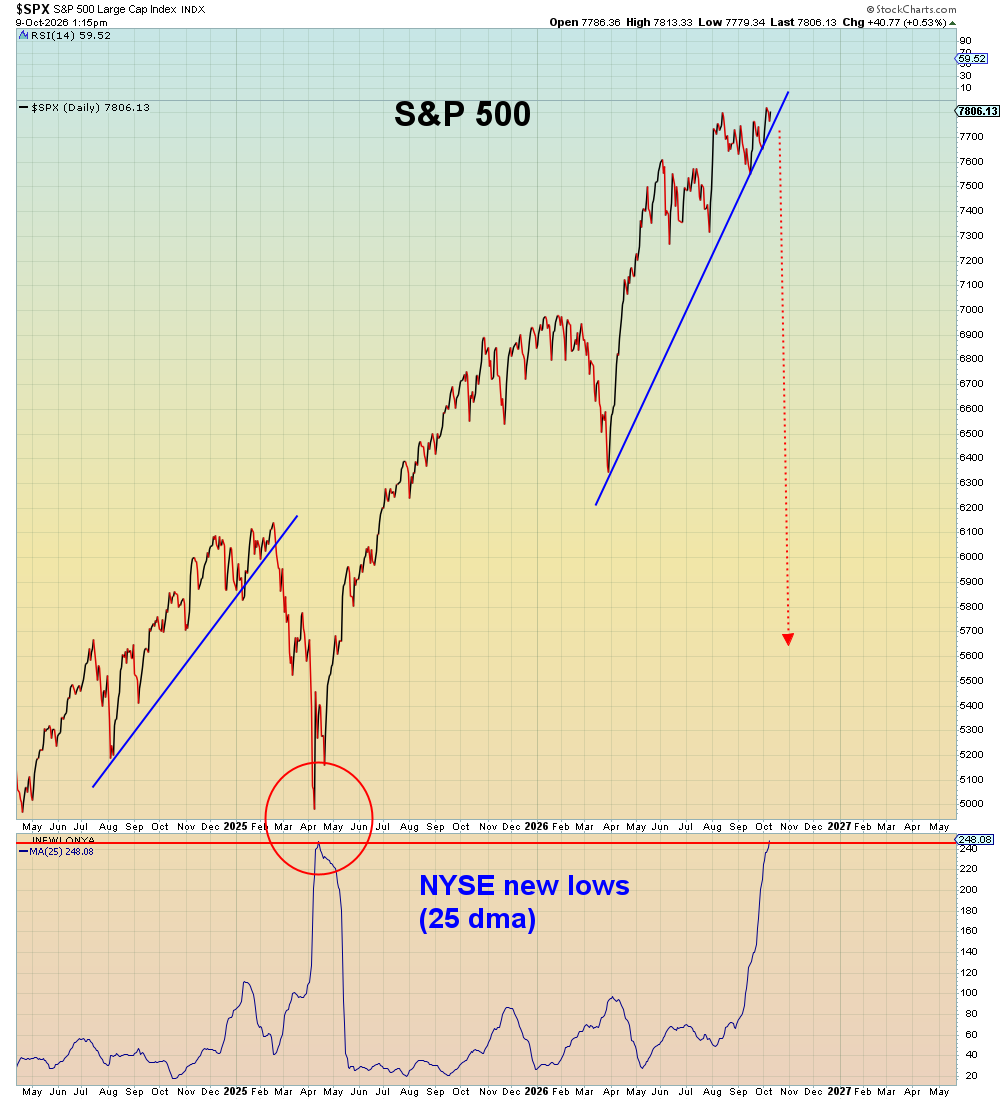
$SPX — THE 40-WEEK CYCLE UPDATE.
On August 5, I published the 40-week cycle study.
Three months later, here we are.
This cycle has been running since January 2022.
Every completed cycle has delivered a correction of roughly 10% or more.
The latest cycle marker arrived August 14, 2026.
As of November 6, the correction has reached approximately −6.3% peak to trough.
Is the correction finished? Nobody knows.
Does this guarantee another 10% decline? Absolutely not.
The cycle identifies the window. PRICE confirms the move.
The next 40-week marker is May 21, 2027.
I said it in August, and I'll say it again:
Trade what price does, not what you think it should do.
Bookmark this post. We'll circle back in a few months and see if history rhymes once again.
Original August 5 analysis attached below. 👇
https://t.co/6g7ytAsBcW
$SPY $QQQ @Optuma
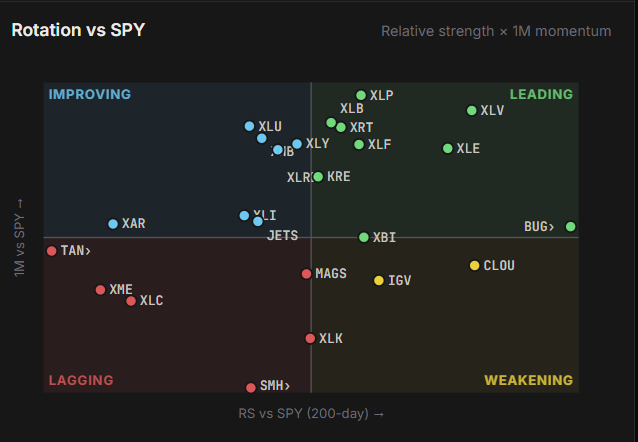
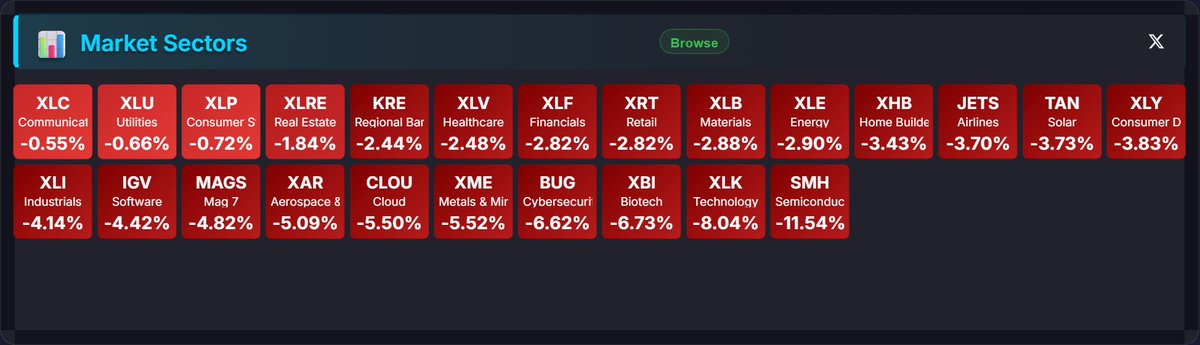
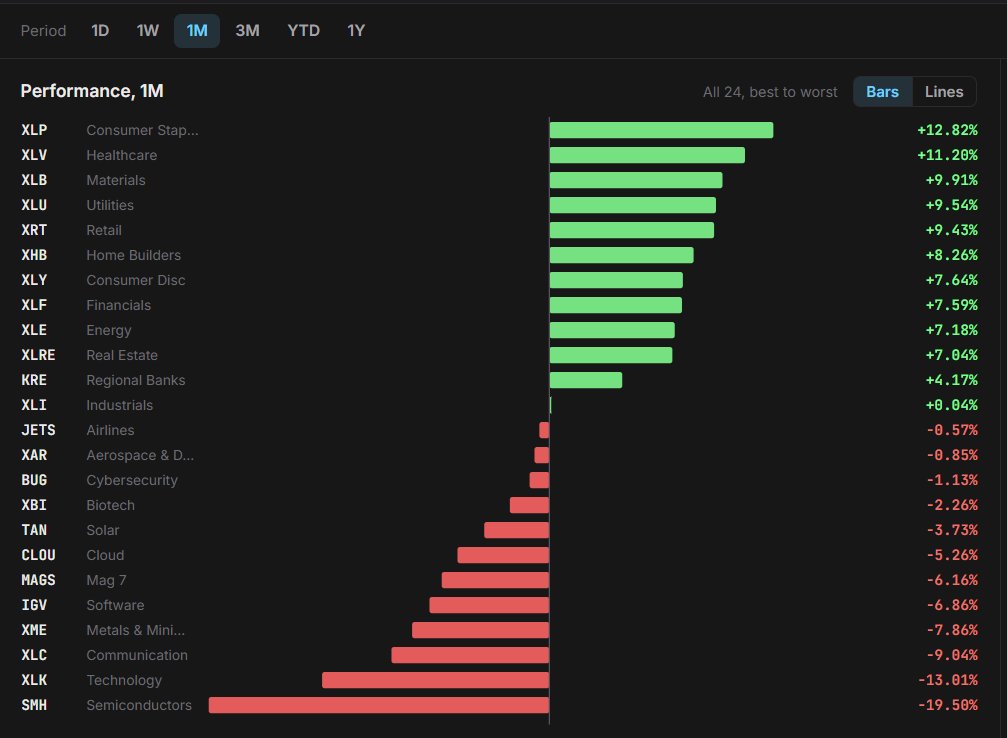
1M Strongest to weakest, defensive sectors leading the charts. I want to see Semi, tech take the lead before we conclude the market is reversing.. $SPY $QQQ $SMH $XLK $XLP $XLV
🚨 WARNING: MONDAY WILL BE THE WORST DAY OF 2026!!
Something catastrophic just happened behind the scenes.
99% of people will lose everything.
When markets open next week, this won't be just another dip.
If you want to be in the TOP 1%, you MUST read this before November 2.
Stocks will dump.
Metals will dump.
Bitcoin and crypto will dump even harder.
The warning signs are becoming impossible to ignore.
→ China is dumping $550 BILLION in U.S. Treasuries
→ Japan is dumping $5.2 TRILLION in U.S. Treasuries
→ China's AI stocks have crashed by over 40%
→ The Strait of Hormuz remains CLOSED
→ U.S. Treasury yields are SURGING
→ Inflation is OUT OF CONTROL
→ The Fed is injecting BILLIONS into the economy to prevent another crash
These are NOT separate problems.
They are interconnected issues putting enormous pressure on the entire financial system.
Japan is selling.
China is selling.
And every dollar of debt they sell must find a new buyer.
To attract those buyers, the market must offer higher yields.
That is why Treasury yields are climbing.
People are demanding greater compensation for the risks of holding U.S. government debt.
And this is where the dangerous cycle accelerates:
→ Foreign demand for U.S. Treasuries weakens
→ The market struggles to absorb the growing supply of government debt
→ Treasury yields rise to attract buyers
→ Higher yields increase U.S. government borrowing costs
→ Rising borrowing costs pressure stocks, real estate, crypto, and virtually every other asset
→ Energy disruptions drive oil prices higher and fuel inflation
→ Persistent inflation keeps upward pressure on Treasury yields
And China's market crash adds another layer of risk.
When investors lose confidence in AI stocks, the bubble starts to pop EVERYWHERE, not just in China.
Capital retreats.
And the shock spreads into global markets and other risk assets.
This is happening while the broader financial system is already under pressure.
Then there are the Fed's liquidity injections.
The Fed is trying to support the markets and prevent a China-style crash.
But they do NOT eliminate inflation.
The conflict between inflation control and financial stability intensifies.
More liquidity can support asset prices.
Rising inflation puts pressure on interest rates.
Higher yields undermine bonds, stocks, real estate, and other sensitive assets.
This is the contradiction people can't afford to ignore.
Most people will focus on the stock market and wait for the crash to begin.
But the bond market, inflation data, liquidity conditions, and collapsing risk appetite are already flashing warning signs.
You must pay attention NOW.
I've spent more than 12 years studying financial markets and calling market tops and bottoms.
If you want to survive the 2026-2027 cycle, follow and turn on notifications.
You'll want to know what's happening BEFORE the market reacts.
I stopped into the local vitamin store on my way to workout. The young clerk saw my car and struck up a conversation with me. He asked what i do, I told him I am a future’s trader. We chatted about how I got my start and how much easier it is now. He asked about all the YouTube nonsense, I told him to be careful, there is a ton of BS out there. He is a very respectful and nice young man.
All you young people, take your time. You dont need all the answers today. Just create a vision for yourself and make a plan, then methodically get about the work of shaping your life.
You are in charge. You are in control. Yoi are not a victim of anyone or anything and NOBODY owes you shit. Make it happen.
You are more powerful than you know.
You are loved.
Go get it Julian.
This is so good and it applies to trading and investing too by @alexandr_wang
“Mark has internalized that failure doesn't matter. It just matters when you win, how big you win.”
“Mark has this great quote that says: The biggest risk is not taking any risk. In a world that's changing the only strategy that is guaranteed to fail is not taking risks.”
It reminds me of Stanley Druckenmiller’s quote:
“It isn’t about how many times you win or lose, but how big you when on your winners versus losers on your losers”
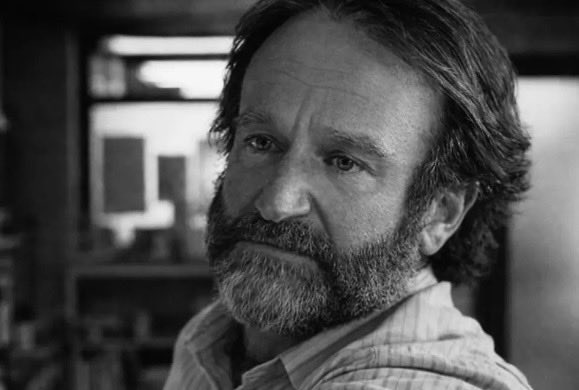
“I think the saddest people always try their hardest to make people happy because they know what it's like to feel absolutely worthless, and they don't want anyone else to feel like that.”
- Robin Williams
There is a painful paradox in comedy: sometimes the people who bring the most happiness to others are quietly carrying struggles of their own. Robin Williams, remembered for his extraordinary humor, warmth, and boundless energy, has often been associated with the sentiment that the saddest people may work the hardest to make others happy because they understand how deeply emotional pain can hurt.
The idea speaks to something profoundly human. For some people, making others laugh or feel valued becomes a way of transforming their own difficulties into empathy and kindness. Instead of allowing their pain to define what they give the world, they use their experiences to make sure someone else feels a little less alone.
It also reminds us that outward happiness doesn’t always reveal what someone is experiencing internally. A person can be funny, generous, successful, and surrounded by people while still facing private struggles that others may never see.
Perhaps that is why the message continues to resonate so strongly. It encourages us to look beyond appearances and extend compassion not only to those whose struggles are obvious, but also to the comedians, caregivers, and naturally uplifting people who spend so much of their lives making everyone else smile.
Everyone wants fast wealth in the market. Few understand Mark Minervini's rule of a 10-year horizon.
Mastering market craft requires deep specialization in one proven strategy rather than chasing short-term performance across different styles.
Longevity rewards deep focus.
On September 11, both towers of the World Trade Center came down less than one hundred yards from a 235-year-old church.
Not one of its windows broke.
For the next eight months, it did not close. Not once. Not for a single hour.
St. Paul's Chapel opened in 1766. It is the oldest church building in Manhattan. On April 30, 1789, George Washington walked out of his inauguration as the first President of the United States and came straight here to pray. His pew is still inside.
On the morning of September 11, 2001, a hundred and ten stories of steel fell in the churchyard's direction.
A sycamore tree on the corner of the property, about a hundred years old, took the hit. A steel beam that should have gone through the chapel wall went into the tree instead. The sycamore was torn out by its roots.
The chapel behind it stood. Every pane of glass intact. Only the organ was damaged by dust.
Within days, the church made a decision.
Across the street, thousands of firefighters, police, ironworkers, and volunteers were digging through sixteen acres of rubble for the dead. They were working twelve and sixteen hour shifts. They had nowhere to sit. Nowhere to eat. Nowhere to sleep. Nowhere to be a human being for ten minutes.
So St. Paul's opened its doors. And it left them open, twenty-four hours a day, until May 30, 2002.
Here is what the inside of a church looked like for those eight months.
The choir loft became a dormitory. Cots in rows. Firefighters too exhausted to make it home to Queens or Brooklyn slept there in their turnout gear.
The pews became beds. Men in steel-toed boots lay down on 235-year-old wood and slept for an hour, and got up, and went back to the pile.
Three thousand meals a day. Breakfast, sandwiches, bagels, coffee, and, because New York restaurants were sending whatever they had, Thai food, Italian, Mexican. One volunteer put it simply. If it was Monday, it was meatloaf.
George Washington's pew, the one he knelt in as the first President of this country, became the podiatry station.
Volunteer foot doctors sat there and treated blisters and torn-open feet. The workers were spending sixteen hours a day on twisted steel and broken glass. Their feet were destroyed. A podiatrist would sit them down in Washington's pew, take off their boots, and go to work.
The volunteers said the podiatrists were the most popular people in the building.
Chiropractors worked the aisles. Massage therapists set up tables. Musicians came and played, quietly, so that men who had been pulling bodies out of the ground for twelve hours could sit with their eyes closed and hear something that was not a diesel engine.
More than five thousand volunteers passed through, in twelve-hour shifts, around the clock, for eight months. They came from every state. Most of them had never been to New York. They made beds. They served meals. They washed dishes. They sat with firefighters who did not want to talk and did not want to be alone.
The clergy wore a vestment during services, and workers started pinning their patches to it. FDNY. NYPD. Port Authority. Ironworkers Local 40. Search and rescue teams from Texas and California. By the end it was covered.
Outside, the wrought-iron fence around the churchyard filled up. Flags. Photographs of the missing. Children's drawings. Rosaries. Letters. It stretched the full length of the block. A wall of grief in front of a building that had somehow come through untouched.
A poet who volunteered there said it this way. What happened at Ground Zero was hate. What happened at St. Paul's was the reverse of it.
On May 30, 2002, the recovery operation officially ended. That same day, St. Paul's held a closing service for the workers, and the eight-month ministry ended.
The church cleaned up. They repaired the organ. They refinished the floors.
But there was one thing they decided not to fix.
The pews.
Two hundred and thirty-five years old, and now covered in scratches and gouges. From steel-toed boots. From tool belts. From men who lay down in them, for an hour, in the middle of the worst days of their lives.
The church left every mark.
They are still there.
You can walk in today, sit down where a firefighter slept in October 2001, and run your hand along the wood, and feel where his belt buckle caught.
The roots of the sycamore are cast in bronze in the churchyard now.
The tree died. The church lived. And then it spent eight months keeping other people alive.
Not one window broke.
Not one door closed. 🇺🇸