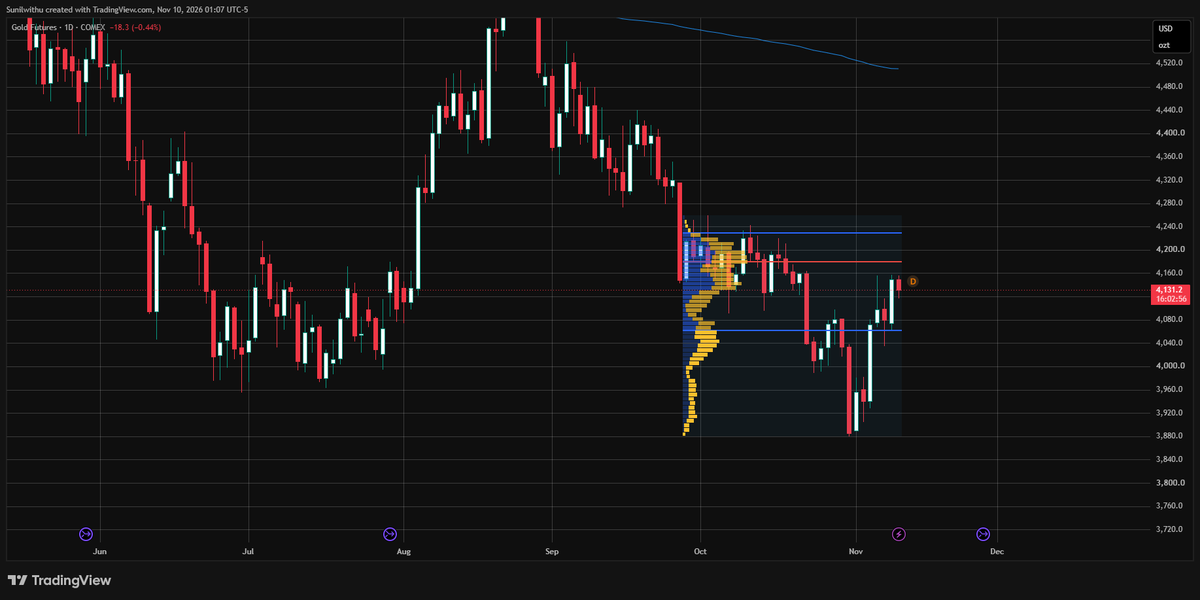
Today was the ideal kind of day for gold to trigger a short-covering rally.
But the CPI reaction pushed yields sharply higher, especially at the short end of the curve, while the dollar strengthened.
More importantly, gold failed to reclaim the consolidation zone despite the setup being in place. That tells us bears are still in control for now, and the buying pressure needed to force them out hasn't materialized yet.
However, the move below $4,000 has largely achieved the sentiment reset we were looking for. Much of the speculative positioning has likely been shaken out.
What we could see next is a period of grinding price action around the $4,000 region, allowing the market to absorb the remaining selling pressure before attempting another move higher.
I still believe the conditions for a short-covering rally are developing, but we need price confirmation rather than simply anticipating it.
The setup is there, but the trigger hasn't arrived yet and seems to be taking further time.
Gold's volume profile since October suggests heavy short positioning was built around the $4,130–$4,230 zone, with the Point of Control (POC) near $4,180.
Today's CPI release could be the catalyst that pushes gold above this high-volume resistance zone.
If gold manages to break and sustain above $4,230 expect short covering to accelerate, potentially triggering a much further rally as trapped shorts rush to exit their positions.
The key is not just the initial breakout, but the forced buying that could follow.
🚨 The US midterm elections are today.
Control of Congress is at stake, and the result could move stocks, crypto, bonds and the dollar.
Here are the possible scenarios:
1. If Republicans win both chambers:
• Stocks and AI companies could benefit from continued deregulation and policy support.
• Crypto legislation could face fewer political obstacles.
• Bond yields could rise if markets expect more government borrowing and spending.
• The U.S. dollar could strengthen if yields rise.
2. If Democrats win both chambers:
• AI and Big Tech could face tougher oversight and investigations.
• Trump's tax and spending plans could face more resistance.
• Crypto legislation could face longer negotiations.
• Budget and debt ceiling disputes could increase market volatility.
3. If Democrats win the House but Republicans keep the Senate:
• Major legislation could become harder to pass.
• Markets could face more uncertainty over government funding and the debt ceiling.
• Stocks could benefit from fewer major policy changes, although political deadlock could create short-term volatility.
4. If Republicans win the House but Democrats take the Senate:
• Republicans could retain control of spending legislation in the House.
• Senate confirmation and legislative priorities could face more resistance.
• Markets could price in slower policy changes and more political negotiations.
5. If results are extremely close or delayed:
• Stocks, bonds and the dollar could experience short-term volatility.
• Uncertainty could continue until control of Congress becomes clear.
One important thing, a Democratic win does not automatically mean stocks crash, and a Republican win does not guarantee a rally.
Historically, U.S. stocks have performed well after midterms regardless of which party controls Congress.
Elites fighting elites, no need to shed tears but some details on Hashwani vs Zardari-Military:
Behind the scenes of the Pearl-Continental saga, the Hashwani family’s hospitality empire is being dismantled through an orchestrated corporate squeeze. The battle centers on Pakistan Services Limited (PSL), where outside interests acquired a roughly 56% voting majority by exploiting disputed share pledges and distressed market pricing. With state regulators and courts failing to provide an institutional shield, the family found itself outflanked within its own flagship publicly listed firm.
Once voting control was secured, Fauji Foundation moved in to orchestrate the carve-up, compelling the Hashwanis through a forced out-of-court settlement to surrender premier northern and garrison-adjacent properties, including PC Lahore, PC Bhurban, and PC Muzaffarabad. Simultaneously, corporate vehicles tied to the ruling civilian political apparatus specifically Thatta Cement, linked historically to the Omni Group and the inner circle of Zardari, have positioned themselves to take control of the southern assets, including PC Karachi.
Sadruddin Hashwani spent decades in a vicious personal feud with Zardari. While large industrialists historically survived civilian vendettas by seeking shelter with the military establishment, the current political reality leaves no room for such maneuvering, as the civilian coalition and military leadership now govern in direct alignment, subservience, partnership, SIFC, whatever else you want to call it.
The forced surrender of the PC hotel network sends an unambiguous signal to the wider business community. In Pakistan's current economic model, independent private conglomerates cannot maintain independence without state patronage. When ruling political figures and military-backed conglomerates set their sights on prime commercial assets, regulatory protections evaporate, leaving legacy family dynasties vulnerable to state-backed corporate absorption.
Altın neden düşüyor? Başkasının borcunu ödüyor.
Savaş var, enflasyon var, belirsizlik var, insanlar korkuyor.
Bu durumda altın güvenli liman sayılır ve yükselmeliydi.
Oysa altın düştü.
Tek başına da değil, borsa ve Bitcoin ile birlikte.
Bunun basit bir kuralı var.
Panikte insan satmak istediğini değil, satabildiğini satar.
Satabildiği de altındı.
Bunun sebebi, başkasının borcu.
Şöyle düşünün.
Hisseyi şirket çıkarır, tahvili devlet, parayı merkez bankası.
Hepsinin arkasında birine verilmiş bir söz, yani bir borç var.
Altının arkasında ise kimse yok, o kimseye borçlu değil.
Bu yüzden her zaman alıcısı olur, her an kolayca paraya çevrilir.
Nakit lazım olunca da satılan o olur.
Peki o nakit neden birden gerekti?
Son 2 yılın en büyük bahsi yapay zeka oldu.
Yatırımcılar bu hisseleri çoğu zaman borçla aldı.
ABD'de borçla alınan hisse Haziran'da 1.5 trilyon dolarla rekor kırdı.
Bu hisseler düşünce aracı kurum ek teminat ister.
Parayı koyamayan, elindeki başka varlığı satmak zorunda kalır.
İnsan burada zarardaki hisseyi değil, kârdaki altını satar.
Çünkü zarardakini satmak, o zararı kalıcı hale getirir.
Altını düşüren işte bu, kendi zayıflığı değil, kapatılması gereken bir borç.
Üstelik bu bahis göründüğü kadar sağlam değil.
Yapay zeka şirketleri birbirine borç verip aynı parayla birbirinden alım yapıyor.
Biri ödeyemezse bütün zincir geriye doğru kopar.
IMF de uyardı, değerlemeler düşerse teminat çağrısı ve zorunlu satış gelir.
Altının üstünde bir baskı daha var.
Savaş petrolü pahalılaştırdı, enflasyon yükseldi, Fed 3 yıl sonra ilk kez faiz artırdı.
Faiz yükselince getirisi olmayan altını tutmak pahalılaşır.
Aralıkta yeni bir artış ihtimali de yüksek.
Bunu daha önce de gördük.
2008 krizinde altın önce yaklaşık %30 düştü.
Sebebi inanç kaybı değildi, insanların nakit ihtiyacıydı.
Kriz geçince altın 2011'de rekor kırdı.
2020'de de aynısı oldu, önce düştü, aylar sonra zirveye çıktı.
Altın likidite krizinde önce düşer, sonra yükselir.
Bugün de satan belli.
Borçlu fonlar altını satıyor.
Aynı anda merkez bankaları almaya devam ediyor.
Yani altını satan ondan vazgeçmedi, borcunu kapatmak zorunda kaldı.
Altın, onu aldıran sebepler bittiği için düşmüyor.
Bugün nakit gerektiği için düşüyor.
O nakit de başkasının borcunu kapatmaya gidiyor.
ABD'li bankacı J.P. Morgan 1912'de Kongre'de şöyle demişti.
Altın paradır, gerisi sadece kredidir.
Altın bugün düşüyor çünkü kredinin, yani borcun bedelini ödüyor.
Gelişmeleri takip ediyorum. Sizi bilgilendireceğim.
Except oil, almost everything is getting hit today.
Gold, silver, copper, equities. All under pressure.
But the most important development is the recent change in market behaviour.
Higher oil prices are no longer pushing bond yields higher.
The most likely interpretation is that markets are starting to price the growth damage from higher energy prices more aggressively than the inflationary impact.
This is a significant shift.
Oil is increasingly being priced as a threat to economic growth, not just an inflationary force.
Things are changing.
1. Gold can be created in a lab.
2. China’s AI bubble popped, erasing trillions.
3. Google crashed -13%, erasing $482 billion in a single day, its worst drop ever.
4. US plans another operation against Iran.
5. Crypto exchange Binance got hacked for $5.6 billion, the largest heist in human history.
All this happened in just past 5 days.
Market pricing in an October FOMC hike
=
USD strength
Remember...
The key variable that move markets is not "what happened"
It's "what happens next"
If the market goes on to fully price in this hike, the Dollar strenghtens more
If the market decides the FED does not need to hike in October, the Dollar reverses
Your task, with fundamental analysis, is to analyze the conditions in order to judge how these expectations SHOULD move
Do you think the FED will need to hike in October or not?
The answer, gives you the macro bias on the Dollar
And that makes all the difference
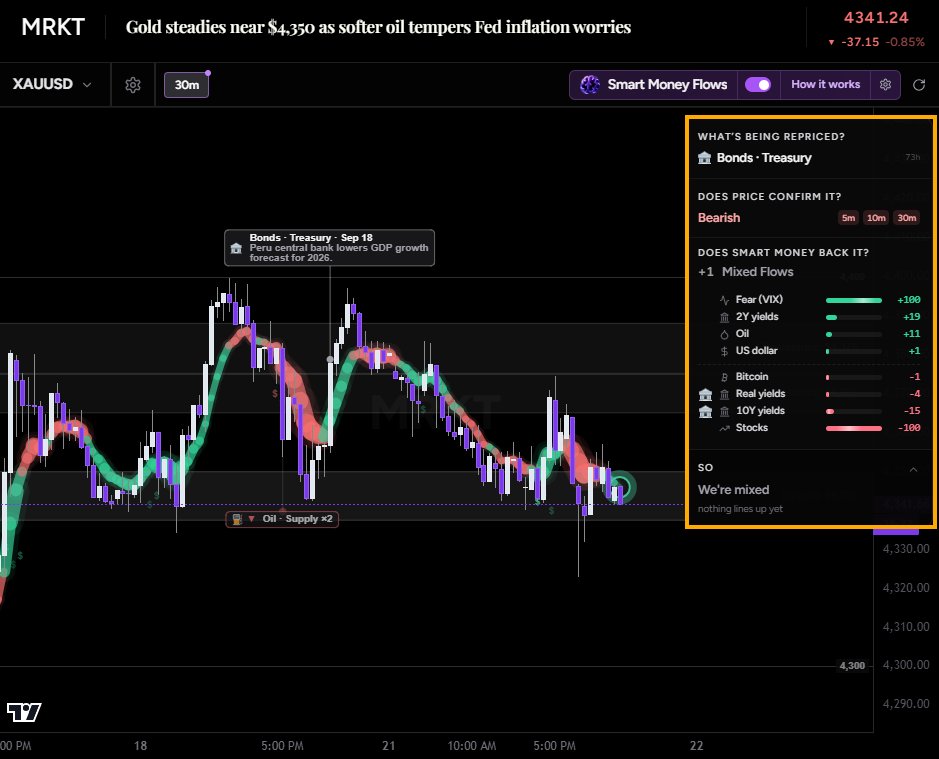
Oil down, Yields down & .... Gold down too ??
You are not on the wrong side of the move.
The Capital is just not that interested to come into Gold at this point.
Oil down + Yields down = Kinda supportive for Gold intraday
But at the same time, its also supportive for classic risk on assets (Bitcoin + Indices)
We are clearly seeing outflows from Oil, but most of those outflows are going into Bitcoin and Indices at this point.
Hence, Gold is having a very controlled downside move (mainly stuck in a range if we talk about h4 or daily)
But remember, the more discounted it gets while the macro remains supportive, the more capital it will attract.
We remain bullish as long as something doesnt change and we look forward to keep buying the move downside.
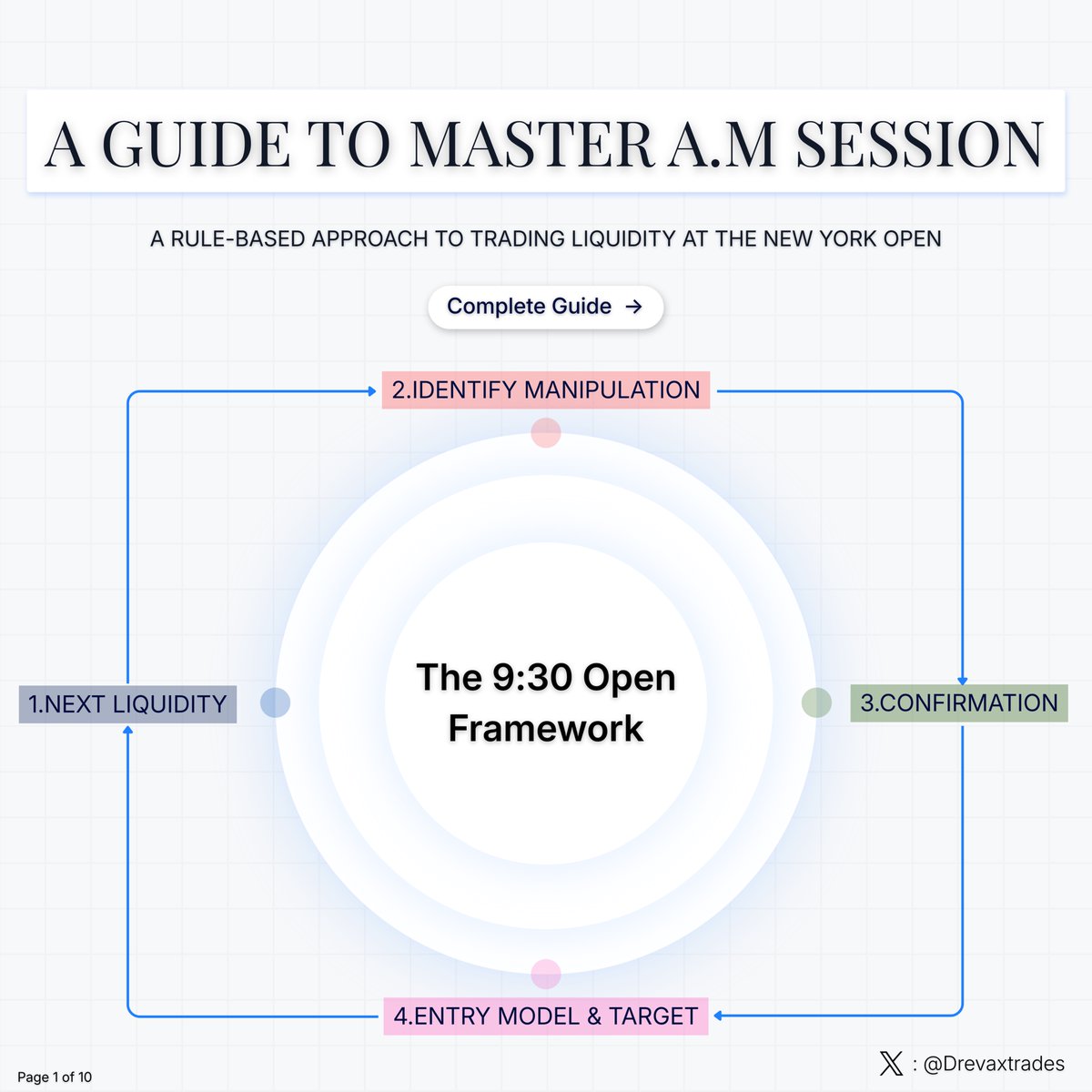
MASTERING The 9:30 Open. 🧪
The 9:30 Open: A Liquidity-Based Framework
Understanding market behaviour through structured, rule-based observations.
A Thread
TODAY WAS ABSOLUTELY INSANE IN THE STOCK MARKET.
Here’s everything you need to know:
1. The Fed delivered its first rate hike in three years, lifting the funds rate 25 basis points to a 3.75%–4.00% range.
2. The vote was unanimous, and Chair Kevin Warsh said inflation "is too high and has been for too long."
3. Stocks were green into the 2 p.m. decision, then sold off hard once Warsh’s hawkish press conference landed.
4. The dot plot showed most officials expect at least one more hike this year, so this was not sold as a one and done.
5. The Dow took the worst of it, dropping 631 points as financials, energy, and transports got hit.
6. $NVDA, $DELL, and $INTC finished higher as chips bounced even while the broader tape cracked.
7. The 2-year yield jumped after the announcement, and the dollar extended its winning streak.
8. Warsh refused to give forward guidance, saying he is "not in the forward guidance business."
9. President Trump criticized the hike, putting the new Fed chair immediately at odds with the White House.
10. The S&P 500 fell 0.4%, the Dow dropped 1.2%, and the Nasdaq was basically flat.
And that’s just ONE trading day.
Are you ready for tomorrow?
Using Forex Factory on FOMC is SUICIDE.
You are literally praying to have your account blown.
You are using a tool that only tells you what just happened and It gives you no minimum or maximum ranges, no prep, and ZERO playbook for the volatility.
Here is the exact playbook to prepare before the release hits👇
MARKET INSIGHTS, PREDICTIONS, PREP AND ANALYSIS.
*This is from Sunday September 6th in Capital Hungry
But extremely educational, predictive and usable for next week.
FOMC next week and most traders are focused on the wrong thing.
A hike is priced in, thats not the trade.
The trade comes from what happens in December.
Markets are already ready for a hike in September, the actual hike wont matter.
But what comes next will.
Warsh will probably stick to the same old script, but the real story may happen even before the conference starts.
"The Projections"
FED members will vote on the future of monetary policy:
Do they see more hikes ?
Was this just a one time hike ?
That vote is the trade.
If the majority leans towards one and done then the rate hike / hawkish narrative dies even before the press conference starts.
Focus on the projections, not on what is already priced in.