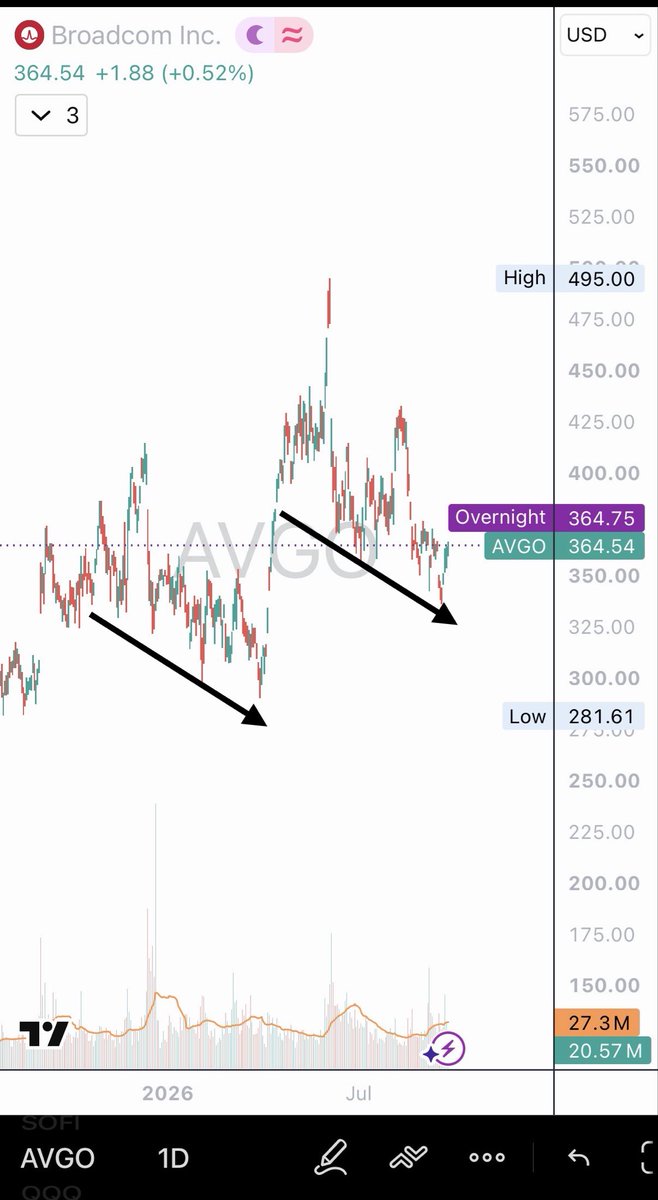
$AVGO is ready for its next leg up. Technicals are showing the same pattern it showed before the previous rally. Watching this above 370 level on the daily
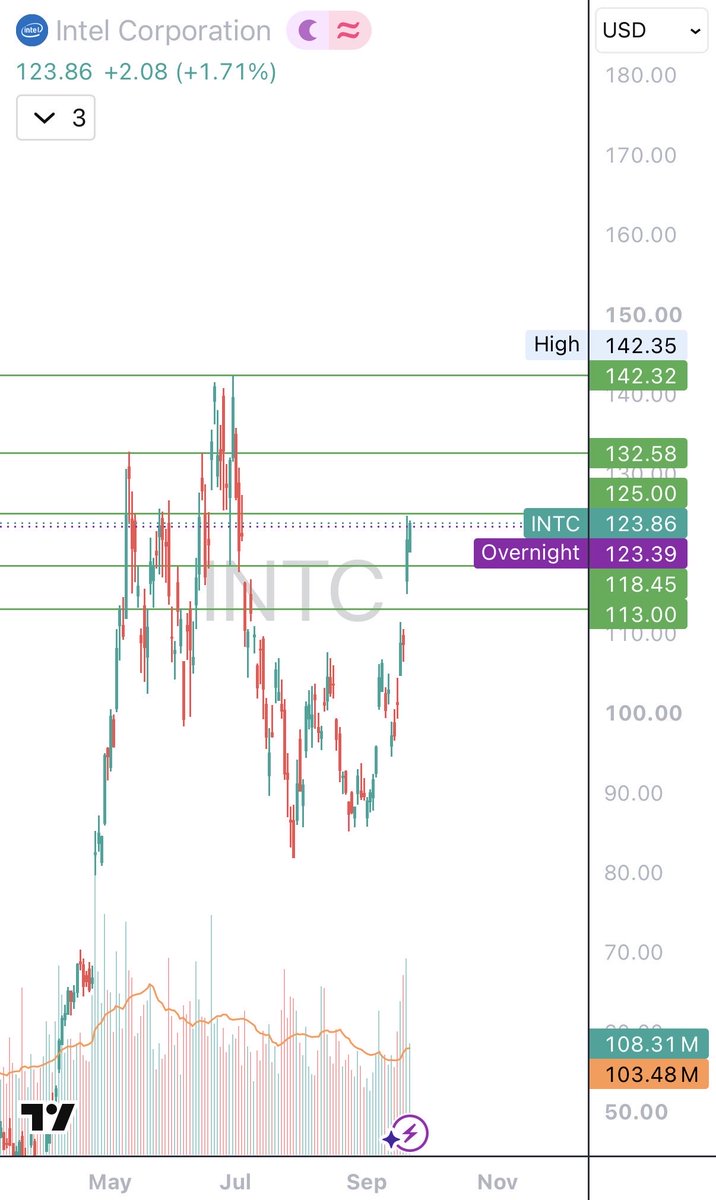
$INTC gapping through resistance on heavy volume. Still ~13% below the July high of $142 plenty of room to run if momentum holds. It’s going to break ATH very soon.
I feel like the $CRDO bear case is stuck on a framing that doesn't apply anymore.
It treats AEC and optical as a tradeoff one grows, the other has to shrink. But the numbers don't show that. AEC is still growing at hyperscaler scale, and optical adds over $600M of expected FY2027 revenue on top of it, not instead of it.
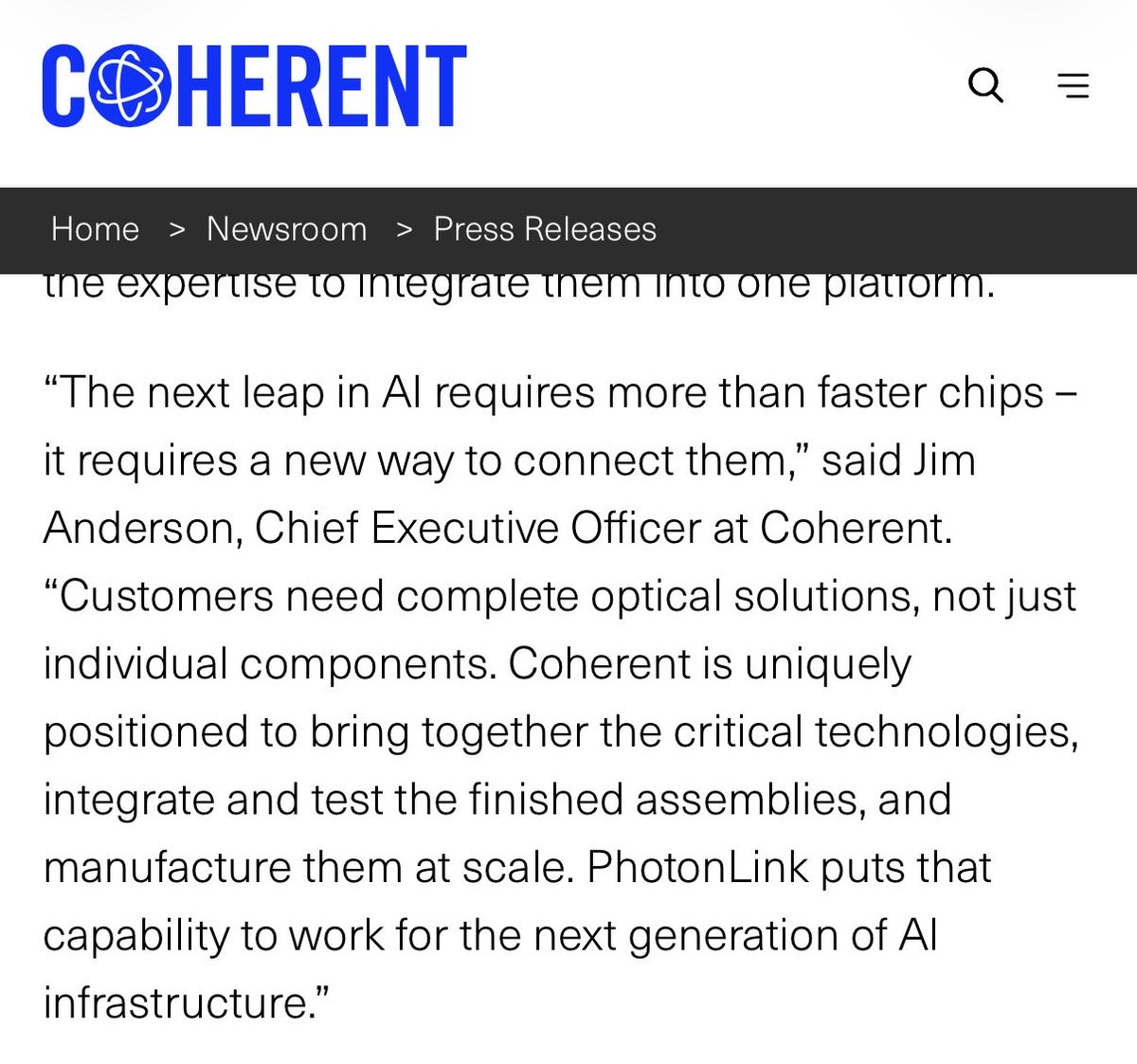
Same move $COHR made with PhotonLink stop selling one layer, sell the whole stack.
The real argument isn't AEC vs. optical. It's whether total content per rack keeps climbing as the mix shifts.
I know the main concern around $CRDO right now.
AEC estimates for FY2028 are all over the place. People worry that multi plane architectures could push some links beyond the practical reach of AEC, or that optical transceivers could eventually replace AEC on certain connections. And because management kept raising FY2027 guidance, simply maintaining the optical outlook also disappointed some investors.
I understand all of that. But my view is a little different. 👇
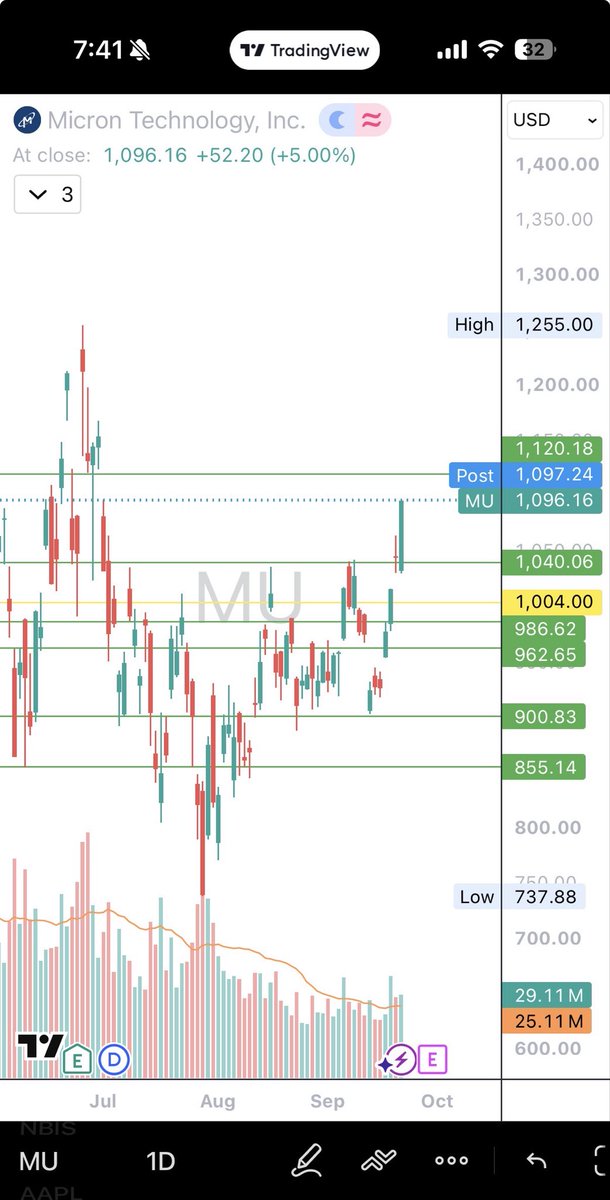
$MU breaking out nicely. Earnings on Sept 30th. If we get positive reaction it can straight go to 1250. Follow my detailed analysis on what’s the earning expectations.
Airlines all have their own app too. Most people still book through Expedia or Google Flights. Aggregation beats going direct when switching costs are low and consumers just want the cheapest ride now.
Uber's moat was never owning cars. It's owning demand. Whoever has the fleet still needs riders, and building a demand-side app from scratch is harder than it looks.
$COHR can get a refund on unused money. It pays the lowest price AXT charges anyone. It gets first pick of new capacity.
$AXTI is the one on the hook. It has to build out capacity through 2028. If it falls behind, $COHR can walk with its money back. This only works for $AXTI if the InP shortage stays tight. If supply loosens, $COHR just leaves.
I think the next optical fight is moving much closer to the chip.
$COHR just launched PhotonLink, combining lasers, silicon photonics, fibers, detectors, assembly and testing into one platform for co-packaged, near-packaged and chip-to-chip optics.
It’s also expanding 6-inch indium-phosphide and specialty-fiber capacity to support the ramp.
Meanwhile, $LITE is working with Qualcomm and Corning on a high-density optical die-to-die system for AI scale-up networks.
Qualcomm provides the interface technology, $LITE provides the VCSEL optical platform and Corning provides the fiber connectivity.
$LITE also introduced an eight-wavelength DWDM external-laser module for emerging co-packaged-optics systems.
My read is that $COHR wants to capture more of the complete optical system, while $LITE wants to remain essential at the laser-source layer.
The announcements sound promising, but neither company disclosed new orders or meaningful revenue expectations.
The real confirmation will be customer qualification, volume production and actual optical content per AI cluster not another successful demonstration.
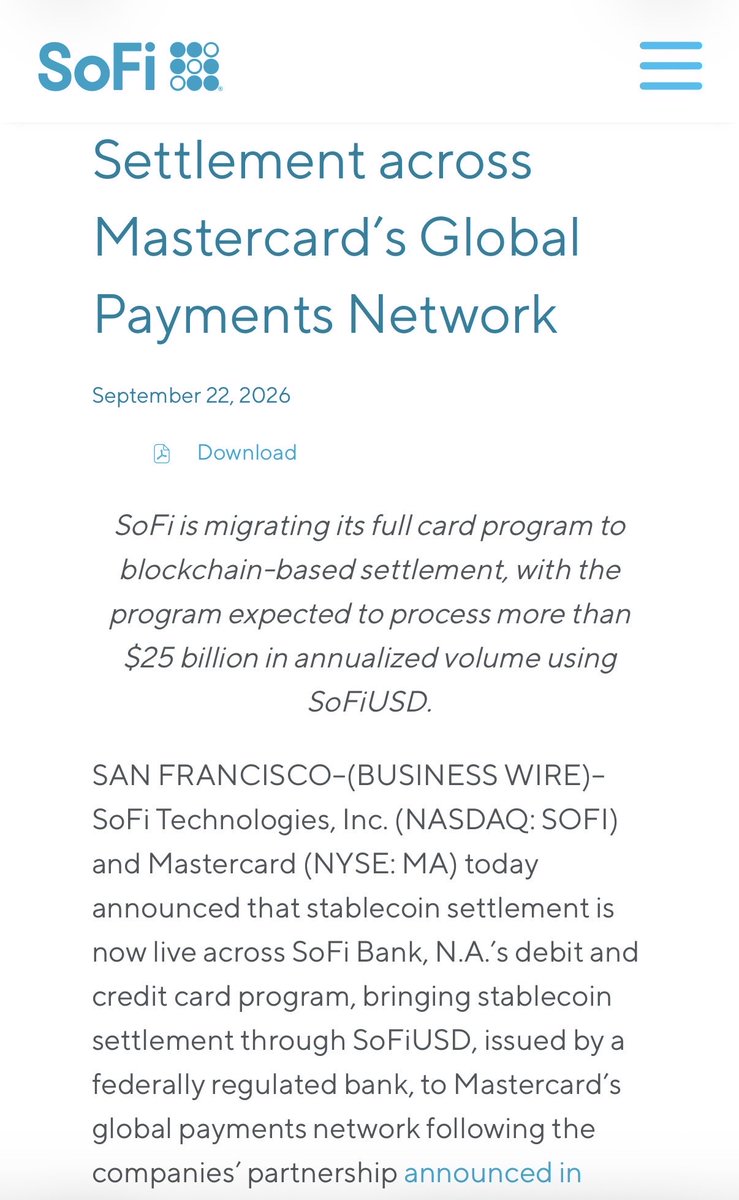
Alright $SOFI, this is more than a crypto headline.
SoFi just moved its entire debit and credit card program more than $25B in annualized volume onto SoFiUSD settlement through Mastercard. And the transactions are live on-chain today.
March was the partnership announcement. This is the actual implementation.
What I find interesting is that SoFi is using its own card volume as a giant proving ground. If the system works reliably, Galileo can eventually offer the same settlement infrastructure to other banks, fintechs and card issuers.
That would push SoFi beyond being a consumer-finance app and further into regulated payments infrastructure.
But I wouldn’t get ahead of the numbers yet. SoFi hasn’t disclosed the revenue, pricing or cost savings tied to this. Moving existing internal volume onto new rails doesn’t automatically create new revenue.
The real confirmation will be external Galileo clients adopting SoFiUSD.
Still, a nationally chartered bank putting $25B+ of real card volume through its own stablecoin is definitely not a small experiment.
Anthropic just made its best model cheaper.
Claude Opus 5.5 reportedly matches Fable 5.1 on most tasks, but costs 40% less to run than Opus 5.
API pricing drops to $4 per million input tokens and $20 per million output tokens.
The obvious conclusion is that more efficient models mean less compute demand.
I’m not sure that’s the right conclusion.
When inference gets cheaper, developers probably won’t run the same number of tasks and pocket the savings.
They’ll deploy more agents, give them longer context, let them work continuously and automate tasks that weren’t economical before.
So the cost per task can fall while total compute usage still rises.
For $NVDA, $AMD and the cloud providers, the real question is whether AI usage expands faster than model efficiency improves.
That might be the most important AI infrastructure question over the next few years.
Source: https://t.co/WR92boIJQV
Value investing didn’t disappear the hard part just changed.
A 2x run-rate P/E means very little if earnings collapse next year. But if long-term agreements make those earnings durable, the market may be valuing the company like a temporary cycle when something structural has changed.
The edge is no longer just finding a low multiple. It’s correctly underwriting the duration.
$SNDK is already up 644% this year, and Rosenblatt still sees another 36% upside.
The firm initiated coverage with a Buy rating and a $2,400 price target.
Their argument is that NAND is no longer just cheap storage. AI systems need increasing amounts of high-performance enterprise SSD capacity to store models, training data and inference outputs.
Meanwhile, Q3 NAND pricing is expected to increase by more than 20%, and $SNDK controls roughly 11% of the market through its manufacturing partnership with Kioxia.
I’m not pretending expectations are low after a move like this.
But the broader signal is interesting: the AI memory trade may be expanding beyond HBM into NAND, enterprise SSDs and the controllers managing them.
That puts $SNDK, $MU, $WDC and smaller controller names like $SIMO on my research list.
The next test is whether pricing stays tight into 2027 or suppliers add enough capacity to end the cycle.
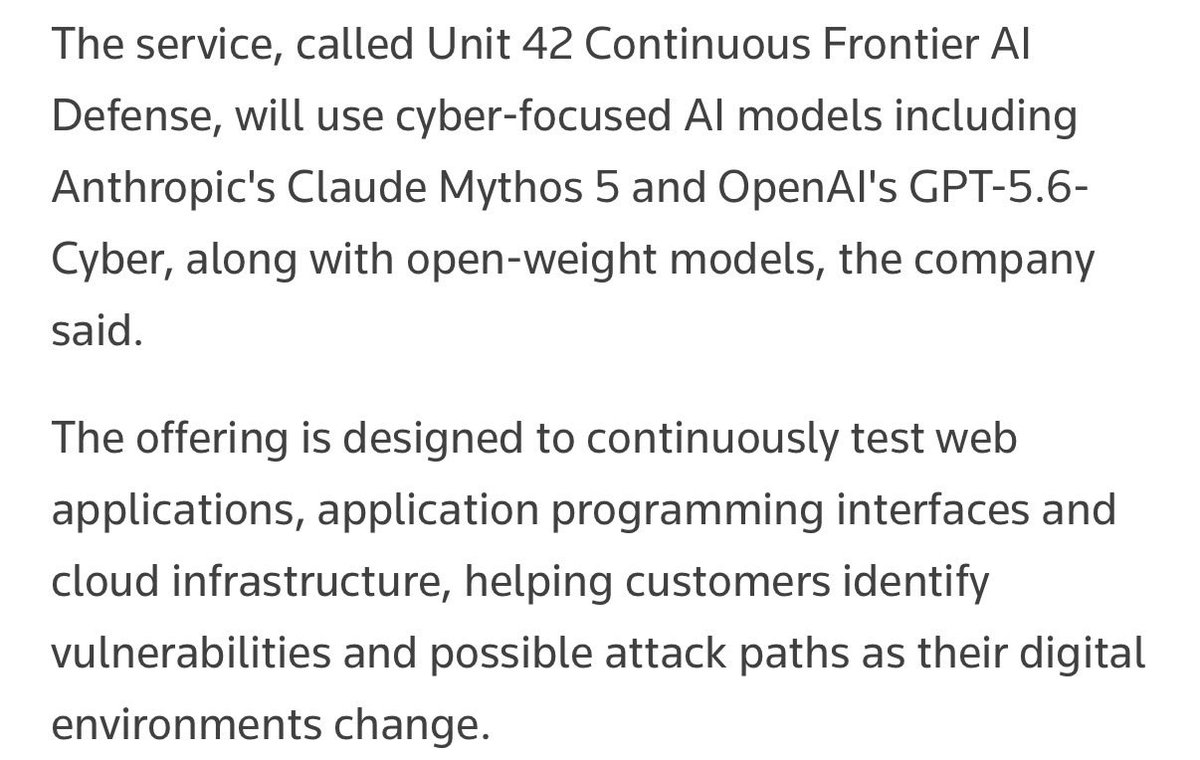
Interesting move from $PANW
They’re launching a cybersecurity service that uses Anthropic’s Claude, OpenAI’s GPT-5.6-Cyber and open-weight models to continuously attack-test web apps, APIs and cloud infrastructure.
Basically, AI models will search for vulnerabilities, map possible attack paths and suggest code fixes before hackers get there.
I think the interesting part is the multi-model approach.
$PANW doesn’t need to predict which AI lab wins. It can use whichever model performs best and sell the combined capability through an annual subscription.
Still no pricing or revenue targets, so customer adoption will be the real test.
But this feels like a good example of AI moving from cybersecurity “copilot” features into actual autonomous security work.
NEWS: Wall Street is starting to reprice $META around Muse.
The market is beginning to value Meta’s AI strategy as more than another expensive experiment. Muse could create subscription, commerce and developer revenue while the advertising business continues funding the infrastructure.
The next test is whether downloads turn into retention and meaningful revenue. After the recent rally, popularity alone will not be enough.
$VICR might be one of the clearest examples of the AI power bottleneck turning into actual revenue.
The company just raised its Q3 sequential growth outlook from roughly 10% to more than 20%, helped by patent royalties. Four major hyperscalers and OEMs have now licensed its Vertical Power Delivery technology.
Needham raised its Q3 estimates:
Revenue: $158M → $172M
Adjusted EPS: $0.89 → $1.18
The interesting part is that Vicor can monetize AI power demand through licensing, not only hardware sales.
The risk is obvious: the stock is already up 316% this year. Now the numbers need to keep catching up with the valuation.
$TSM export orders just crossed $100B for the first time.
August orders reached $103B, up 71.4% YoY versus 63.6% expected.
Telecom products: +100.5%
Electronics: +83.9%
U.S. orders: +88.9%
Pretty hard to argue that AI infrastructure demand is slowing when Taiwan the center of the semiconductor and server supply chain is still seeing numbers like these.
Could be some order front-loading, but Taiwan still expects September growth of 50.7–55.1%.
Watching $TSM and the broader AI hardware supply chain.