The brain does not hate hard work. It hates unclear effort. If it cannot see where the work is going, how long it will last, or why it matters, it starts treating the task like failure instead of a challenge.
Bro, I challenge you to try this in July
- No revenge trading
- Max 3 trades/day
- Risk only 1% per trade
- 7+ hours of sleep
- Journal every single trade
- No looking at P&L during market hours
- Read 20 pages on trading psychology daily
- Write down 3 things you did right today
Shall we?
There is a famous experiment from a 10 years ago. Researchers gave a group of finance graduates and traders a simple game.
A coin biased to land heads 60% of the time. $25 to start. Half an hour to bet however they wanted. Maximum payout capped at a generous number so the prize was real.
A 60% coin is a gigantic edge. Anyone who sized properly should have walked out with the cap. However 28% of the participants went to zero. A third of supposedly numerate adults blew up a game that was rigged in their favour, in half an hour, with real money on the line.
What happened to them is what happens to most. They had an edge and they treated it like a certainty and they oversized.
The Kelly Criterion is the answer to this problem and you have probably seen the formula. In its general form for a position with a defined win and a defined loss, the optimal fraction of your capital to risk is:
f* = p/l minus q/g
Where p is your win probability, q is one minus p, g is the fractional gain on a winner, and l is the fractional loss on a loser. The formula gives you the bet size that maximises long term geometric growth. Bet more than f* and you simultaneously lower your expected growth rate and raise your probability of going to zero, which is the worst outcome.
Three things matter about Kelly that are essential before you use the formula.
The first is that you do not actually know p. You estimate p from a backtest, tracked trades, your intuition about the setup. Your estimate is always wrong. The question is how wrong your estimate could be before ruining you.
The second is that Full Kelly produces drawdowns that will trigger chemical responses. A strategy sized at Full Kelly with a real edge will routinely give back 50% of peak equity on its way to its long term growth rate. The drawdown is emotionally taxing even if you survive it mathematically. Your grin will be gone.
The third is the only thing you need to remember. Half Kelly is the answer. Half Kelly captures roughly 75% of the long term growth of Full Kelly with roughly half the volatility. Quarter Kelly is even safer but gives up more growth. Pros are running fractions of a Kelly, and the fraction is set by how much they trust their estimate of p, not by how aggressive they want to feel.
The deeper point is that position sizing is an estimation problem, a mixture of math and pattern recognition.
The reason Half Kelly works is that the formula provides more airbags at half scale. The drawdowns it produces stay below the threshold that triggers your cortisol response to keep yourself thinking clearly enough to take the next trade. You are positioning yourself for the next best high probability idea.
This is the trick the 28% of bust participants in the coin flip experiment missed. They had the edge but no skill.
[The experiment was the Haghani and Dewey coin-flip study (2016). 28% went bust, 21% hit the cap and 51% landed in the middle.]
A Chicago philosopher wrote one book in 1940 proving that 95% of the books you have read in your life, you didn't actually read, and Charlie Munger has been telling people to read it for 50 years.
His name was Mortimer Adler.
He spent 40 years at the University of Chicago, ran the editorial board of the Encyclopædia Britannica, and built his entire career on one uncomfortable observation about the people around him.
Most adults who called themselves well-read had not actually read a book in the real sense even once. They had run their eyes over the pages, registered the words, formed a vague impression, and put it back on the shelf.
The book had passed through them without ever entering them.
In 1940 he wrote How to Read a Book. It has stayed in print for 86 years.
Charlie Munger recommends it. Naval Ravikant recommends it. Fareed Zakaria recommends it.
Every serious thinker who builds a career on absorbing information eventually finds their way to this book, and the reason is that Adler had isolated something nobody else was naming clearly.
There are four levels of reading. Almost everyone is stuck on the second one. The fourth level is so different from what most people call reading that you have probably never done it in your entire life.
Level one is elementary.
You learn it as a child. You decode the letters into words and the words into sentences. You finish the sentence and understand roughly what it said. This is reading the way a 7-year-old reads, and almost every adult on earth has stopped developing past this point in some quiet way.
Level two is inspectional.
This is skimming. You move through a book quickly to figure out what it is broadly about. You read the back cover, scan the table of contents, glance at a few paragraphs, and form an opinion. Most adults who claim to have read 50 books a year are actually doing this. They are inspecting books, not reading them. They walk away with a vague sense of the argument and almost none of the evidence that supports it.
Level three is analytical.
This is the level Adler said most people have never properly experienced. You take one book and you wrestle with it for as long as it takes. You identify the question the author is trying to answer. You map their argument from front to back. You write your disagreements in the margins. You force yourself to articulate, in your own words, what the author is claiming and why. The point is not to finish the book. The point is to argue with it as if the author were sitting across the table from you. Most people never do this once in their life, because it is exhausting and slow and feels nothing like the reading they were taught as children.
Level four is the one almost nobody knows exists. Adler called it syntopical reading. The word means "across topics," and the technique is something closer to running a small private research lab in your own head.
You pick a single question that actually matters to you. How does power corrupt people. Why do civilizations collapse. What makes a marriage last. How does a person change their own mind. Then you assemble five or ten or twenty books from different authors, different centuries, different traditions, all of them taking a swing at the same question.
You do not read any of them cover to cover. You move between them. You find the chapter in book three that addresses the same question as the chapter in book seven. You force those two authors to argue with each other inside your own head.
The book stops being the unit of reading. The question becomes the unit. And the authors become voices in a conversation you are now hosting.
This is the level where reading stops being consumption and starts being construction.
You are no longer absorbing what someone else thinks. You are building a position of your own out of the friction between people who disagreed.
Adler argued that this is the only level of reading where you stop being a passive receiver of other people's ideas and start being someone who can produce ideas of their own.
The reason Charlie Munger has been recommending this book for 50 years is that this is exactly how Munger has always thought. He calls it building a latticework of mental models. The technique he is describing is just syntopical reading applied for a lifetime.
You take the strongest insight from psychology, the strongest insight from biology, the strongest insight from economics, and you stack them against the same problem until something new falls out the bottom.
The reason most people never reach level four is not that it is intellectually difficult. It is that it is logistically uncomfortable. It requires you to keep multiple books open at once.
It requires you to take notes that nobody is going to grade. It requires you to abandon the goal of finishing books and replace it with the goal of answering questions.
This is also why AI just changed everything Adler was teaching.
NotebookLM, Claude, and tools like them let you do syntopical reading at a speed that would have looked like magic to a Chicago philosopher in 1940.
You upload 10 books on the same question. You ask the AI to surface every place those authors agree and every place they contradict each other.
The technique Adler said almost nobody on earth had reached can now be run on a Sunday afternoon by anyone with a laptop and one good question.
The technique was always the unlock. The bottleneck used to be time. The bottleneck is now curiosity.
Most people will keep reading the way they always have. A book at a time. Eyes over the pages. No question driving it. No other authors in the room. Adler called that level two for a reason.
You are not behind on your reading list.
You are behind on the level you are reading at.
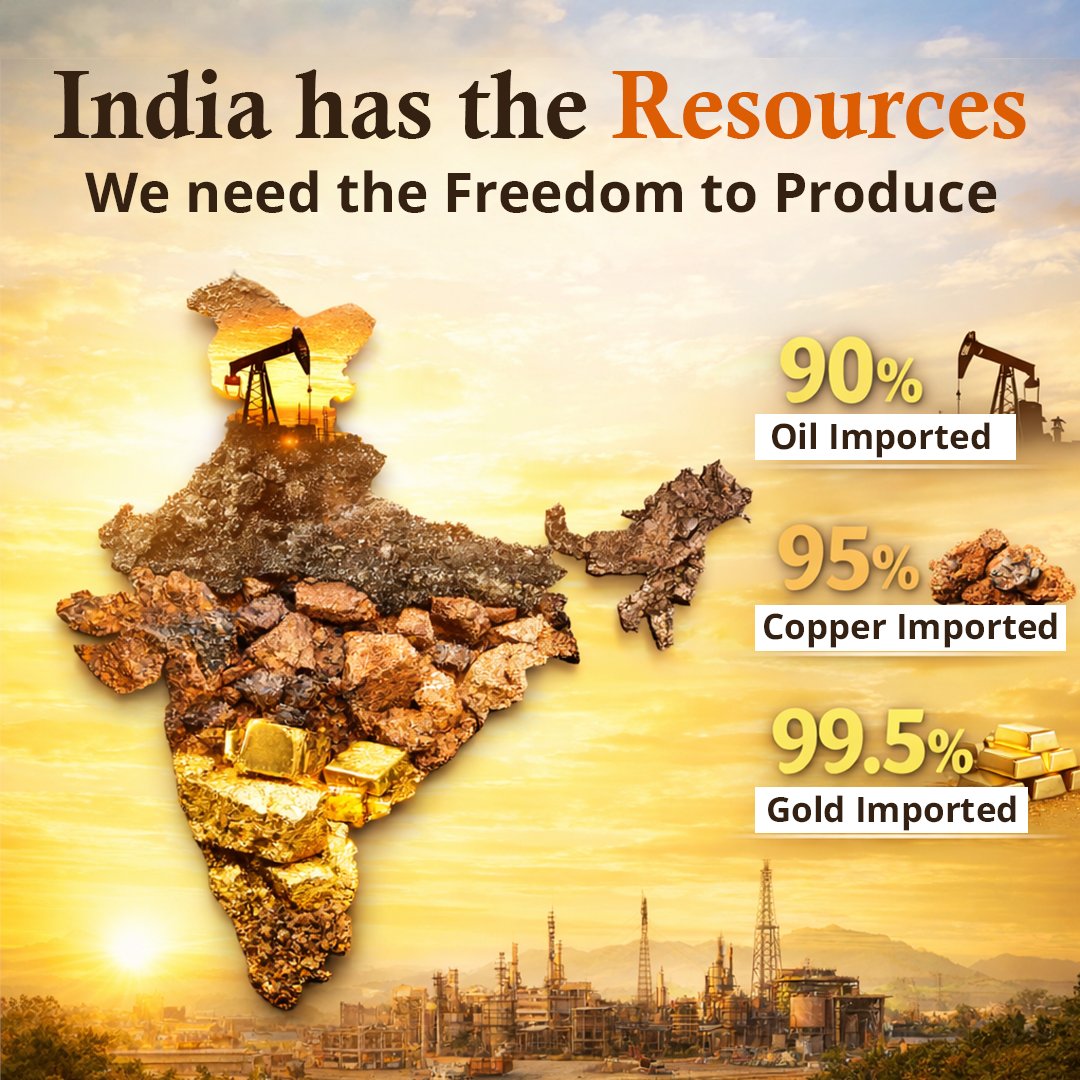
It is painful to see India face the adverse consequences of a war we have nothing to do with, particularly because of raw material security. We don’t have to import 90% of our oil, or 95% of our copper or 99.5% of our gold or any other metal resources. Mother Earth has given us the best geology. Last 40 years of practice in the minerals, metals and oil industry have taught me this. Now is the time, with this positive government, to give entrepreneurs freedom.
At just 19, I came to Bombay from Bihar and built a company in this industry from scratch. Vedanta was able to acquire Hindustan Zinc and BALCO under a privatisation programme which was never completed. 26% and 49% stakes are still held by the government and not been transferred as per a predetermined agreement. Vedanta also acquired ONGC Oil and Gas asset via UK’s Cairn and Sesa Goa Iron ore from Japan’s Mitsui.
In each one, the ambition and goal was to increase the production so much that India wouldn’t need to import but, in fact export. In Hindustan Zinc and BALCO, we succeeded. We increased zinc production 10 times, 20 times in aluminium. In the process, more than 1,000 companies have come up for processing this raw material. And Vedanta has contributed Rs 4.5 lakh crore to the exchequer in the last ten years. In oil and gas, our vision is to produce 1 million barrels per day. In iron ore, my vision is to produce 100 million tonnes, 33% of today’s production level. There are many more underperforming government assets that can perform the same way.
Three or four decades ago, there was no know-how, no experts, no finance in this industry. It took a lot of determination. Vedanta raised 35 billion USD from abroad and invested in India. It brought experts and technology. Because of that, Hindustan Zinc can also produce silver and fertiliser, and we are working very hard to start producing critical minerals very soon, something we were told would never happen in India.
Globally, only few very large companies engage in mining as it is very difficult without scale. Vedanta should be for India what Rio Tinto and BHP are for Australia or Vale is for Brazil. Other entrepreneurs and companies must create new Vedantas.
Most of the advanced countries have become prosperous by developing natural resources, including oil and gas. In India, the system has to stop creating hurdles. It needs to take a long-term view, as this government is not revenue-minded but, production-minded. It must facilitate. Instead of notices and judicial activity, all businesses need to receive recognition and respect. Benefit of doubt should pass onto them.
In India, we have economic heroes who can raise production equal to the biggest and best in the world. We should not allow tunnel vision or outdated mindset to keep us small and dependent. Some may remember the case of Rio Tinto which had invested in a diamond mine in Madhya Pradesh. It could have made India a global hub for diamond production, but they exited because of a complex, interfering and discouraging system.
The most important thing is trust. Keep the system simple, keep regulation limited and you eliminate the root cause of wrongdoing. We should have self-certification instead of lengthy approvals and clearances. The Government issues the rulebook and entrepreneurs strictly comply, subject to audit. Constant enquiry and interference only discourage enterprise. Also, the mindset of discrimination between public sector and private sector should change.
This year my family had the biggest tragedy. It was heartening to hear the words of the Prime Minister who said, “You must stay strong and continue to do work which is important for India.” That is the motivation of my life. I have the blessings of my grandfather and grandmother, who spent 40 years in Vrindavan in a small hut, in Manav Seva Sangh with their guruji, Swami Sharnanand Ji Maharaj. They always advised me, if you have wealth, you must use it for society. If you don’t have wealth, you must always help society with your hand. We all are willing to work hard, take risks and ensure that India becomes self-sufficient. The system should encourage us to deliver for our society and nation; this will eradicate unemployment and encourage women empowerment. This sector has given the maximum revenue to the exchequer in India and in the world for nation-building. It will help in making our country a developed nation, as envisioned by our Prime Minister. Let’s make India & Indians proud.
“If all you ever did was buy high-quality stocks on the 200-week moving average, you would beat the S&P 500 by a large margin over time.” - Charlie Munger $NFLX
Strategic Suicide: Iran’s Historic Blunder. China’s Oil Lifeline Is About to Collapse.
The US and Israel struck Iran, but the real shockwave will hit Beijing.
This isn’t just another Middle East escalation. Iran is the backbone of China’s West Asia strategy: discounted oil, yuan settlements, sanctions evasion, and a critical Belt and Road anchor. Now missiles have crossed Gulf airspace, Dubai has shut down, and regional alignment is shifting fast.
If Iran destabilizes, China loses a sanctioned oil lifeline and a key geopolitical pillar. If Hormuz closes, the energy shock hits Beijing hard.
A rare Śrauta Yāga will be held 25–29 March 2026 in Vijayawada, by Dendukuri Kasi Vishwanatha Haviryaji, preserving Agnihotra and the Vedic paramparā .
✨ Support and sustain Dharma
🌐 https://t.co/hO2HPm8xdF
🕉️ Dharmo rakṣati rakṣitaḥ
Jaya Jaya Shankara Hara Hara Shankara
Charlie Munger’s 5 Mental Models for Smarter Decisions:
1. Inversion Flip the problem.
• Ask: “What would cause failure?”
• Make an “I Don’t Do List”
• Avoid mistakes first
2. Second-Order Thinking See beyond the obvious.
• Ask: “And then what?”
• Anticipate ripple effects
• Think long-term impact
3. Circle of Competence Stay in your lane.
• Know what you know (and don’t)
• Focus on strengths
• Expand carefully through learning
4. Opportunity Cost Every choice has a price.
• Every “Yes” = a “No” elsewhere
• Time and energy are finite
• Weigh trade-offs before acting
5. Compounding Small steps, huge impact.
• Improve 1% daily
• Habits compound over years
• Tiny wins = massive results