What you really need isn’t another indicator.
It’s confidence in your strategy and the discipline to follow your rules.
No one can hand that to you—it’s earned through preparation, effort, and commitment to your own process.
5/5
Never waste energy trying to control the market—it’s beyond you.
What you can command are your prep, your risk, and your actions.
Master those, and real trading power is yours.
Results will flow naturally from a flawless process.
Thanks for reading!
What you can control in trading 🧵
Many traders waste energy and lose capital by fighting what they cannot control. Market movements.
The outcome of a single trade. None of these are under your command.
📷1/5
4/5
“Following rules doesn’t ensure a win.” True—because one trade is random. But breaking rules doesn’t ensure a win either. That’s why we create rules with an edge and stick to them, letting consistency and probability deliver results over time.
When markets are closed, it’s easy to study charts with a clear head.
But once the market starts moving, that calm disappears.
The real challenge is not in planning, but in how
accurately you can carry out that plan under pressure. That’s the skill that separates traders.
The harder you chase results, the faster they slip away.
Lose sight of the process, and the results suffer even more.
The paradox is this: the best way to get results is to forget about them—
and commit fully to the process.
People often say, “keep your losses small.” But small doesn’t mean absolute—it’s always relative to the profit potential you’re targeting.
Exiting a trade the moment it dips into a minor unrealized loss isn’t risk management—it’s a misconception. That mindset assumes every winning trade must move instantly into profit, which is unrealistic.
What actually matters is respecting your predefined stop-loss within a system that has a proven edge over many trades. As long as you stick to that, sitting through short-term drawdowns isn’t a mistake—it’s just part of the process.
It’s not “did I make money or not,” but “did I stick to my rules.”
Detach yourself from the outcome of any single trade.
Your only responsibility is discipline and consistency.
Don’t get distracted by short-term fluctuations.
Trust that over time, the law of large numbers will reveal your system’s edge.
Consistency isn’t about repeating victories—
it’s about repeating your rules.
Each win and each loss that comes from those rules
adds to your data.
And only when that data is built with consistency
does probability reveal its true edge.
#trading#forex#futures
When traders engage in revenge trading, they often:
☑ Ignore their trading plan.
☑ Increase their position sizes to recover losses faster.
☑ Trade without proper analysis.
☑ Let emotions take over rational thinking.
These behaviours only amplify the problem. Instead of a calculated, methodical approach, traders end up making reckless decisions that further damage their accounts.
To be successful in trading, always remember –
“ ❌You don’t recover losses by trading more
✅you recover them by trading better.”
Position sizing isn’t about chasing big wins today.
It’s about ensuring you’re still here tomorrow.
Consistency allows probabilities to unfold.
Your size should purchase longevity, not adrenaline.
5/5
What happens after you exit a trade is none of your business.
Your only responsibility is to execute your plan. Nothing else.
Follow the rules of a strategy you’ve tested, apply it consistently, and let the edge play out over hundreds of trades. That’s how the law of large numbers works in your favor.
Appreciate you reading 🙏
Never regret after the fact 🧵
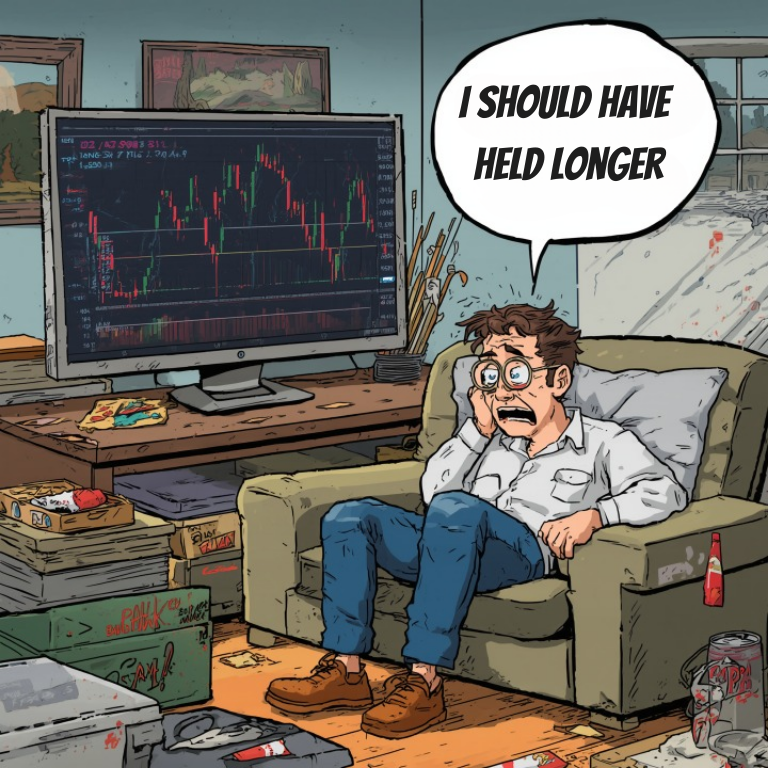
Watching the chart climb after you exit and thinking “I should’ve held” is dangerous.
That mindset will stop you from ever succeeding—because one day, the bomb will explode.
Here’s why:
🧵1/5
4/5
You might think, “If the market often rises after I exit, maybe I should adjust my rules?”
The real lesson isn’t in those few trades—it’s in whether your strategy was tested on a large enough sample size before you ever started. If your exit rules weren’t built from broad testing, that’s the actual issue.
If they were, then trust the edge. Stick to it until the end.
The problem is, traders rarely remember the exits that caused no regret. But when a trade triggers regret, the emotional impact burns it into memory. After a few of those in a row, the brain invents patterns that don’t exist.
That’s not edge. That’s illusion—the gambler’s trap.