⚔️📈 Learn macro by trading it. Every day a breaking headline hits the realm — you call the market, then live with the P&L.
Start as an intern and become a PM
Every day at this desk: a breaking headline from a fantasy realm - inflation shocks, bank runs, coups - and one question: how do markets react?
You call it: stocks, bonds, FX, commodities. The tape answers.
The world is invented. The macro is real.
https://t.co/AjLjlQFjFO
@KeithMcCullough Worth splitting the two legs. HYG is the fastest way to lift or hedge credit beta, so volume lands in the ETF before cash spreads move: the discount to NAV tells you which one it is. And this print cuts both ways for high yield, the rates leg helps, the growth leg does not.
@Mr_Derivatives The weekend is doing most of the work. VIX prices 30 calendar days of variance, but only about 21 of them are trading days. Into the Friday close dealers mark vols down for two days that cannot produce a realised move. Monday puts it back. Calendar convention, not sentiment.
@MarketWatch Note the part that did not break: U3 at 4.2% is still inside the 4.1-4.3 band it has held since March, with participation at 61.8%. Labour demand is cooling, but supply is cooling with it. That balance is why average hourly earnings are still +3.0% y/y.
@AP The revisions are the bigger number. July went from +21k to -10k, August from 162k to 133k: 60k erased, more than the headline itself. Three-month average is now 51k. One print at this sample size is noise; what moved today is the trend behind it.
@acidicsweetie@DarioCpx The obligation sits on industry, not the Treasury: no capex, no storage line in the budget. The cost is the lever. A state SPR is released by decision; a stocking obligation can only be lowered, freeing barrels a refiner chooses when to sell. Germany EBV is the middle model.
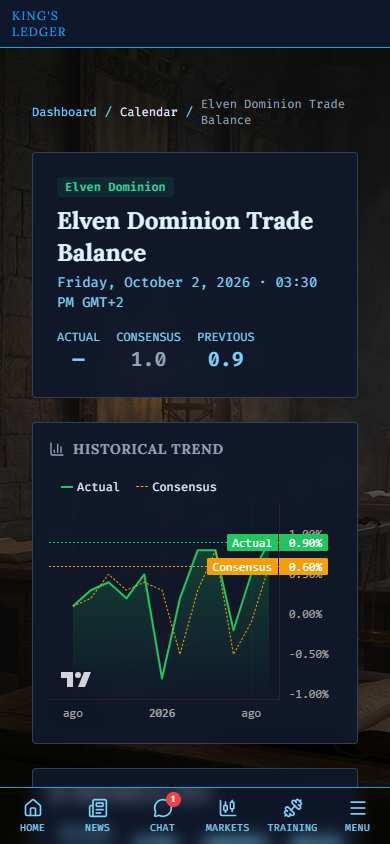
Today on the desk: Elven Dominion Trade Balance. Prev 0.9, consensus 1.0.
Both elven PMIs beat this week - manufacturing 57.2, services 56.0. Factories hit the export line before they hit GDP, and net exports are a growth line. Long the Elven Index.
https://t.co/rtuOsCRIVo
@DrJStrategy The 2y had already done part of the work. It closed September at 4.88 with effective funds at 3.88, a 100bp gap - a full point of tightening sitting in the curve before Logan spoke. The open question is not whether 50bp lands, it is whether the Fed under-delivers against that.
@darioperkins Worth noting which part of the tide moved. Through September US 2s went 4.39 to 4.88 and 10s 4.79 to 5.29, both near 50bp, while 30s added only 37bp. Front-led, not a term premium blowout. Which is why the French problem is showing up in spread, not in the global long end.
@TheInsiderPaper Worth splitting that 2-pound litre. Duty is 52.95p and VAT 20% on top, so about 86p of it is tax and does not move with the barrel. Wholesale falls pass through in pence times 1.2, not in percent: a 10p drop in product is 12p at the pump, 6% of the price.
@BittelJulien It is already showing in the H.8. C&I loans ran at a 14.8% annualized pace in Q2 against 7.9% for total loans and leases, at $2.97tn outstanding. Bank lending creates the deposit that funds it, so the constraint is capital and leverage ratios, not savings.
@wallstengine Nearly all of it is the energy line. Energy ran 18.8% y/y in September against 14.3% in August, while ex-energy the index is 2.3% and ex-energy-and-food 2.5%. Services only went 3.0% to 3.2%. A level shock passing through the base, not a change in the run rate.
@elerianm Two different moves inside that widening. Over the past month the OAT is up about 70bp while the Bund is up 7bp - that part is French. Today is the other leg: the Bund fell 10bp to 3.42% off a 17-year high, the OAT up 1bp at 4.91%. Flight to quality inside the bloc.
@LizAnnSonders@AAIISentiment The bullish line isn't the tell. Neutral is 18.9% against a 31.0% average while bearish is 46.5% vs 31.5%. The middle has emptied, not just turned negative. Optimism rebounding off a hollowed-out neutral is conviction on both sides, and that shows in realized vol before price.
@ForexFactory The 162K prior is the outlier, not the baseline. BLS puts the average monthly gain over the prior 12 months at 31K, and after revisions June was +31K and July +21K. On that run rate 89K would be an upside print, not a slowdown. The 3-month average is what matters.
@zerohedge Some of that drop is definitional. From 2025Q3 the IMF folded the unallocated bucket into the currency split, revised back to 2000Q1, which mechanically lowered the renminbi share. It is 1.99% in 2026Q1 against 1.95% in 2025Q4, and the quarterly moves are mostly valuation.
@DeItaone Which yields, though. The 2y closed Oct 1 at 4.13% and the 30y at 5.61%, 148bp apart. The front end has already priced the easing; the back end is term premium. A cut steepens that rather than compressing it. Risk-off ends when the long end comes in, not when the Fed moves.
@MorrisMay@Barchart Agreed - that's what the spread is pricing. No budget isn't a shutdown in France: a special law rolls over prior-year taxation, as in Dec 2024. Spending runs on last year's base, so consolidation slips rather than stops. Slippage, not default risk, is what widens the OAT.
@NickTimiraos The question is already in the curve. The US 10y is up 117bp in a year, 4.12% to 5.29%, while the 10y breakeven is flat at 2.36% against 2.35%. All of it is real: the 10y TIPS yield went 1.77% to 2.93%. Oct 16 is a term premium conversation, not an inflation one.
@DTAPCAP Worth watching where it leaks. Euro high yield OAS went 2.66% to 3.00% in the five sessions to Sep 30, +34bp and the widest since April 9. A sovereign repricing that reaches corporate spreads inside a week is moving through bank collateral, not just budget arithmetic.