@WCespar To low SES children referred to psychiatrists. Because, even though they’re more likely to be referred to a psychiatrist than high SES kids, they’re less likely to get treated with AD even though they have massive gains in test scores when treated. So yes,lower inequality.
🆕 RFBerlin Discussion Paper: @SoniaBhalotra, @MeltemDaysal and @tramir provide some of the first evidence of impacts of antidepressant treatment in childhood on mental health and economic indicators over time. https://t.co/IpgUS0gYmg
Don't forget! Oct 6th, VERB will be hosting a webinar with Professor Meltem Daysal on how antidepressant treatment in childhood affects schooling, work, and health later in life. https://t.co/HgOfKKhYFU
@instrumenthull This is super cool! You probably already know this, but Chyn et al (JEL) also make this point for the binary treatment-continuous instrument case https://t.co/ali0LsTTU0
Vi har i ROCKWOOL Fonden starten en ny enhed op: “Produktivitet og Velstand”. Det har vi fordi vi er overbeviste om, at det er vigtigt, at fokusere på produktivitet i de kommende år i Danmark og ikke mindst i Europa. Se mere om initiativet i Børsen idag. https://t.co/yxmak0j8Dc
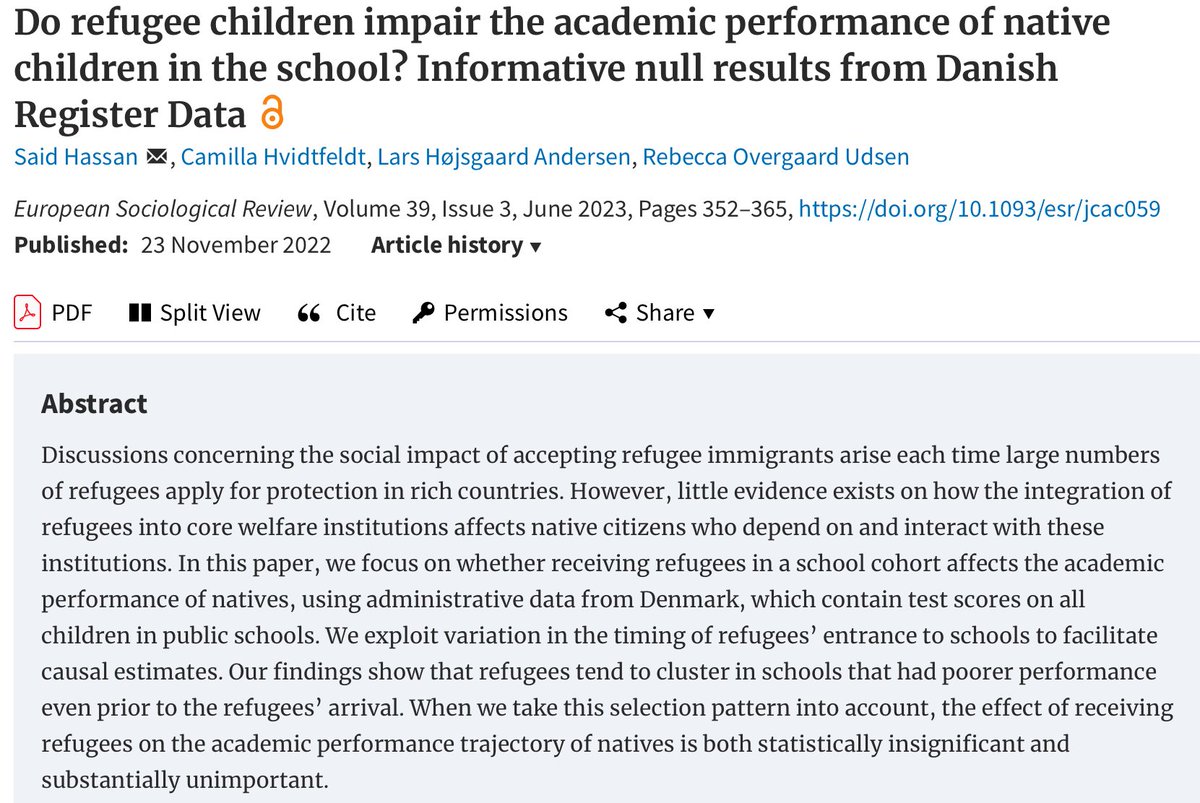
Our congratulations to @SaidAJHassan@C_Hvidtfeldt@L_H_Andersen & @RebeccaUdsen for winning the ECSR-ESR Best Article Prize 2024 with manuscript: Do refugee children impair the academic performance of native students?
Read the award winning article here: https://t.co/ijvtfdqCoQ
Such an honor!
For a recap of the article’s highlights, see https://t.co/MadfXY80Gm
Also: I realize it shouldn’t be a thing. But I am very happy to see this honor given to a null finding. A super informative one, but a null nonetheless. You help set the tone, @ESR_news, thanks!
@estebanjq3@dynarski The Rockwool Foundation is purely a research institute, it does not have a framework for a network like the IZA. Source: I work there 😊
One of the many super interesting papers by my significantly better half @MeltemDaysal is now featured on the front page of the NBER! #EconTwitter
https://t.co/ZeKhYpjZlz
@SHamiltonian@pontus_rendahl Europe vs US. As a case in point: had a fun experience with EJ and AEJ:Applied each recommending that we submit to the other after rejecting our paper 🤷🏻♂️
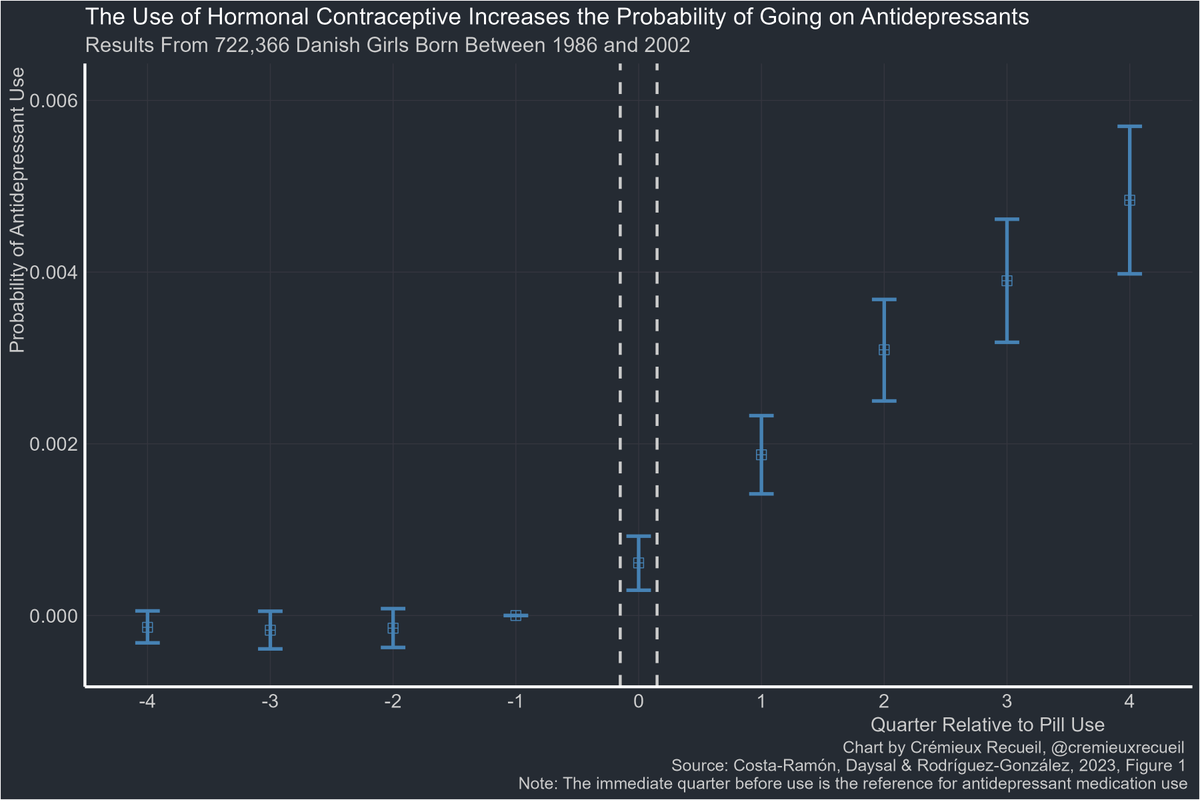
New research shows even stronger support for this result: it seems likely that hormonal contraceptives cause depression.
Researchers used a massive register sample of people born between 1986 and 2002 to see if taking the pill affected mental health.
The result? Check it out:
@KiraboJackson@SteveRo48195125 One past experience of mine: referee reports looked strong, AER rejection letter sounded like borderline case. Fwd reports to AEJ, got rejected again and was told that one referee was extremely dismissive of the paper in the letter to editor. How can you “prevent” such a case?
@SamuelKaplan13@DinaPomeranz Magne Mogstad has a bunch of papers:
https://t.co/5cpX7a2EuK
https://t.co/PNhwgnod70
https://t.co/sAbeNnEjx7
https://t.co/loIQ17B0nY
https://t.co/mPZ7Xprtff
@pqblair There are many economists at https://t.co/7bLqipqV3I, an instance set up by @paulgp. We’re waiting for you 😊 (it’s quite easy to migrate servers).