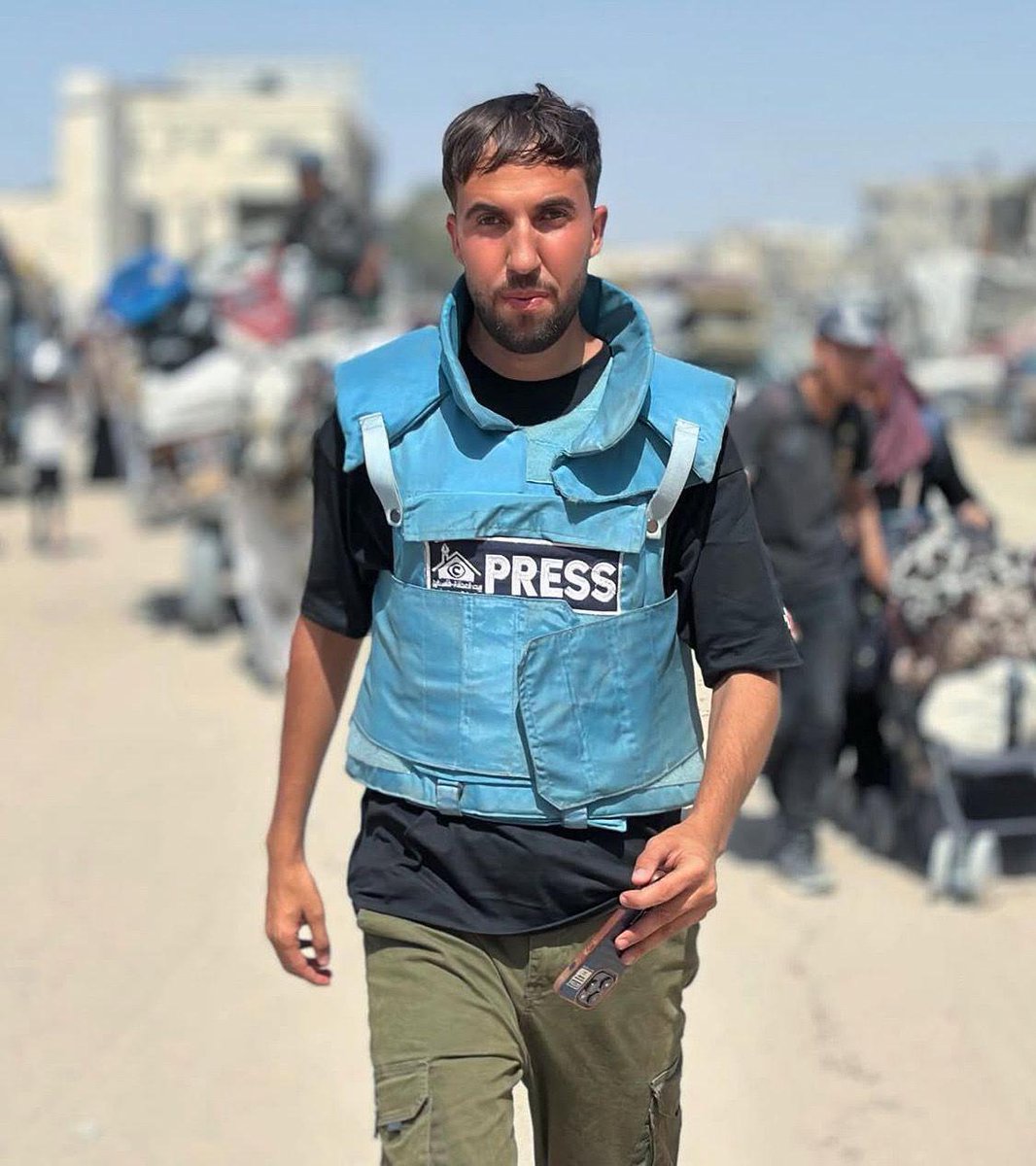
Rest in Peace - Our dear colleague journalist Moaz Abu Taha has been martyred in the massacre caused by the Israeli occupation bombing of Nasser Medical Complex in Khan Younis. Moaz has been actively documenting the cases of severely ill children at Nasser Hospital for the purpose of medical evacuations.
Israeli occupation soldiers stormed two boys' schools in Burqa, northwest of Nablus in the occupied West Bank, on the morning of November 25, 2026, as students gathered for morning assembly. Several military jeeps drove into the town, closed off roads, and troops pushed into the school yards and classrooms of the Secondary Boys' School and the Basic Boys' School, barred students from going in and forced teachers to evacuate both buildings. Israeli occupation terrorists stayed stationed around the schools as frightened parents arrived to collect their children, and the army set up a checkpoint at the town's entrance. As it so often does, the occupation army claimed its 'soldiers' had been pelted with stones.
A Burqa council member says the schools have been raided again and again on the same pretext. Raids like this are routine across the West Bank. Since October 2023, the Palestinian Ministry of Education says, Israeli occupation forces and colonists have killed 128 West Bank schoolchildren, wounded 861 and arrested 421, while also raiding classrooms, firing tear gas into school yards and blocking roads to stop children reaching their lessons. In the occupied West Bank, a school offers no protection from soldiers. It is one more place they can storm.
‼️Meningitis, an infection of the membranes that surround the brain and spinal cord, is spreading at an alarming rate in Gaza. So far, dozens of children have died and the number of cases is increasing.
Two-month-old Mohammed al-Sarsak has spent five days in hospital with a suspected case after his mother brought him in with a fever and vomiting, thinking it was a passing flu. On November 24, 2026, Gaza's Health Ministry declared an epidemic alert across all governorates. Meningitis cases hit 272 in October, more than eight times the normal monthly rate of 30 to 50. Bacterial meningitis, the deadlier form, jumped from 10 to 20 cases a month to 108 in October, with another 100 since the start of November. Fifteen people, most of them young children, have died this year. "It's because of the genocide, because the sewage system was destroyed, because of the tents, because rainwater mixes with regular water," his mother says.
Health officials agree. The Israeli occupation has destroyed Gaza's water and sewage networks, leaving families crammed into tents surrounded by rats and sewage, and Oxfam found bacteria in nearly one in five wells it tested. Ministry Director-General Dr. Munir al-Bursh says the medicines needed to fight the outbreak are sitting at the crossings, waiting for Israeli permission to enter. Doctors cannot even identify which strain is spreading, because the occupation's restrictions have left Gaza without the lab tests to do it. "As a mother," she says, "I fear my child will suffer what the other children did."
Source: ahmed_kaheel0 (IG)
Israeli occupation soldiers forced Palestinian schoolboys to kneel on a dirt road outside Idhna, west of Hebron in the occupied West Bank, blindfolded with strips of cloth and their hands held behind their backs, in footage posted on November 25, 2026. As armed soldiers stand over them, a voice asks the boys their names. Two of them answer, blindfolded: Amr Khaled Abu Juheish and Mohammed Ibrahim Abu Juheish. Their faces show how young they are.
The same morning, near Nablus, occupation soldiers stormed two boys' schools in Barqa during morning assembly, forced teachers to evacuate the buildings and set up a checkpoint at the village entrance while parents rushed to collect their children. The army claimed it had been pelted with stones, the same excuse it uses again and again to raid schools and detain children. Palestinian children are the only children in the world systematically prosecuted in military courts. Between 500 and 700 are put through them every year, most accused of throwing stones, and Palestinian prisoner groups say around 350 children are being held in Israeli prisons. For a Palestinian boy in the West Bank, the walk to school can end on his knees, blindfolded, saying his name to the soldiers who took him.
An Israeli occupation drone fired on a group of Palestinians, children among them, as they were putting up a tent to shelter in at al-Tawam, northwest of Gaza City, on November 25, 2026. Osama Ali Joudeh was killed on the spot, and several others were wounded. Hours later, his brother Mohammed Ali Joudeh died of his critical injuries, joining Osama.
They were killed doing what hundreds of thousands of displaced families in Gaza are doing this winter: trying to put a roof of plastic and cloth over their heads after storms flooded their camps. The same morning, an occupation strike on a home in al-Shati camp killed four members of one family, including two girls, and a drone hit a tent in Jabalia, killing another man. Gaza's Health Ministry says 1,679 Palestinians have now been killed since the ceasefire took effect. In Gaza, even raising a tent is enough to be targeted.
Source: press.saleh (IG)
8-month-old Amal Abu Arar spends almost every hour of her day lying motionless on a thin mattress in a tent in al-Mawasi, Khan Younis. Displaced with her family from Rafah, she was born with a severe congenital condition that has left her head badly enlarged. She cannot move, and her parents struggle to feed her, give her water, dress her and even comb her hair. Her family says her life is in grave danger and that the treatment she needs does not exist inside Gaza. Amal is one of hundreds of children born with congenital deformities during the genocide.
Gaza's Health Ministry recorded 260 cases in the first nine months of 2026 alone, more than in all of 2022, and has called for an independent investigation into the role of maternal starvation, heavy metal pollutants, and the weapons the Israeli occupation has rained on Gaza. Instead of hospital beds and specialist care, these children are spending the winter in flooded tents, because the occupation has bombed, besieged and gutted Gaza's hospitals, killed more than 1,700 health workers, and continues to restrict the entry of medicines and medical equipment, treating even essential drugs as "dual-use."
Around 21,000 sick and wounded Palestinians are waiting to leave Gaza for treatment, while the occupation lets out only a trickle. For Amal, the family can only rarely reach a primary healthcare centre at all. The Israeli occupation is not only killing Gaza's children with bombs. It is condemning those born in its genocide to suffer without care.
Source: hani.alshaer (IG)
The Israeli occupation's COGAT stopped a shipment of blankets and winter clothing bound for Gaza at the Kerem Shalom crossing on November 24, 2026, and froze the permits of the Israeli company and trader bringing it in "until further notice," claiming hundreds of kilograms of tobacco were hidden inside. That raises two questions.
First, why does Gaza lose a winter supply line because of what an Israeli supplier allegedly packed? The tobacco could have been confiscated and the blankets let through. Instead, families who have just watched their tents flood are left with fewer blankets, while the UN says more than 150,000 tents are still waiting outside Gaza for Israeli permission.
Second, why is tobacco banned at all? Cigarettes are a legal consumer product, not a "dual-use" item that could be turned into a weapon. Before the genocide, Gaza consumed around seven million cigarettes a day through legal imports. Israel has blocked them since October 2023, and when AP asked COGAT why, it did not reply. Israeli officials claim the ban denies Hamas revenue, yet it is the ban itself that created a black market where a single pack has sold for $140, and for over $1,000 during the total blockade. That market has enriched smugglers, including Israelis: dozens were indicted this year, among them the brother of the head of Israel's Shin Bet, and AP found some Israeli soldiers take payment to let banned goods through. Gaza economists note that when Israel wanted to undercut profits on flour, it flooded the market instead. The pattern is the same as with toilets, batteries and pumps: control over what Palestinians are allowed to have, enforced through people's everyday lives.
While at work in Qabrikha today, filming the destruction of the town of Qantara, the IDF sent their surveillance drone over to monitor us (unfortunately normal). It hovered for the duration of our stay. A second drone came over and dropped a grenade behind our vehicle just as we got in the car to leave. Another drone then followed us all the way through town.
This is a violation of international law. Journalism is not a crime.
Instead of beginning life with a cry, newborns in Gaza are beginning it with a fight. Alaa was born with a hole in her heart. Malak was born with a rare congenital malformation. Nour was born without arms.
They are not isolated cases. Gaza's Health Ministry recorded 260 cases of congenital anomalies in the first nine months of 2026 alone. That is already more than the 184 recorded in the whole of 2022, and it follows 322 cases in 2025. These cases are rising even as births in Gaza have fallen sharply.
These numbers are not a full count of every baby born with a defect. They are only the cases that could be measured and recorded. Hospitals have been bombed, maternity wards and neonatal units are overwhelmed, and prenatal care has collapsed, so many defects are likely never diagnosed or documented. The real toll is probably higher.
Doctors report cleft lips and palates, shortened limbs, heart defects and babies born with several anomalies at once. Ministry Director-General Dr. Munir al-Bursh has called for an independent international scientific investigation into the rise. He points to maternal malnutrition, exposure to pollutants and the collapse of prenatal care during the genocide. The ministry says the weapons the Israeli occupation used to bomb Gaza are among the most dangerous factors. MSF found that more than half the mothers of newborns in Gaza City's neonatal intensive care units were malnourished during pregnancy.
Even when a defect is diagnosed, the specialised surgery these babies need is often unavailable in Gaza's destroyed health system, and the Israeli occupation besieges them from birth, blocking them from leaving for treatment. For some, the result is a life cut short before it has properly begun.
Source: @qudsn
"We are children. Why must we live in tents?" Children in Gaza remember what winter used to mean: wrapping up in a blanket in front of the TV while their mothers made sahlab or tea. Now winter means waking up in soaked bedding, watching their mothers pile blankets and mattresses on the ground to keep the rainwater out, and lying awake wondering how the family will fix a torn tent or where they will sleep when the next storm comes. One girl says her notebooks, books and school supplies were all ruined by the floods, so she could not study. Another just wants to go home and play with her friends in their own street.
Earlier this month, the first winter storm flooded around 70,000 tents in Gaza within hours. Save the Children says more than 560,000 children are living in critical shelter conditions, and that winter clothing has reached just 1 percent of those who need it. Meanwhile, more than 150,000 tents sit outside Gaza, waiting for the Israeli occupation's approval. A nine-month-old baby has already frozen to death in his family's tent in Khan Younis this month. "We love winter and everything about it," one child says. "But why must this happen to us?"
@trtarabi
An UNRWA worker was killed in Jabalia refugee camp in northern Gaza on the morning of November 23, 2026, when an Israeli occupation drone fired on a group of Palestinians gathered near al-Tawba clinic. Adel al-Helou was on duty when the drone struck, and he died still wearing his blue UN vest. "To al-Tawba clinic! To al-Tawba clinic!" men shout in the footage as they rush the wounded through the camp's streets to the nearby clinic, all that passes for emergency care in a camp where the occupation has destroyed hospitals, roads and homes.
The video captures the chaos and terror that follow every strike: shouting, running, and the cries of "God is great" as people try to save whoever they can. Adel was killed more than a year into a ceasefire the occupation violates every day, with Gaza's Health Ministry reporting 1,675 Palestinians killed since it took effect. UNRWA has lost more than 390 of its staff and the people supporting its work in Gaza since October 2023. Even those who serve Palestinian refugees under the UN flag are not safe from the occupation's drones.
Source: hamza._mousa (IG)
A doctor of philosophy now lives beneath a staircase. Dr. Muhammad Othman al-Khatib, 58, sleeps under a damaged stairwell in Jabalia refugee camp in northern Gaza, after an Israeli occupation airstrike destroyed his home and the war took his job as a teacher and his only income. "These are the certificates I pulled out from under the rubble," he says, holding up the papers that record a lifetime of study: a bachelor's degree in Fundamentals of Religion and Comparative Religion, a master's in Islamic theology, and a doctorate in Philosophy of Science and Scientific Research Methodology.
His studies took him from Gaza to Jordan, Turkey and Malaysia, where he worked at the International Institute for Muslim Unity at the International Islamic University. Yet he still talks about the future: his dream is to build a university city devoted to methodology, because he believes this millennium will be the one in which the human mind is reshaped through how we think. Quoting Imam al-Ghazali, "learn everything in one field, and something from every field," he says what matters most is to live with confidence, conviction and positivity, and never be a burden on others. The Israeli occupation has bombed Gaza's universities into ruins and killed hundreds of its academics, scholars and students. It could not bury what Dr. al-Khatib carries in his mind.
@TRTArabi
A child in Gaza died of lead poisoning today, killed by the batteries his family needed just to have light. Gaza's Health Ministry announced on November 23, 2026, that the child died of acute lead poisoning after medical investigations found clear signs of poisoning, and that his father repairs old batteries inside a displacement camp. In Gaza's camps, where there is almost no electricity, families rely on car batteries to light their tents and charge their phones. With the Israeli occupation blocking new batteries from entering the Strip under its "dual-use" restrictions, repairmen dismantle dead ones by hand, stripping 10 or 15 to rebuild a single working battery, inside cramped tents with no ventilation, where children sleep, eat and play. Opening old batteries releases toxic lead.
The Health Ministry in Gaza warned that this child's death may only be the first visible case, with large numbers of children likely suffering chronic lead poisoning that has never been diagnosed, because Gaza lacks even the lab supplies needed to test lead levels in the blood. Lead damages children's brains and development permanently, often without symptoms until it is too late. The ministry holds the occupation directly responsible and is calling for safe batteries and blood lead testing equipment to be allowed in.
An Israeli occupation drone strike killed UNRWA worker Adel al-Helou on the morning of November 23, 2026, as he was on duty near al-Tawba Mosque in Jabalia refugee camp, northern Gaza. The drone fired on a group of Palestinians gathered there, killing Adel and wounding others. He died still wearing his blue UN vest, its emblem pierced by shrapnel. He was killed more than a year into a ceasefire the occupation violates every day; Gaza's Health Ministry says 1,675 Palestinians have now been killed since it took effect.
UNRWA, the UN agency for Palestinian refugees, has lost more than 390 of its own staff and the people supporting its work in Gaza since October 2023, most of them teachers and health workers, many killed alongside their families. At the same time, the Israeli occupation has banned the agency, bulldozed its headquarters in occupied East Jerusalem, shut its schools and blocked it from bringing aid into Gaza. Killing the people who feed, teach and treat Palestinian refugees is part of the same campaign to erase the refugees themselves, and with them the right of return.
Source: Anwar al-Amoodi
In 2014, Born in Gaza documented the lives of ten Palestinian children during the war. Ten years later, Born in Gaza II returns to some of them, revisiting their stories as Gaza faces another devastating war.
Streaming exclusively on Watermelon+ December 11, worldwide.
Mustafa al-Kafarna's head and arm were badly burned when an Israeli occupation strike hit near his family's home in Gaza. The blast knocked over the table where a pan of hot oil sat on the stove, and the boiling oil poured over him. The burns reached the third degree. Doctors in Gaza grafted skin from his thigh onto his right arm and his head, and the grafts took, but his hair will not grow back. He needs a hair transplant and specialised care that his family says can only be done abroad.
Until then, the scarred skin on his head itches constantly. Mustafa scratches it open, the wounds become infected, and the infection keeps hurting him. "My plea is for my son to be able to travel abroad," the family says. "Nothing more." He is one of around 21,000 sick and wounded Palestinians stuck in Gaza waiting for treatment outside, as the Israeli occupation lets only a trickle of patients leave through the Rafah crossing, far fewer than agreed under the ceasefire. For a child like Mustafa, every week of waiting means more pain, more infection and more damage that may never be undone.
Source: Wafa News Agency
🔴️️️️️️ Il faut sauver le docteur palestinien Hussam Abu Safiya !
👉️️️️️️ https://t.co/PFAhdsh3ON
Agissez dès maintenant : https://t.co/G5PL93W2ip
#FreeDrHussamAbuSafiya
Israeli colonial terrorists beat Palestinian women while they harvested their family's olives in Wadi Ma'in, in Masafer Yatta, south of Hebron in the occupied West Bank. "He's hitting me! Why? What did I do?" one of the women from the Mus'af family cries out in the footage, published on November 21, 2026, by local activist Osama Makhamreh, who says the colonists attacked the family and stole their olives. It is not the first time this season.
A month earlier, Israeli occupation forces arrested Palestinian Khader Mus'af and his son Suleiman as they tried to reach the same land to pick their olives, while colonists moved into the family's grove, stripped the trees and carried off the harvest. Last week, colonists beat olive pickers from the neighbouring al-Jabarin family in Wadi Ma'in under the protection of occupation soldiers, who then detained members of the family instead. Across Masafer Yatta, families face a choice the occupation has engineered for them: abandon their land, or be beaten, arrested and robbed every time they try to work it.
Source: osamamakhamrh
Ten-year-old Qusai Mohammed al-Joulani was shot in the head and killed on the morning of November 21, 2026, at the entrance to his UNRWA school in Shuafat refugee camp, occupied East Jerusalem. A gunman on a motorcycle opened fire and fled. The killer remains unidentified. Across the occupied West Bank and Jerusalem, the Israeli occupation's police and army shield Israeli colonial terrorists, protecting criminals and covering up their crimes, while Palestinian lives go unprotected and their killings uninvestigated.
In footage filmed by B'Tselem in a-Tuwani, in the South Hebron Hills, colonists assault Palestinians in front of armed soldiers who do nothing to stop them. After the attack, police arrested the Palestinian whose family owns the land. In Shuafat, the occupation's wall cuts the camp off from the rest of Jerusalem, abandoning its residents behind concrete and checkpoints. In May 2025, Israeli authorities shut down Shuafat's three UNRWA schools, forcing children out of their classrooms. Now a ten-year-old has been killed at a school gate, and no one has been held accountable. This is apartheid: Palestinian communities walled off and divided, their children denied even the most basic right to safety.
@tamerqdh
NFL star Azeez Al-Shaair speaks about his fines from the NFL for honoring Palestinian children and reads a poem from his grandfather who passed away just two weeks.