@AskVenice Are you sure?
Your policy defines data categories for email, IP address, cookies, device info, and usage metadata, but has zero mention of user prompts, AI conversations, or generated content.
Privacy is a human right. So put it in the policy.
Everyone is worried that Suno hit #1 on the App Store.
Above Spotify. Above Apple Music. Above every tool you actually pay to make music with.
The AI flood of the music industry just officially started.
Musical ability in popular music just became ambient.
A working track, in any genre, in under a minute, from a prompt.
That used to take three years of practice to reach.
But even though it sound all bad here's the switch. That means fuck all for the identity expressive artist.
A generative music model cross-references across every life work it trained on.
Your brain cross-references across one.
One specific life. Your life.
The album that owned you two months ago.
The song you played to death in the car. It got wired into your nervous system and no model has ever lived that.
There are parts of you inner being that cannot be fabricated out of thin air.
AI will not replace you.
But it will if you are not pulling your ideas from the part of you that no model was ever trained on.
What survives the flood is the artist who can still hear their own truth underneath the noise.
Tonight, try this as an experiment: Before opening a synth, a sample folder, or a reference track, write down one memory the track is allowed to come from.
Not a genre.
Not a trend.
Not a prompt.
A real piece of your life.
Then let it unfold from there see what happens.
Tune Your Mind
Comment “Join” and we’ll send you the free Neural Music Newsletter + PDF.
#neuralmusic #music #aimusic #ai #musicproducer #musicartist
You bounce the track. You listen in the car. The mix is clean, the arrangement works, but your body does not feel it.
The song sounds correct, but it feels like a ghost wearing someone else's clothes.
Most creators spend years building inside borrowed architecture.
You pick a genre because it gives you walls and a roof. It tells you where the kick drum goes. It hands you a blueprint so you don’t have to face the terrifying, silent blankness of an empty project file that refuses to be built a genre framework that does not represent your identity.
But a borrowed room always feels hollow.
Personal Sonic Architecture is not a plugin chain. It is the physical structure of your own nervous system, translated into frequencies.
Look at what you build when no one is watching. The textures you gravitate toward. The rhythm of your own speaking cadence. The precise amount of dissonance you need to feel safe. The empty space you leave in a track because you learned early on to stay quiet.
That is your raw material.
Every choice you make in a DAW is a load-bearing decision. When you drag in a snare sample because the genre demands it, you are letting an algorithm pour your concrete. You are building a prefabricated house.
To build your own Sonic Architecture, you have to be willing to dismantle the blueprint.
You stop asking, “Does this fit the genre?” and start asking, “Does this feel like my memory?”
You stop laying frequencies down because a trend told you they belong there, and you start making structural choices from your own interior logic.
It is lonelier. There are no reference tracks for your own identity. But it is real. You stop imitating a style and start inhabiting a space.
The track stops sounding like the artists you admire. It starts sounding like the person you are.
Music that cannot be categorised. Because it was never built from a category.
Tune Your Mind.
Comment "JOIN" and we will give you access to the Neural Music Newsletters and PDF.
#musicproducer #creativeprocess #musicproduction #artistdevelopment #neuralmusic
You hear a track on a playlist that just works. The artist sounds completely, unmistakably like themselves.
You tab back over to your own session.
Suddenly, everything you liked about your arrangement ten minutes ago feels wrong.
That drop in confidence isn't you losing your ear. It’s just your nervous system doing what it evolved to do: scanning the room to see how you measure up.
Theodore Roosevelt once said, "Comparison is the thief of joy." In the studio, that is the Comparison Cage.
You hear someone else's finished identity, and your brain quietly convinces you to abandon your own signal to match their blueprint. So you start tweaking. You delete the weird, honest parts of your track to make it sound more "correct."
A few hours later, the mix might sound closer to the reference.
But the music doesn't feel like you anymore.
Tune Your Mind.
Comment "Join" and we will give you access to the free Neural Music Newsletter and PDF
#NeuralMusic #Psychology #CreativePsychology #Musiccreator #MusicProduction
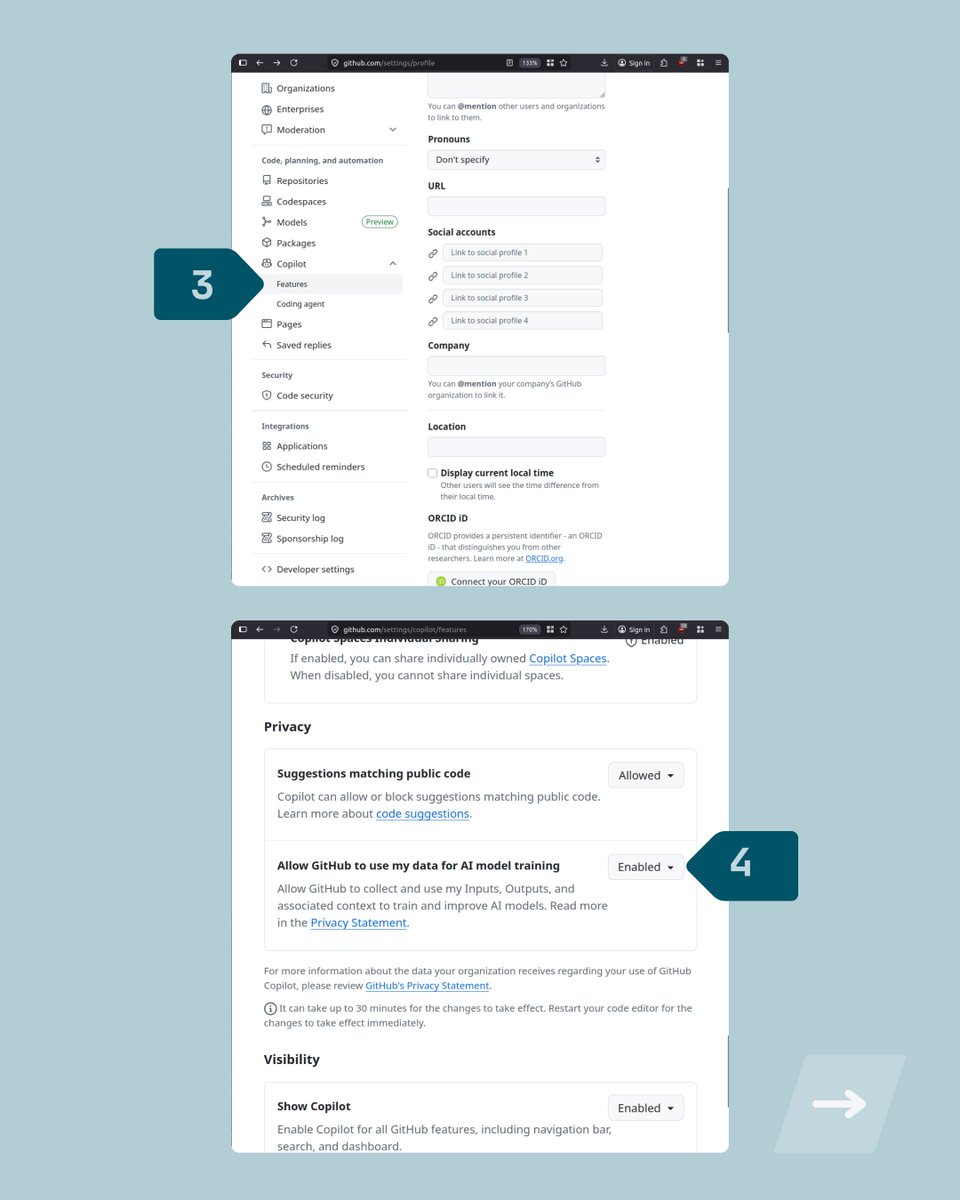
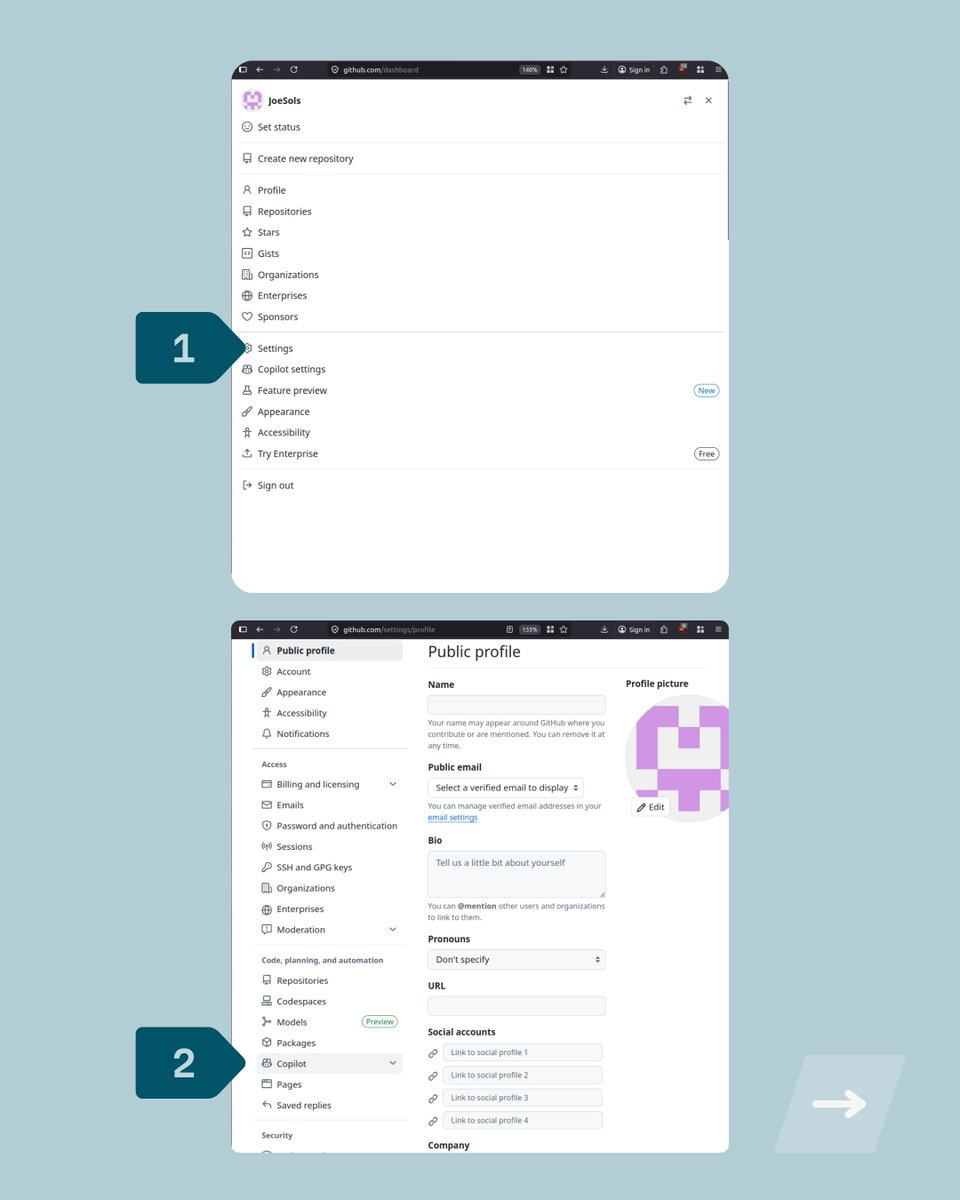
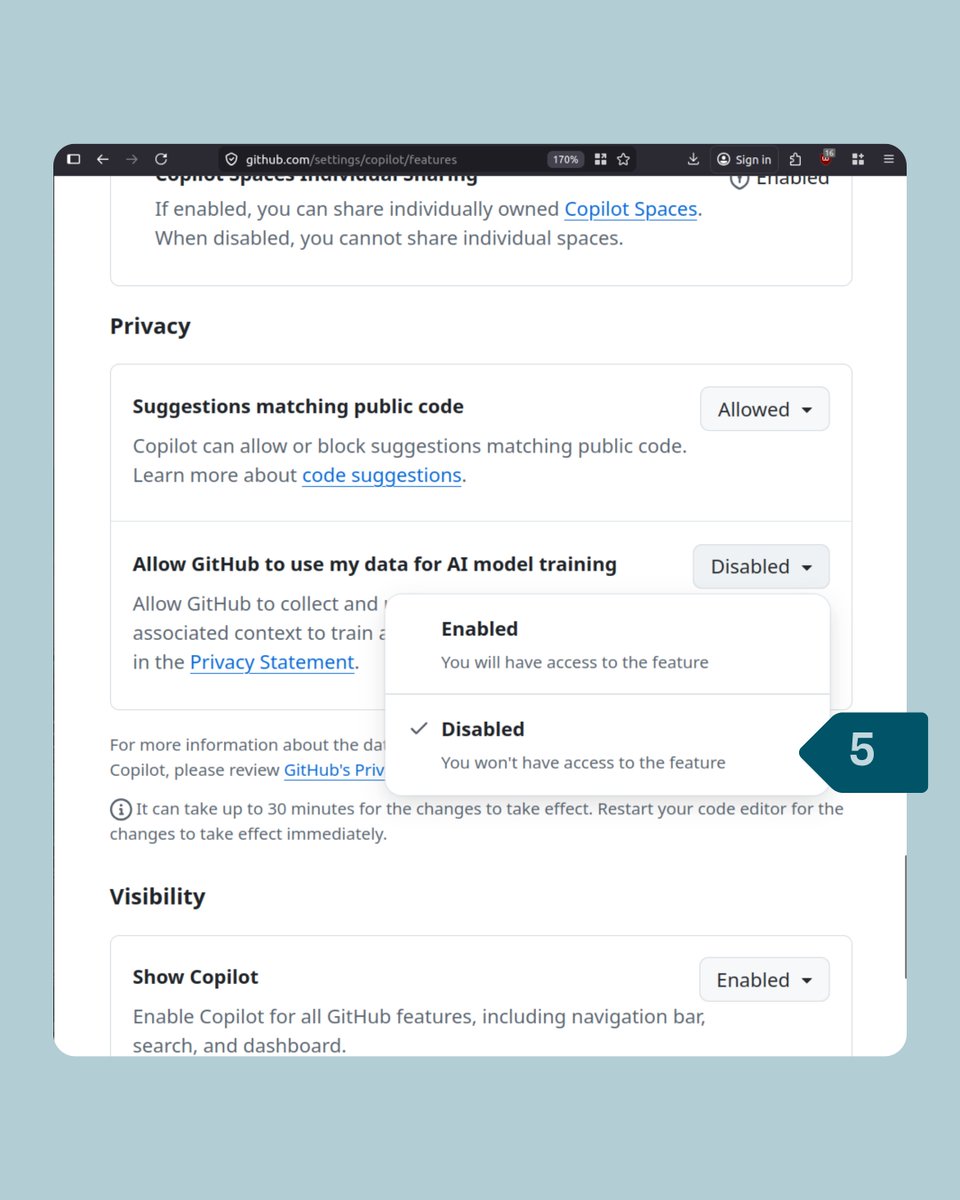
🚨 OPT OUT & say NO to #GitHub using your interaction data to train & improve its AI models. 🚨
GitHub is the next company to choose to opt you into having your data used - by default. 🚩
Opt out in Settings --> Copilot --> Features.
Under "Allow GitHub to use my data for AI model training" -→ Disabled.
It recently announced that if you do not opt out before April 24th, it will use your interaction data when using #Copilot this includes:
- Inputs & outputs
- Code snippets
- Associated context
This applies to Copilot Free, Pro, and Pro+ users.
AI can now clone any genre in minutes.
If your music fits neatly into a genre bucket, you are currently building inside its training data.
But there is one specific type of sound architecture that no AI model can ever replicate.
Here is why you need to stop copying trends, and the exact psychological mechanism to build the sound it can never clone
Comment "Join" and we will send you the free Neural Music Newsletter + PDF
#NeuralMusic #AIMusic #MusicProducer #FindYourSound #MusicIdentity
@suno a company currently being sued for training on artists' music without permission is now asking you to voluntarily upload your voice under a perpetual irrevocable license. and calling it "unmistakably yours." it's unmistakably theirs. read the terms.
5 minutes.
That is all it took to hinder creativity.
This Psychology Fact Explains Exactly Why Creating Externally Does Not Help You Make Better Music.
Not years of bad habits. Not burnout. Not lack of talent.
Five minutes of thinking about what other people would think.
A 1985 study by Harvard psychologist Teresa Amabile found that creators who shifted their focus to external rewards scored significantly lower on creative output. And the damage goes deeper than psychology.
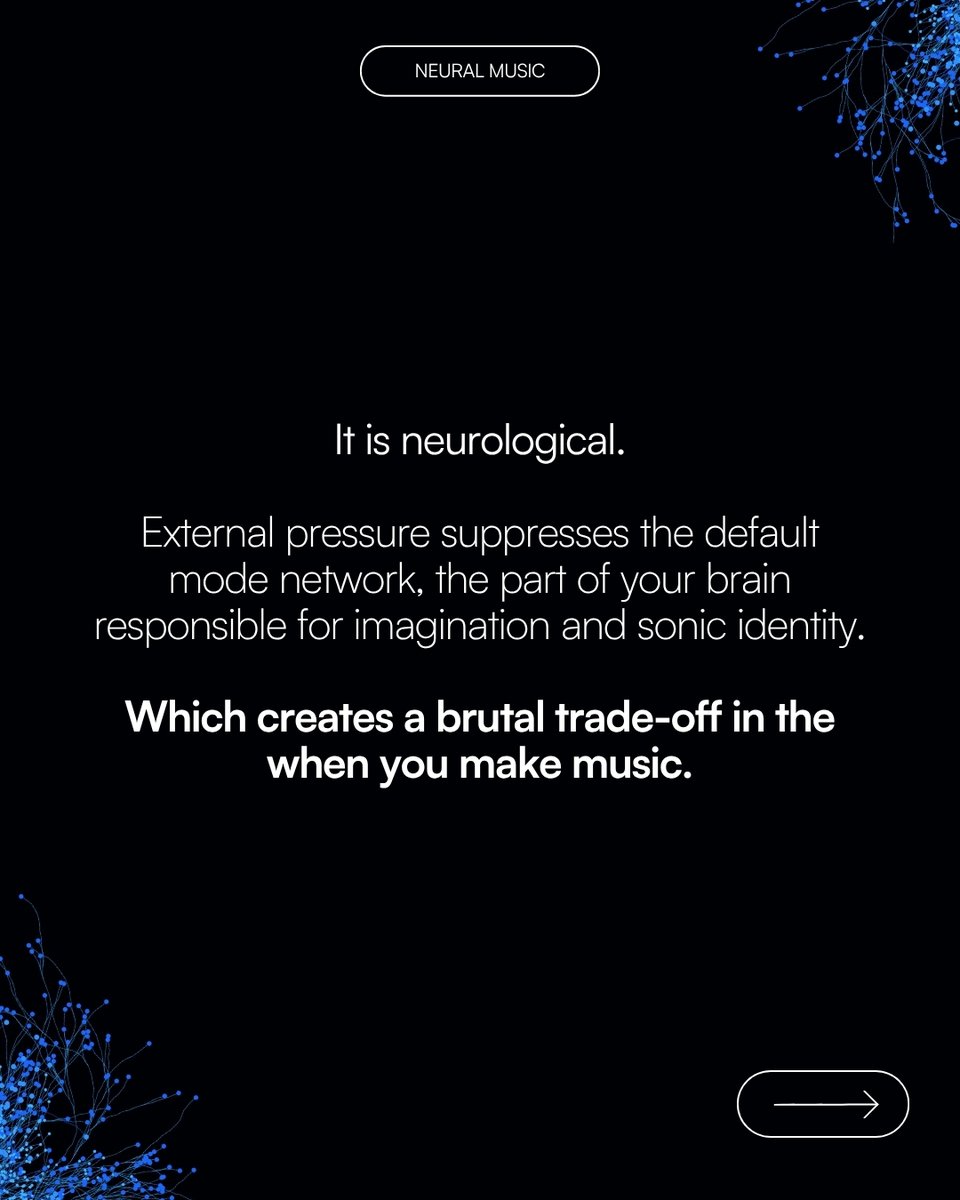
External pressure suppresses your default mode network — the part of your brain responsible for imagination, identity, and original thought.
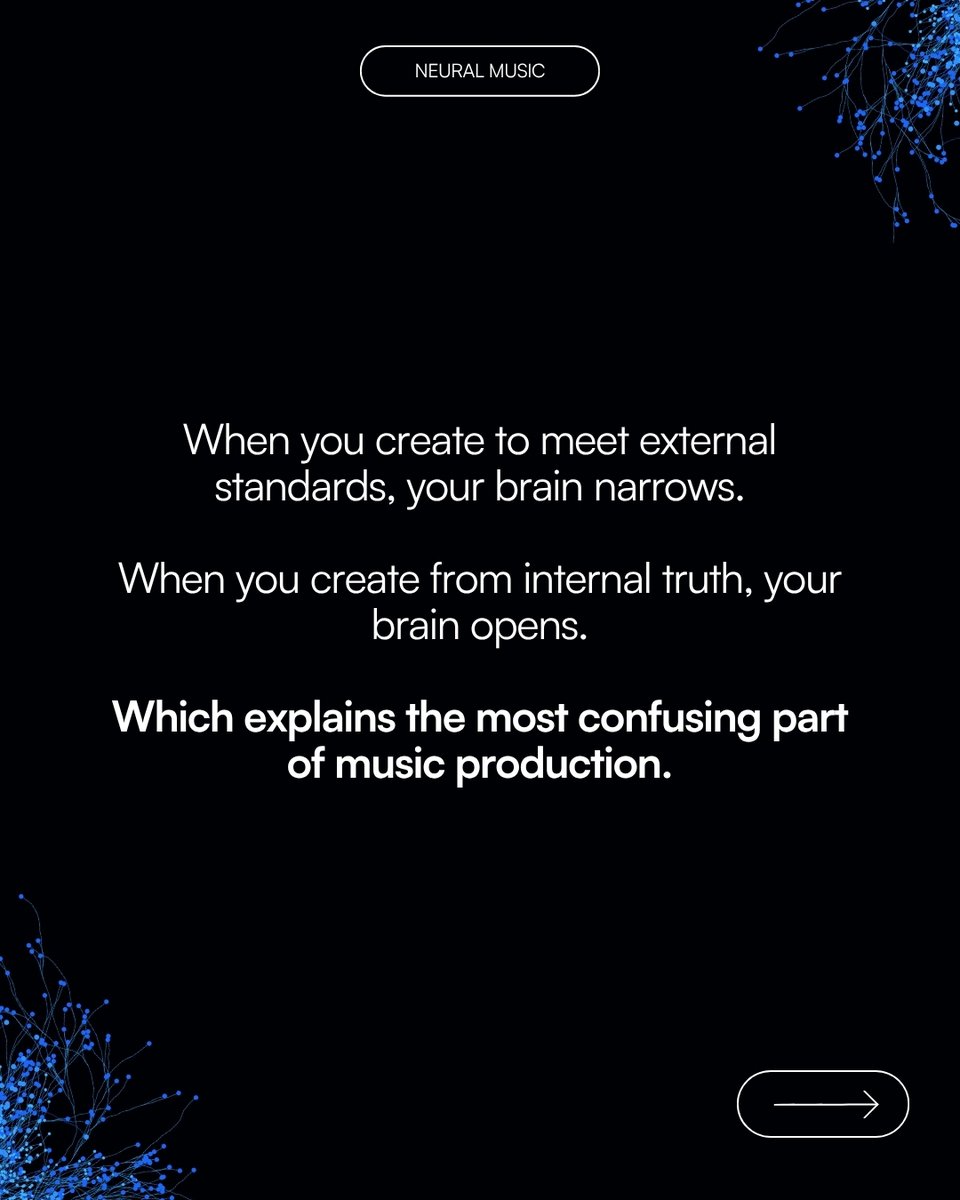
When you create to fit a trend that does not match your identity, your brain was barely in its most creative state when you made it.
The listener cannot explain why it feels off. But their brain can.
Stop asking: will they like this?
Start asking: does this feel true?
Save this for your next session. Share it with a creator who needs to hear it.
Tune Your Mind.
Comment "Join" and we will give you access to the Free Neural Music Newsletter and PDF
#neuralmusic #musicproduction #musicpsychology #creativemindset #sonicidentity
You're struggling to find your sound.
You're looking in genres, other artists, and trends.
But the film music industry has a secret that might change how you look at music.
Tune Your Mind.
Comment 'Join' for the free Neural Music Newsletter & PDF.
#neuralmusic #innersound #sonicidentity #soundarchitecture #musiccreator #musicproducer
Liking too many genres isn't a weakness. It's your greatest creative asset.
You simply haven't learned how to read it yet.
Tune Your Mind.
Comment "Join" for the free Neural Music Newsletter and PDF.
#neuralmusic#findyoursound#musiccreator#sonicidentity #musicneuroscience
Comment "Join" and we will give you access to the free Neural Music Newsletter and PDF
100,000 songs get uploaded daily, and yours probably sounds like the majority of them.
Think about your favorite artist. They stick out because of their unique identity. You cannot find anyone exactly like them.
So when you upload your next song, ask yourself: have I built this from my identity, or copied it from someone else's?
Because right now, you're probably making music that sounds 'good', but it doesn't sound like you.
Neural Music changes that. It turns your passions, memories, and life experiences into sound, not by copying genres, but by building your own from scratch.
In an ocean of music, identity is what stands out the most.
Tune Your Mind.
#neuralmusic #creativeneurosceince #musicidentity #creativepsychology #musicpsychology
What if the very thing you’re doing to “stay relevant” is quietly erasing your creative identity as a music creator?
Tune Your Mind.
Comment "Join" And we will give you access to the free Neural Music Newsletter and PDF.
#Neuralmusic#creativepsychology#creativeneuroscience #creativecomparison #innersound
Comment "JOIN" and we will give you access to the Free Neural Music Newsletter and PDF.
Einstein called intuition a sacred gift. Most artists have forgotten how to listen to it.
Your nervous system sends signals every time you create. That moment when a sound stops you mid-scroll, when something resonates before you can explain why, that is not random. That is recognition. Your brain matching what you hear against everything you have ever experienced.
But instead of listening, most creators override it. They replace instinct with strategy, trends, and formulas. And slowly, the signal goes quiet.
This post breaks down why instinct is compressed intelligence, how we lose connection to it, and how to tell the difference between real signal and noise.
The one insight Einstein captured: we have built a culture that honors logic and forgets the gift. But your sound does not come from analysis. It comes from listening to what your body already knows.
Start honoring the gift again.
Tune Your Mind.
#NeuralMusic #CreativeNeuroscience #CreativePsychology #CreativeInstinct #MusicInstinct