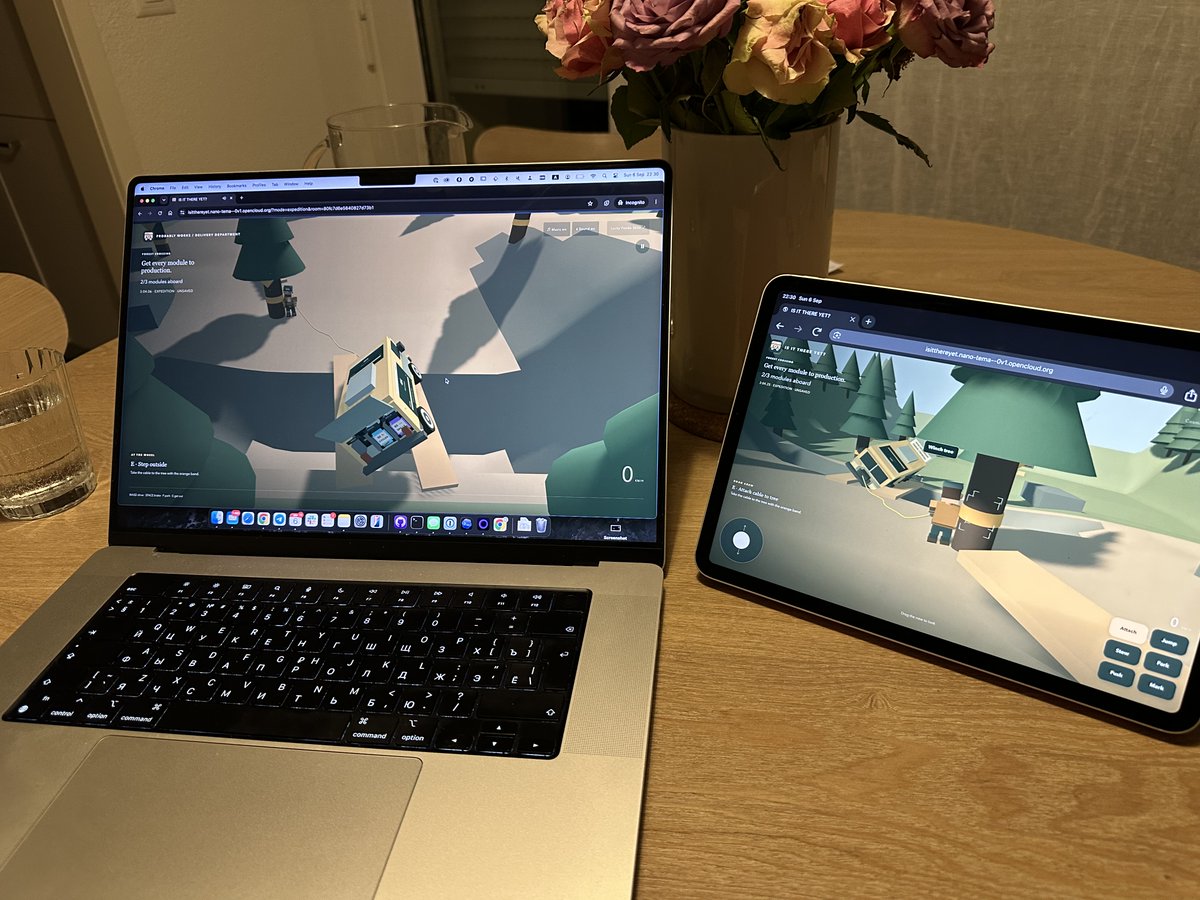
"Co-op next", I said yesterday.
Well, co-op is here.
You guys need to try harder though... the smallest #ICP nano cloud engine barely felt it.
Added a few more canisters (analytics + co-op rooms), and planks to get across the gaps.
Bring a friend and make it to production together.
This is exactly what internet-computer:native is about.
To drive home the point of decentralization: what if ICP really did take over so instead of a handful of cloud giants like Amazon and Microsoft, we’d have ICP instead? Wouldn’t that be just as bad (or worse, if we went from a handful of providers to just one)?
Nope, and that’s the whole point. Because ICP is a decentralized protocol, it means that independent providers collaborate under the protocol to run the service. Under ICP you can have hundreds, or thousands, or eventually millions of independent node providers that make up the Internet, rather than just a few giants.
ICP is not a competitor to AWS and Azure - it is a complementary protocol to TCP/IP that lets anyone become a competitor to AWS and Azure, on a level and fair playing field.
TCP/IP lets anyone send messages and be a message relay, ICP lets anyone become a cloud provider.
The Internet wouldn’t become more decentralized if we had several other competitor protocols to TCP/IP going, that would only fragment it. It is because a decentralized protocol emerged that everyone could agree on that the Internet at its core can be so decentralized.
In the same way, seeing ICP grow means seeing the decentralized Internet grow again, reversing the march towards centralization of cloud services that so far characterized web2.
The more resilient computing platform of the future that IMF, and increasingly others too, are asking for is exactly the use case that the Internet Computer Protocol was designed to serve. It’s encouraging that the demand for this use case seems to be growing.
Making simple games with GPT-6 Astra feels easy! really like a wish machine.
Building on #ICP + Cloud Engines does too!
Today I built a little game: your app is a bus, get it to production without losing your canisters or skills.
Co-op next. Shipping is a team sport 🙃
The United States really needs to start looking at the Internet Computer Protocol(ICP) if we’re going to keep our critical data, apps, and services safe. Using AWS or Google Cloud is getting more dangerous with each passing day — and the International Monetary Fund agrees. #ICP
@IcpayOfficial Great job. Consider LP farming too. Heard few people in the ecosystem are making a lot through MaxFI. If you could implement the same thing (tech of MaxFi, heard their APRs are very very great and their TVL has reached 10 million), it might be good for icpay, just a suggestion :)
How to get started with Caffeine Inference.
1. Open Inference from your Caffeine workspace.
2. Pick the tool you already build in. Claude Code, Cursor, and OpenAI comaptible tools.
3. Create an API key, then paste the config command Caffeine gives you.
4. Run the test, and watch your first request come back.
You stay in the tool you know. Caffeine runs the models behind it.
The private key that moves a Bitcoin never gets assembled anywhere. Nodes hold shares and sign jointly, which is how an @dfinity canister can spend real bitcoin:native with no bridge and no custodian. internet-computer:native ⬇️
https://t.co/ISDPBBnLQL
How do you evaluate the ICP network, when it’s so different from other networks? I don’t give financial advice, but I want to point at some differences that are worth keeping in mind.
DeFi blockchains like to measure Total Value Locked (TVL). That is, how much money is held in custody by smart contracts.
It’s easy to measure in that you can track on-chain where all the tokens are, and you can check the token values on exchanges, so you just multiply the amount of tokens locked up in smart contracts by the token price.
With the arrival of TEE/SEV-SNP subnets, ICP supports on-chain private state that even node operators can’t see. This means you can store secrets in canisters (even my paranoid LLM is coming around to this being a reasonable approach) such as valuable API keys.
An AI API key can represent a very high value indeed, and being protected by smart contracts and the network it ought to count towards TVL.
The point of boasting a high TVL is to show “our chain secures great value and yet we’re not getting hacked”. Storing API keys should definitely count towards such a claim.
Yet, there’s no way to just enumerate all the secret API keys stored on ICP and add up their values. And API keys are just one example of valuable secrets, where the value is obvious. Estimating the value of all the secrets ICP protects by keeping them secret is not really possible.
So that’s one example of how ICP has a much broader and harder to measure metric compared to other chains.
The story continues, and the point is further driven home, by considering public data in smart contracts. While it’s in the nature of the private data that we can’t know what’s there, making it impossible to count TVL, public data would be possible to analyze. Almost immediately, however, we run into the core issue: how do you place a value on public data?
What is a banger post worth? A token has an exchange rate, a social media post has no obvious price. What is a public, immutable log of admin actions in a game worth? How much for a collection of vacation pictures? According to old camera manufacturers they would be priceless, but even if we scoff at that, they’re also not worthless.
The inconvenient position we seem to land on is that it’s damn near impossible to estimate the TVL for an application platform like ICP.
Another metric people like to look at when evaluating blockchains is the transaction volume. The main reasons are that these transactions pretty directly represent economic value on a DeFi chain, and that many chains get a meaningful portion of their revenue from transaction fees.
But on ICP the average transaction is someone creating a social media post, or moving to the next room in a game. Some transactions represent sending money around, but it’s not generally the case like on other chains. Transaction volume doesn’t necessarily translate to economic activity.
So the main metrics we use to evaluate the health of other chains seem hard to apply to ICP. That certainly invites the question: is there some other way we can measure ICP that makes more sense?
The answer, of course, is Cycle Burn Rate (CBR). The purpose of ICP is to serve applications with compute and storage that they pay for with gas (cycles). The more cycles applications burn, the more valuable these applications must find it to run on ICP.
Instead of trying to estimate how much a company’s secret API key and their public website might be worth, we simply let the company make that calculation, and if they come up with an answer that makes it worth it for them to burn cycles on ICP, we can conclude that the value must be greater than the gas cost.
All we have to look at, then, to get a kind of floor on the value delivered (not really “locked”) to our customers is the CBR. When CBR goes up, we don’t have to know exactly how the newly deployed hit app places monetary value on the ability of its customers to post product reviews with proof of humanity attached, all we have to see is how much the CBR went up. The CBR is also the most direct measure of revenue to the network.
I wish I could wrap up this post with “and just look at our wonderful CBR!” - but I can’t. The CBR is still low. It pretty much proves that the network isn’t being used as much as one might hope yet.
You could interpret that as being early, or you might draw more negative conclusions. I am still hopeful.
So the point of this post is not to try to convince you that ICP is already successful and you’re just looking at the wrong metrics - looking at the right metric also reveals there isn’t much demand yet. However, if you’re interested in keeping an eye on ICP and be in the loop if the situation changes, and adoption starts to come, looking at classic metrics like TVL, transaction volume and transaction fee revenue might make you miss it if it happens.
Thus the takeaway from this post should be that the metric to keep your eye on should be the CBR. When it starts to climb is when it’s on.
NEW: The United Nations Development Programme partners with @Dfinity to pilot decentralized AI and sovereign cloud infrastructure across governments and civil society organizations.
When builders are shipping real products, amplify them.
Mozzi is doing some really interesting work on internet-computer:native, and even Dominic has called out its potential.
Definitely one to watch. 👀
In this video I walk through the basics of moxzi and the demos we have on the alpha site: https://t.co/1tnwvOH45f
Knights of the Round Table: Actors use an LLM to get smarter and hunt dragons and save citizens.
MoxDB: A simple Actor DB that shows progressive upgrading of actors using orthogonal persistance and self reporting and self healing indexes.
Your fingerprint as the login, a different identity for every app, and no seed phrase to lose.
How Internet Identity on internet-computer:native makes cross-app tracking structurally impossible ⬇️
https://t.co/U9XEBzKbq3
@BlockchainPill If LP farming is giving you better returns, then that’s probably a SIGN to allocate more TIME and CAPITAL there instead and follow what you believe is WINNING.
And yes, people should absolutely be respectful to creators but DFINITY / Community doesn’t owe creators anything :)
Motoko is a great language for LLMs. It’s very strict, which means better feedback to your AI trying to get things right. It could be a great target language in the AI age, but then it can’t be constricted to just running in ICP canisters. @afat just fixed that.
Mingle Pay is nearly live.
Take any payment, straight to you. Cards and crypto in one checkout, running entirely on the Internet Computer.
No server to run. No API key in your frontend. No escrow account. The money moves from the buyer to you, and we are never in the middle.
Customer addresses are encrypted with vetKeys before they leave the buyer's browser, to your identity. We cannot read them. Neither can the node providers. That is not a policy, it is cryptography.
And it runs behind Singularity Shield: a watcher that can hit the brake in seconds but can never resume, never move value, never change a setting. Plus a daily spend cap per currency, because a cap is a blast radius, not a fee.
· Cards, Apple Pay, Google Pay, PayPal, Klarna, Bizum, iDEAL, SEPA
· ckUSDC, ICP, ckBTC, ckETH straight from the customer's wallet
· Subscriptions on a single wallet approval, cancel by revoking it
· Every status change provable on chain
One link behind your buy button is the whole integration. Building on Caffeine? Drop in our SDK and take your first payment with Oisy this week.
https://t.co/uGgTTVRsHH · https://t.co/AftHw1xjRD @SingularityICP