I spend time everyday trying to convince myself other equities are worth focusing on but $IREN risk reward and moat are impossible to ignore. You are not prepared enough for what they will announce at Sweetwater
Esta semana ha pasado algo que, bien leído, es oro para la tesis de $IREN : Google ha tenido que alquilar GPUs a un competidor. SpaceX, que se quedó con la antigua xAI, le va a cobrar a Google 920 millones de dólares al mes desde octubre de 2026 hasta junio de 2029 por unas 110.000 GPUs de Nvidia. Cerca de 30.000 millones en total. Si lo bajas a lo que de verdad importa, sale a unos 11,5 dólares por GPU y hora. Y conviene parar aquí un segundo: Google, una de las empresas que más centros de datos construye del planeta, está pagando una millonada por alquilarle GPUs a un rival. ¿Por qué? Porque ni siquiera ella construye lo bastante rápido.
Y esa es, justo, la mesa en la que se sienta $IREN . Cuando hasta Google tiene que llamar a la puerta de un tercero y soltar 11,5 dólares la hora, el mercado te está diciendo una cosa muy clara: están desesperados. Y quien tiene megavatios, manda. $IREN tiene más de 5 gigavatios de potencia asegurada entre Texas, Oklahoma, Canadá y España. ¿Cuánto ha vendido? Solamente un 4%.
Y ahora, permíteme un poco de remember. Hace unos meses, mientras X se llenaba de subnormales diciendo "WEN DEAL, WEN DEAL" pidiendo un contrato a gritos, yo decía justo lo contrario: que cada día que pasaba sin acuerdo, brindaba. No por llevar la contraria. Por aritmética. Que firmar no era el problema, ojo. Vender unos pocos megavatios baratos a Microsoft fue la jugada maestra: con un 4% de su capacidad, IREN se ganó a un hiperescala de primer nivel, demostró que sabe construir y entregar a esa escala, y desbloqueó financiación a grado de inversión usando ese contrato como aval. Esos 2 USD por GPU y hora no fueron debilidad. Fueron el cebo barato que valida el modelo, demuestra la ejecución y paga todo lo demás.
Lo que no tenía ningún sentido era lo que pedía la grada: que $IREN siguiera malvendiendo el resto a la carrera. Porque el tiempo jugaba a su favor por partida doble. Por un lado, el precio del cómputo subía mes a mes, y eso lo reconoce hasta la competencia directa, por escrito, en sus informes a la SEC. Por otro, cada mes de espera era un mes más de potencia energizada, de ejecución demostrada y de volverse más imprescindible. Esperar no era estar parado de brazos cruzados. Era acumular precio y poder a la vez.
Y aquí está la regla que la grada nunca entendió: en una crisis de suministro como esta, el que tiene el recurso escaso pone las normas. $IREN ha dejado de ser el que busca que los gigantes lo validen, de hecho NVDIA lo ha elegido para llevar a la práctica sus últimos desarrollos. $IREN ahora es el que tiene la energía que esos gigantes necesitan para no quedarse atrás. Se acabó firmar con prisa y con descuento. De aquí en adelante, o el comprador acepta el precio, el plazo y las condiciones que marca $IREN, o se levanta de la mesa con las manos vacías. El que antes tenía que rogar un contrato es ahora el que elige cliente, plazo y tarifa. Ahora el precio lo pone $IREN.
$IREN: The cloud market's dark horse
I bet most $IREN bulls are starting to get increasingly exhausted by the price action. I certainly am.
However, as long-term investors, we should see day-to-day price action as nothing more than noise.
$IREN is particularly "noisy," which makes it an especially difficult hold. Yet in times like these, it's important to step back and refocus on the company's fundamentals rather than let price action sway one's emotions.
And the way I see it, $IREN's competitive standing is rapidly improving.
I recently came across an interesting research report by Goldman Sachs that highlighted the discrepancy between planned data center capacity and realized capacity.
Out of the ~18 GW planned to be commissioned over the past 6 quarters, only about ~11 GW actually got built.
Not only is the gap between planned and realized capacity rapidly widening, but the rate at which new capacity is coming online has actually declined over the past couple of quarters.
Much of this discrepancy comes down to power continuing to be a major bottleneck.
As grids get more and more constrained with lead times reaching 5+ years, many developers are moving toward behind-the-meter (BTM) generation (on site power generation), circumventing the need for grid connectivity.
Yet that comes with its own set of problems and bottlenecks. The end result is an increasing amount of delays and outright project cancellations.
This industry backdrop plays directly into the hands of $IREN, which now has 5.8 GW of secured grid-connected power across global jurisdictions.
The only reason the industry is switching toward BTM is that it's the only option if you don't want to wait in multi-year queues to secure grid connections. But don't get it twisted, grid-connected power remains the preferred option.
$IREN is in a unique position to capitalize on this structural bottleneck and become one of the few cloud providers that can actually bring on 5+ GW of compute capacity over the coming years.
I'd even go as far as saying that this structural advantage is the primary reason the $NVDA partnership came to be.
While $NVDA undoubtedly remains king of the hill, even they face a real dilemma that could cause cracks in their growth trajectory.
On the supply side, they have to come to terms with the fact that the gap between planned and realized data center capacity is widening, while the trend of new capacity coming online is actually decelerating.
This is the issue I just flagged, and it could act as a potential growth bottleneck for $NVDA, since fewer builds means fewer GPU sales.
Layered on top of this is the demand side. It's perfectly clear that demand for $NVDA's AI hardware remains insatiable. However, when looking closer, it's also apparent that competition is increasing.
Pretty much every hyperscaler is working on their custom chips (TPU, Trainium, Maia, MTIA), and not exclusively for internal use cases anymore, but increasingly to service the compute needs of large AI labs. Anthropic alone has signed deals worth billions for Google TPU and AWS Trainium capacity.
Then you obviously have the likes of AMD and Cerebras directly competing against the AI giant, trying to claim market share.
Taken in aggregate, these two issues could gradually lead to a growth problem for $NVDA if not addressed.
This is exactly where $IREN comes in.
They've got the largest secured power portfolio of any neo-cloud at 5.8 GW and growing fast, they develop 100% of their data centers themselves, and they're not building competing silicon.
That makes them the most reliable demand outlet $NVDA can partner with at scale.
The Sweetwater partnership, positioning the 2 GW campus as a "flagship DSX deployment," isn't $NVDA doing $IREN a favor. It's $NVDA solving its two biggest problems at once.
I'm sure you know the popular saying that "history never repeats, but often rhymes." I think today's neo-cloud market is somewhat similar to the dot com era search engine war.
Back then, the front-runners leading the race were AltaVista, Excite, and Yahoo, while Google was a latecomer that ultimately came out on top.
Today, the vast majority of investors in this space are declaring either $CRWV or $NBIS the obvious winners in the race to become the next hyperscaler.
However, I believe the real dark horse that the mainstream doesn't give much credit to is $IREN.
I believe they have all the ingredients to leapfrog every competitor in a short amount of time, in large part due to their structural advantages and pursuing the right long-term strategy from the get go.
The asset-light model, which both $CRWV and $NBIS have been leaning into, doesn't work well in capital-intensive industries, at least not over the long run.
It's somewhat of an oxymoron, since it seems intuitive that one way to circumvent some of the CapEx burden is to outsource from colocation providers.
Yet that approach leaves you with less control, less flexibility, and ultimately higher costs in aggregate in the form of operating expenses (the landlord also has to earn $).
I studied the Bitcoin mining industry for years, and the asset-light model was once a popular strategy around the 2021 bull market. While it proved to be a strong growth lever, it ultimately ended up being a disaster for anyone who adopted it.
Companies like $MARA are the perfect example.
$MARA heavily adopted the asset-light model and grew to become the largest $BTC miner, yet ended up as one of the most unprofitable public miners of all, leading to significant value destruction for shareholders over time.
Once it became obvious that asset-light wasn't a sustainable strategy, $MARA tried to pivot away from it by increasing self-deployments. But developing infrastructure in-house is a much harder discipline to master, and you don't simply switch into it overnight.
$IREN ultimately won the mining race last cycle by doing the exact opposite of $MARA from the start.
They developed all of their data center infrastructure in-house, backed by a seemingly unlimited pipeline of secured power, which ended up making them the fastest growing and most profitable miner of all time.
While the cloud sector has significant differences from the mining industry, the primary drawbacks of the asset-light model carry over.
Over time, it will become obvious to Wall Street and the broader market that this strategy sounds great in theory, but in practice leads to a stack of operational issues and severe margin compression.
Out of the two current front-runners, $CRWV and $NBIS, I think Nebius will do better. They've at least started moving toward a more diversified mix of self-owned capacity rather than purely relying on hosted colocation, which is the right direction even if they're still early in that pivot.
That said, as the $MARA example showed, developing in-house gigawatt projects at scale is not something you learn overnight.
It's clear to me that a player like $IREN, which has been building this discipline from day one, has the most realistic pathway toward sustained, profitable growth in this space.
In my view, $IREN is the dark horse that will end up winning the race. Thus overthinking today’s price action wouldn't do me any favors.
Cheers guys, have a great weekend! ✌️
The jobs report was a barnburner. Nonfarm payrolls increased by 172,000 versus expectations for 88,000, while prior months were revised higher by 93,000. Wage growth came in at roughly 0.3%. Yet the market sold off. In our view, the market is misreading the signal. It is assuming that stronger than expected employment and growth will cause a an acceleration in inflation. History would suggest otherwise. Productivity growth is running near 3%, while unit labor costs are hovering around 0.5%. Those are not the hallmarks of an inflationary boom. They are the hallmarks of healthy, productivity-driven growth that will lower inflation. Meanwhile, the yield curve continues to flatten despite a roughly 55% increase in oil prices year-over-year based on a three month moving average. In past cycles, an energy shock of this magnitude steepened the yield curve when the Federal Reserve was accommodating it. Instead, the bond market appears to be discounting something much more powerful: the deflationary impact of technological innovation, particularly artificial intelligence, which is beginning to increase productivity across broad swaths of the economy. If tensions with Iran ease and oil prices retreat, we believe inflation could move into negative territory before year-end. In our view, the Fed made a historic policy error when it raised rates aggressively into what was largely a supply-driven inflation shock in 2022. We do not believe the next generation of monetary policymakers will be eager to repeat that mistake. Notably, gold peaked on the day Kevin Warsh was appointed. The inflation trade may already be behind us. If our research is correct, the next phase of this cycle could be characterized by accelerating growth, declining inflation, falling interest rates, and a strengthening U.S. dollar. That combination would create a remarkably supportive backdrop for innovation-led equities and the technologies driving the next productivity boom. I discuss this framework in greater detail in this month’s episode of In The Know.
$IREN - Analyst ratings.
> Canaccord raises PT from $70 to $79.
> B.Riley raises PT from $88 to $96.
> Cantor Fitzgerald raises PT from $77 to $99.
> BTIG maintains PT at $80.
> Bernstein maintains PT at $100.
> Macquarie maintains PT at $90.
> Compass Point maintains PT at $105.
Source: TipRanks.
$IREN - Analyst ratings.
> Canaccord raises PT from $70 to $79.
> B.Riley raises PT from $88 to $96.
> Cantor Fitzgerald raises PT from $77 to $99.
> BTIG maintains PT at $80.
> Bernstein maintains PT at $100.
> Macquarie maintains PT at $90.
> Compass Point maintains PT at $105.
Source: TipRanks.
So $IREN the full picture in the last 30 days:
🤝 NVIDIA 5GW strategic partnership
💰 NVIDIA $2.1B investment at $70
📄 NVIDIA $3.4B 5yr AI cloud contract
🖥️ DSX digital twin with BE Networks
🖥️ Dell Blackwell $1.6B deal
🇦🇺 Australia 800MW
🇪🇸 Spain 490MW
📈 ARR raised to $4.4B
📊 Every analyst repricing up
💸 GB300 financing secured
🪩 Mirantis
Stock at $62 😐
The market is handing you a gift and calling it a meme stock 😂
$IREN In a new research note, Canaccord analyst Joseph Vafi raised his price target from $70 to $79.
Vafi, who ranks among the top 3% of Street stock experts, maintained a Buy rating on the shares.
“IREN continuing to trailblaze even against an industry backdrop that is moving pretty fast in its own right,” the 5-star analyst effusively said.
Vafi’s praise comes in the wake of Monday’s announcement that IREN had secured a $3.65 billion investment-grade financing facility, which will fund the remaining capital expenditures needed to support its $9.7 billion multi-year AI Cloud Services agreement with Microsoft.
Notably, says the analyst, although financing conditions for AI-related infrastructure investments have become increasingly favorable, IREN is the first company in the space to achieve investment-grade status, earning ratings of A from Fitch and A(low) from DBRS. While Vafi points out that those ratings were undoubtedly supported by its Microsoft contract, the significance for future fundraising efforts should not be sniffed at.
Investment-grade status gives IREN access to a much larger pool of capital than is typically available through high-yield debt or convertible equity financing. “We believe the rating agencies analyzed a number of factors here, including not only the creditworthiness of MSFT as an offtake partner, but also IREN’s track record to date in delivering AI cloud services” Vafi sent on to say. “We also believe the forecasted cash flows from this project also support this rating.”
With financing for the Microsoft project now secured, Vafi revised his return analysis upward, reflecting stronger-than-expected economics. IREN secured up to $3.65 billion in funding at SOFR (Secured Overnight Financing Rate) + about 2.2%, which was below his prior cost of capital assumptions and improved the project’s return profile. SOFR is a US benchmark interest rate that reflects the cost of short-term borrowing secured by US Treasury securities.
As such, he estimates "the project could generate an IRR (internal rate of return) of about 32% over the life of the Microsoft contract (5 years). If the GPUs remain useful for an additional two years beyond the contract and retain roughly half their original value, the seven-year IRR increases to about 36%. While the difference appears small in percentage points, IRR is a compounding measure, so even modest increases can translate into meaningfully higher total returns over time."
[PS Personally disagree on the IRR stuff ... but hey, I'm not a 3% top analyst !!]
I've initiated a position in $IREN in the overnight markets.
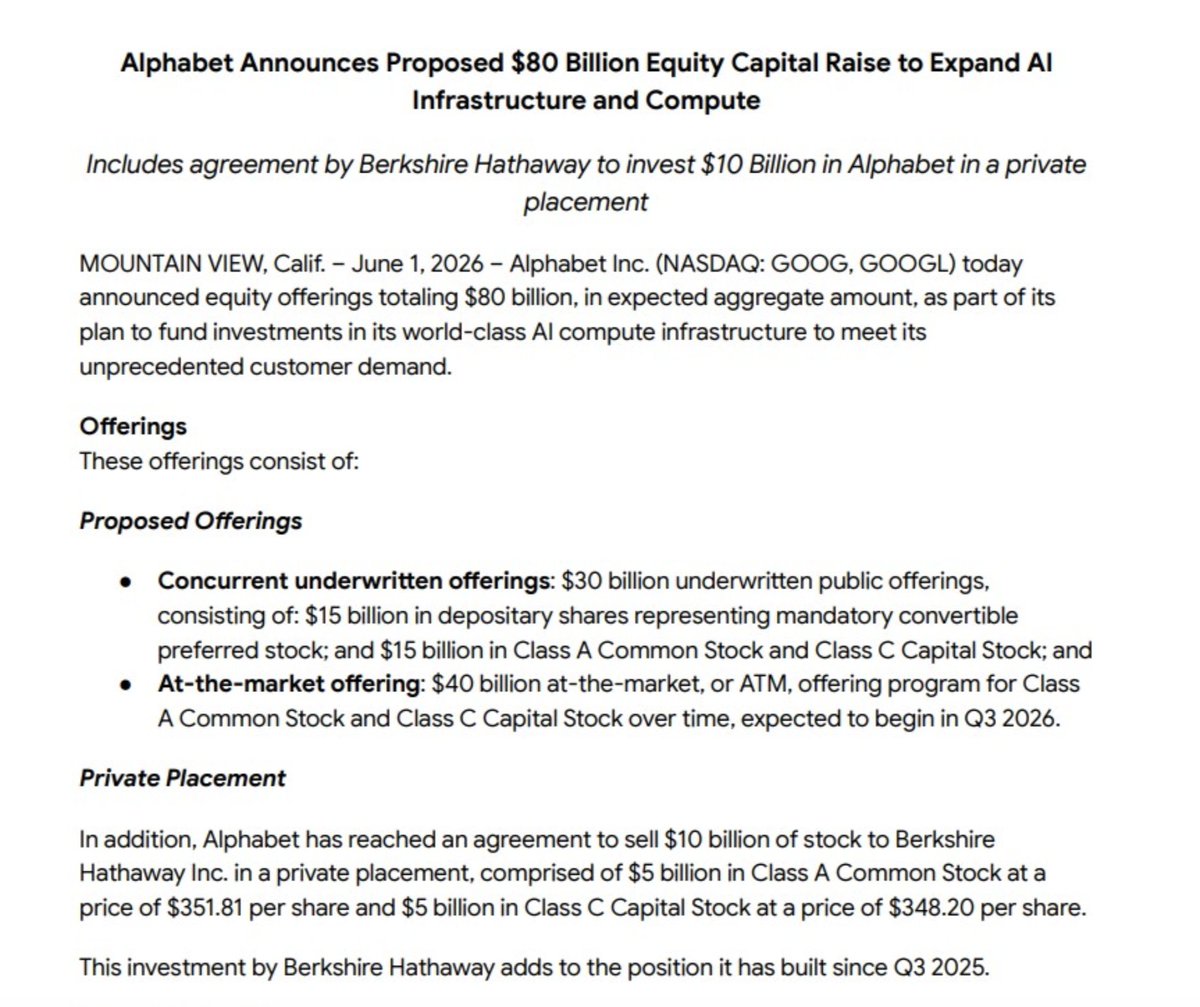
A few hours ago, Google just told the world something important:
Demand for AI compute infrastructure has reached a scale where even $174 billion in annual operating cash flow isn't enough. They're raising $80 billion more in equity on top of $100 billion in existing debt just to keep pace.
Sundar Pichai said "compute capacity" is what keeps him up at night. "Be it power, land, supply chain constraints, how do you ramp up to meet this extraordinary demand for this moment?"
His answer? Raise $80 billion in equity. Dilute shareholders. Do whatever it takes.
They already raised over $85 billion in debt across six currencies in the last year. Total debt balance now over $100 billion. And now back for $80 billion more in equity on top of that. 2027 capex expected to significantly increase compared to 2026's $180 to $190 billion.
This is not a company managing a growth cycle. This is a company in a full sprint that cannot build fast enough.
And that money does not stay inside Google's walls.
It flows downstream into the neoclouds, the power holders, and the companies sitting in the critical path of every dollar they spend.
I initiated a position in $IREN today as the catch-up trade in this space.
Here's why:
- IREN just signed a five-year $3.4 billion AI cloud contract with Nvidia to provide managed GPU cloud services for Nvidia's internal AI and research workloads. On top of that, Nvidia was given a five-year right to purchase up to 30 million IREN shares at $70 per share -> a right to invest up to $2.1 billion. The broader strategic partnership targets deployment of up to 5 gigawatts of Nvidia DSX-aligned AI infrastructure across IREN's global pipeline.
- Nvidia chose $IREN as a strategic partner. That is not a small thing.
- The stock still trades at roughly $4 to $5 per watt while CoreWeave trades at $26 per watt and NBIS at $20 per watt. The big names already ran. $IREN is the catch-up.
Now the risk I want to be honest about:
IREN's buildout is heavily dependent on external capital. Between Nvidia's share purchase right and a $2 billion convertible note offering, dilution and debt servicing are real risks. The ATM program is still active. If the stock re-rates upward, dilution could act as a ceiling slowing the move. Eyes open on that.
But Google raising $80 billion to meet demand that is outpacing their supply is exactly the macro environment where $IREN's pipeline gets filled. That is the trade.
And the options market agrees. $50 million in premium just hit on $IREN calls at a $110 strike expiring January 2027. That is highly unusual flow. Smart money is positioning.
In summary:
- Google raising $80 billion to fund AI infrastructure is the ultimate bull-signal for neoclouds.
-I believe neoclouds are about to go on another heater.
On top of my $NBIS, $CRWV, $DGXX, $APLD, $KEEL, $CIFR, and $WULF positions... I think it's finally $IREN's time to play catch-up. The options flow seems to agree, with there being over $50 million in premium for the $110 calls expiring in January 2027.
Not financial advice. Do your own research. I have a position of 6,000 shares at a $63.70 average cost.
@MichaelZ517@CernunnosCap@grok please explain the impact and importance of this IREN partnership like you are teaching freshman in college with barely any knowledge of data centers and compute
I guess the main point I’m getting at is you can’t entirely rule out SW1 announcement soon as a possibility. Yes i totally agree they likely know who is taking at least the initial block or two and they are just in deep due diligence/planning. As a developer myself i am well aware of all the issues that could push this out albeit on a much much smaller scale. I just think there’s a chance the dd has been ongoing for almost 6+ months and now the final items are things like plans to price, the pricing itself, sub contractor availability, VR timing from NVDA and idea on pricing from them and Dell etc etc. at the end of the day I obviously have no clue - just pointing out it’s also possible we aren’t too far out from something at this site.
@Bare_Birk@_Sgr_A_Star I understand and mostly agree with logic of sequencing deal announcements based on timing of gpus coming online, but there is still a very real scenario where $IREN gets the terms they want from OpenAI or Anthropic now for SW1 and it’s not impossible that gets announced before these other sites coming online sooner. I still think it’s less likely but there is definitely a non-zero chance that is playing out. Personally think Childress is next up for a “deal” but everyone needs a little hopium for a massive SW1 deal with chunks of 200-300MW coming online in stages. Someone at Iren has to get that a lot more doors open with backlog with a top client. ATM and converts could raise so much more money with a higher SP.
@Agrippa_Inv do you agree with @_Sgr_A_Star ? I want to, but when I throw everything into Claude it believes this is just the GPU financing that was announced in Feb actually closing and Bloomberg finding out the actual split/details? If this was something new/additional wouldn’t Iren have to announce it since it’s material. When no announcement came after hours it made me doubt things
when you say more funding are you just saying for the entire buildout or are you saying that the VRs for two more Horizons would be more than this amount? Correct me if I'm wrong am wrong, but isn't the typical order of events: IREN announces order of GPUs, then later announces financing for them? I guess with VRs not out yet maybe that doesn't apply here? Or is there a chance it's for more B300s to go in H5,H6? Very loosely understand this all so apologies if some of this is just way off.