"Activism is a way for useless people to feel important, even if the consequences of their activism are counterproductive for those they clam to be helping and damaging to the fabric of society as a whole."
— Thomas Sowell
At the 1966 Academy Awards, Lee Marvin accepted the Oscar for Best Actor, looked out at the most powerful room in Hollywood, and said: "I think half of this belongs to a horse somewhere out in Nevada." The crowd laughed. He wasn't joking.
The horse — a grey named Smoky — had appeared in every scene alongside Marvin's character in *Cat Ballou*, a legendarily drunk gunslinger who could barely stay upright. Smoky leaned, stumbled, and wobbled with such perfect comic timing that the American Humane Association gave the horse its own award that year.
Marvin dedicated his Oscar to the animal because he genuinely believed the animal had earned half of it.
That was the kind of man he was.
What nobody in that room fully understood was how he had learned to play that role so honestly.
June 1944. The island of Saipan. Lee Marvin was twenty years old, serving as a scout sniper with the 4th Marine Division, when Japanese machine gun fire tore through his unit. A bullet severed his sciatic nerve. He spent the next thirteen months in naval hospitals. He was one of only a handful of men in his company to survive.
He wept for the ones who didn't come home.
He had nightmares for the rest of his life.
After the war, he drifted into acting almost by accident — filling in for a sick actor at a community theater while working as a plumber's assistant. When people later asked where he'd learned to perform, he didn't mention training or technique.
"I learned to act in combat,"he said. "Trying to act unafraid when I was terrified."
That was the foundation beneath every cold-eyed villain, every broken soldier, every man stumbling through his last chance. He wasn't performing danger from the outside. He had lived inside it.
In *Cat Ballou*, he played two completely different characters — the shambling, heartbreaking Kid Shelleen and the terrifying villain Tim Strawn — and won the Oscar for both in a single film.
A first in Academy history.
He kept almost nothing from his entire career. Four things: the Oscar (half of which belonged to a horse, in his mind), a National Cowboy Hall of Fame citation, a gold record for a gravelly talk-sung ballad called *Wand'rin' Star* that somehow reached number one in the United Kingdom to the bafflement of almost everyone including Marvin himself, and one high-heeled shoe that Vivien Leigh had used to hit him with during a scene — kept purely out of affection for her.
Four objects. The rest was just work.
Lee Marvin is buried at Arlington National Cemetery.
His headstone lists none of his films. No Oscars. No awards. No credits.
Just four words of rank:
Lee Marvin. PFC. U.S. Marine Corps. World War II.
He knew exactly what mattered. He always had.
And somewhere out in Nevada, one very deserving horse will never know it shares a piece of Hollywood history with one of the most quietly remarkable men ever to walk across a stage.
Half the Oscar. All the character.
@jimiuorio@jimiuorio@Bob_Iaccino
Great episode with Dylan!
Those years on CNBC were the best. Haven’t tuned in since 2017.
Finally able to watch this. Tried twice before, suffering a loading glitch with my phone.
Thanks
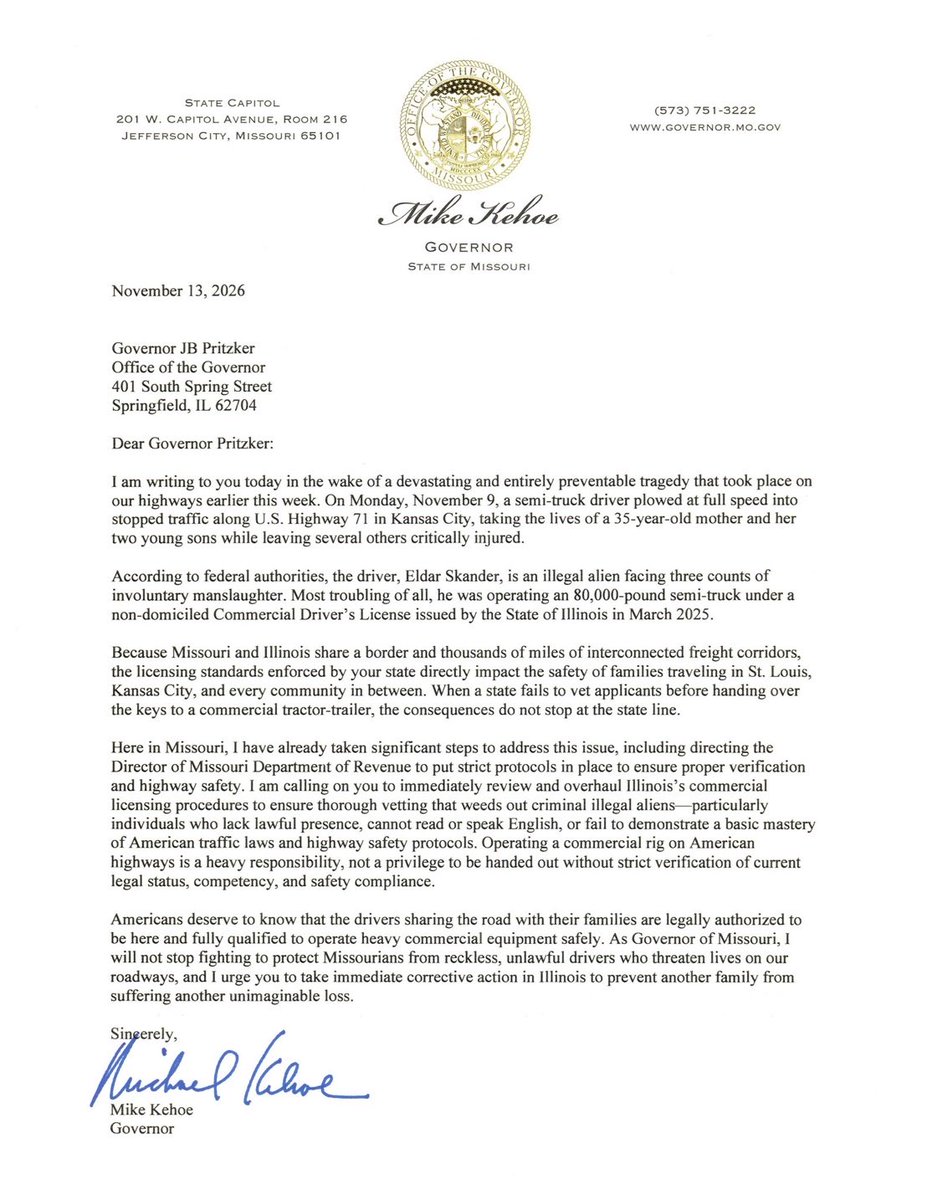
UPDATE: Missouri Gov Mike Kehoe just sent a letter to JB Pritzker SCORCHING him for giving CDLs to illegals after an illegal alien with an Illinois CDL kiIIed a mom and her two kids in Missouri.
“I am calling on you immediately review an overhaul Illinois’ commercial licensing procedures to ensure thorough vetting that weeds out criminal illegal aliens particularly individuals who cannot read or speak English or failed to demonstrate a basic mastery of American traffic laws.”
Thank you @GovMikeKehoe 🙏
The political reverberations of the Nvidia scandal seem hard to predict. On the one hand, it's obviously in Democratic interests to investigate not just Nvidia, but why the Trump administration has been so relaxed about advanced chip exports.
On the other hand, any investigation will emphasize the arms race aspect of AI development, and drive home the worries that China is doing everything it can to advantage its own firms in that race. Democrats have been positioning themselves to ride a wave of opposition to AI and datacenters. How does that political sentiment evolve if geostrategic competition becomes a more salient aspect of the issue?