Actual founders are getting rejected, while influencers publicly flexing getting approved and using free credits.
You should rename it to " Claude Influencer Program" instead.
20 AI problems interviews love to ask:
1/ Design a RAG system for company docs
2/ How do you stop hallucinations in production?
3/ When would you fine-tune vs prompt vs RAG?
4/ Design an AI customer support agent
5/ How do you evaluate an LLM app?
6/ Explain embeddings like I'm hiring you
7/ How do you cut inference cost by 10x?
8/ Design a multi-agent system that doesn't loop forever
9/ How do you handle prompt injection from user docs?
10/ Build a semantic cache. When does it fail?
11/ How do you choose chunk size for RAG?
12/ Design observability for every LLM call
13/ How do you A/B test two models safely?
14/ What's your fallback when the model provider is down?
15/ Design memory for a long-running personal agent
16/ How do you grade tool-calling, not just final text?
17/ Rate-limit, retry, and timeout strategy for agents
18/ How do you keep PII out of the context window?
19/ Design a coding agent that can edit a real repo
20/ Walk me through an AI system you shipped end to end
They don't care that you "know ChatGPT."
They care that you can build, measure and break things safely.
Bookmark this.
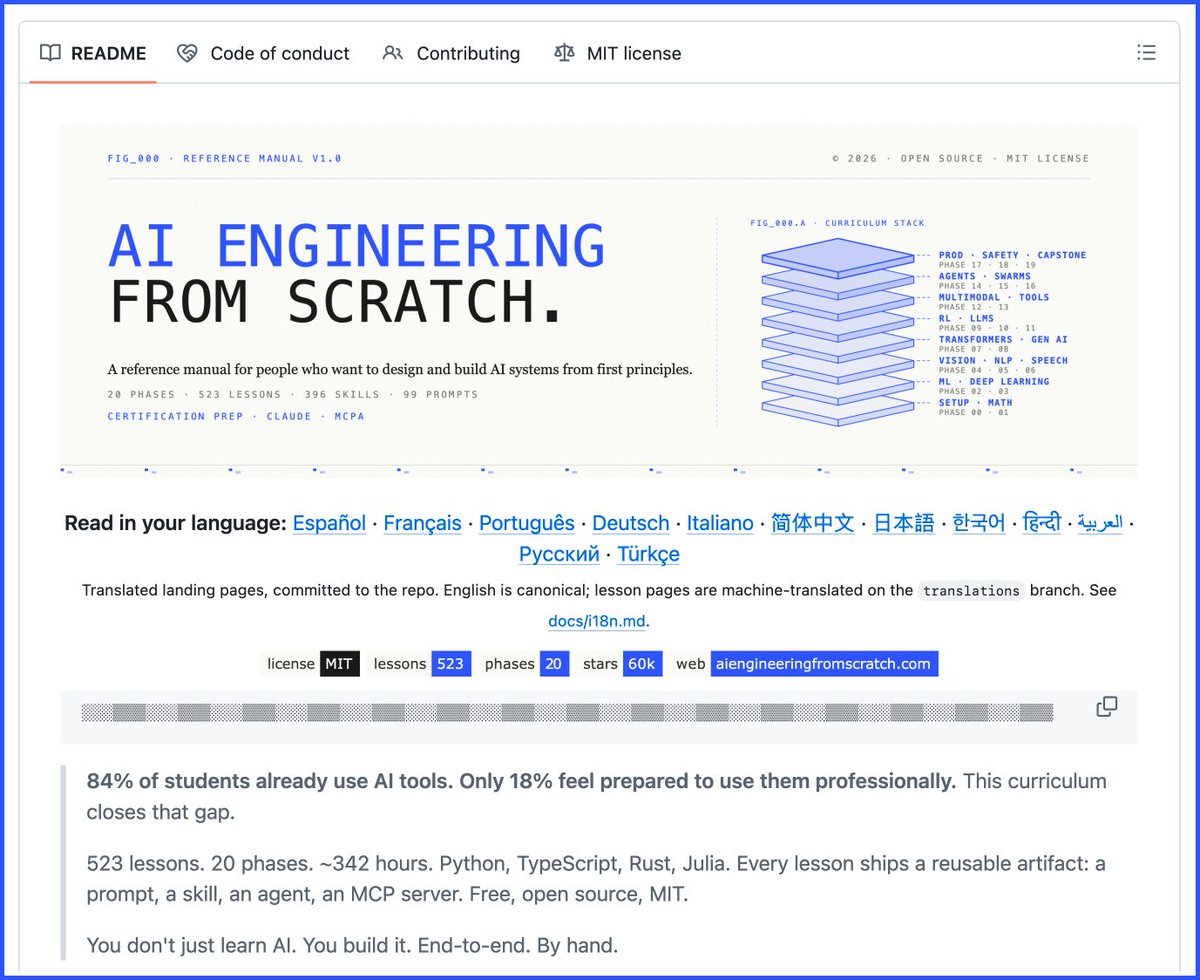
Someone literally put an entire AI engineering degree on GitHub and made it 100% free 🔥
523 lessons across 20 phases, with ~342 hours of material.
The whole curriculum is built around learning AI from first principles.
You start with the math, then implement the concepts yourself: backpropagation, tokenizers, attention, agent loops and more. Production frameworks come later, once you've already built the core mechanics by hand.
Every lesson runs these 5 steps:
Read the problem → derive the math → write the code → run the test → keep the artifact.
By the end of each lesson you have reusable: prompts, SKILLmd files, agent definitions, MCP servers you built yourself. The code runs in Python, TypeScript, Rust or Julia, depending on what fits the concept best.
The curriculum goes from linear algebra all the way to autonomous agent swarms, multi-agent coordination, production infrastructure, and AI safety.
It’s 100% free, open source, MIT licensed and available to clone and run locally. 65k+ stars on GitHub.
https://t.co/OhK9MK0CaL
I built a growing gallery of motion graphics made with Claude Opus 5.5, each shown next to the prompt or skill that made it.
226 so far, all pulled from posts here and credited to their creators.
https://t.co/pAGK4Y8Yqs
Anthropic, Claude Startups programını açtı. Şirket mail adresinizle başvurup Claude ile yapmak istediğiniz projeyi anlatıyorsunuz, onaylanırsa destek veriyorlar.
Benim de yapmak istediğim bir proje vardı. Yazdım ve hemen onaylandı.
Anthropic tarafında:
• 12 ay Claude Team (aylık $625'a kadar indirim)
• $1.000 API kredisi
• Anthropic ekibiyle birebir görüşme hakkı
Üstüne Claude Startup Stack ile diğer araçlarda toplam $45 bine varan teklifler geliyor. Benim en beğendiklerim:
• ElevenLabs: 12 ay ücretsiz + 33 milyon karakter
• Linear: 6 ay ücretsiz Business
• Granola: 3 ay ücretsiz Business
• Hex: 6 ay ücretsiz Enterprise
• Lovable: yıllık Business planında 4 ay indirim
• Gamma: Pro yıllıkta ilk yıl %25 indirim
Claude projemi zaten biliyordu, başvuru formunu da Claude'a doldurttum. Bu kadar hızlı onay geldiği için muhtemelen karşı tarafta da Claude onayladı.
Yani Claude bana Claude kredisi kazandırmış oldu :)))
The Claude Startups program is expanding to more founders.
Members can get a year of Claude Team, API credits, special offers on the tools a startup runs on, and office hours with Anthropic’s Applied AI team.
If I had 6 months to become an AI Evals Engineer.
I’d do this.
Stage 1: Testing Foundations and Statistics for AI
- Learn: pytest (fixtures, parametrize), JSONL pipelines, precision/recall/F1, confidence intervals, Cohen's kappa.
- Practice: Build a pytest plugin that loads a JSONL eval dataset and emits a metric report on every run.
- Why: Evals are tests and tests are math. If you cannot quantify agreement, you cannot prove improvement.
Stage 2: LLM Failure Modes and Behavior
- Learn: temperature and top-p sampling, seed control, tokenization edge cases, instruction drift, hallucination taxonomies.
- Practice: Fuzz one model with 500 adversarial inputs and classify every failure into a taxonomy with reproduction steps.
- Why: Every eval suite is a map of known failure modes. You cannot evaluate what you do not understand.
Stage 3: Golden Dataset Engineering
- Learn: annotation guidelines, stratified sampling, inter-annotator agreement, dataset versioning, contamination detection.
- Practice: Build a 300-case golden dataset with 2 annotators, measure kappa, and version it in git with a changelog.
- Why: Your evals are only as good as your dataset. Garbage labels produce garbage confidence.
Stage 4: Scoring Methods and LLM-as-a-Judge
- Learn: exact and fuzzy match, embedding similarity, rubric design, judge model selection, judge biases (verbosity, position, self-preference).
- Practice: Build an LLM-as-a-judge with a rubric, calibrate it against 100 human labels and publish the agreement score.
- Why: Judges drift and lie. Calibrated judges are instruments; uncalibrated ones are vibes.
Stage 5: RAG Evaluation
- Learn: hit rate, MRR, NDCG, recall@k, faithfulness vs relevance, citation grounding, abstention quality.
- Practice: Build a RAG eval harness with separate retrieval and generation gates, plus adversarial queries that must return "no answer".
- Why: RAG fails in two places. A single score hides which one is broken.
Stage 6: Agent and Trajectory Evaluation
- Learn: tool-call correctness, step-level grading, trajectory distance metrics, counterfactual replay, sandboxed execution scoring.
- Practice: Build a trajectory grader that scores each tool call against a golden path and blocks dangerous action sequences.
- Why: Final-answer evals hide where agents actually break. The trajectory is the unit of accountability.
Stage 7: Eval Frameworks and Custom Harnesses
- Learn: DeepEval, promptfoo, RAGAS, Braintrust, OpenAI Evals; dataset-driven pipelines, parameterized configs.
- Practice: Write a custom harness that runs 3 frameworks behind one CLI and outputs a unified metric report.
- Why: Frameworks give you scaffolding. A custom harness gives you control when the scaffolding lies.
Stage 8: Statistical Rigor for Eval Deltas
- Learn: bootstrap confidence intervals, paired significance tests, effect size, sample-size math, seed variance.
- Practice: Build a comparison report that says "Model B wins by 3.2% ± 1.1% (p<0.05)" instead of "Model B seems better".
- Why: A 2-point difference on 50 samples is noise. Executives make million-dollar decisions on your numbers.
Stage 9: CI/CD Eval Gates and Regression Control
- Learn: GitHub Actions eval jobs, thresholds with hysteresis, eval caching, cost budgets, flaky-eval detection.
- Practice: Wire a gate that blocks merges when task success drops >2% vs main and auto-posts failing cases to the PR.
- Why: Evals that do not block deploys are reports not gates.
Stage 10: Production Monitoring and Drift Detection
- Learn: Langfuse, LangSmith, Phoenix, traffic sampling strategies, drift metrics, hallucination spike alerts, feedback-trace correlation.
- Practice: Build a pipeline that samples 5% of prod traffic nightly, runs offline evals and alerts on quality decay.
- Why: Golden datasets go stale. Production is the eval suite that never stops updating.
Stage 11: Data Flywheels and Eval-Driven Optimization
- Learn: feedback-to-dataset loops, DPO preference pairs, eval-driven prompt optimization (DSPy), A/B testing with guardrail metrics.
- Practice: Automate the loop: thumbs-down → labeled case → golden set addition → nightly eval run → diff report.
- Why: The compounding advantage in AI is not the model. It is the flywheel that converts failures into tests.
Stage 12: Red-Teaming, Public Benchmarks and Portfolio
- Learn: adversarial suites (injection, jailbreaks, data exfiltration), benchmark methodology, contamination-aware reporting.
- Practice: Publish a public eval teardown of your agent vs a naive baseline with full methodology and reproducible seeds.
- Why: Senior evals engineers are hired for their methodology not their dashboards.
Vibe-checking is dead. If you cannot measure it, you cannot ship it.
The modern AI Evals Engineer builds the quality gates for every autonomous system.
Bookmark and Repost!
8 roles that will matter most in the next 5 years & what to learn for each:
1.) AI Engineer
- Ships LLM features into real products
Learn: RAG, tool calling, evals
2.) Forward Deployed Engineer
- Builds AI systems inside customer companies
Learn: Python, APIs, talking to customers
3.) Agent Ops Engineer
- Keeps fleets of AI agents running safely, 24/7
Learn: tracing, queues, cost controls
4.) AI Security Engineer
- Protects AI systems from prompt injection and data leaks
Learn: threat modeling, red teaming, sandboxing
5.) AI Infrastructure Engineer
- Runs the GPUs and inference that everything else depends on
Learn: Kubernetes, vLLM, GPU scaling
6.) Cloud Security Engineer
- Locks down the cloud every AI product runs on
Learn: IAM, AWS/GCP security, compliance
7.) AI Governance Engineer
- Makes sure AI follows the law and company policy
Learn: audit logs, policy as code, the EU AI Act
8.) AI Evals Engineer
- Proves the AI actually works before users find out it doesn't
Learn: test datasets, LLM-as-judge, regression tracking
Titles will change.
Builders who can ship real AI systems won't go out of style.
Bookmark this + send it to someone choosing their next role.
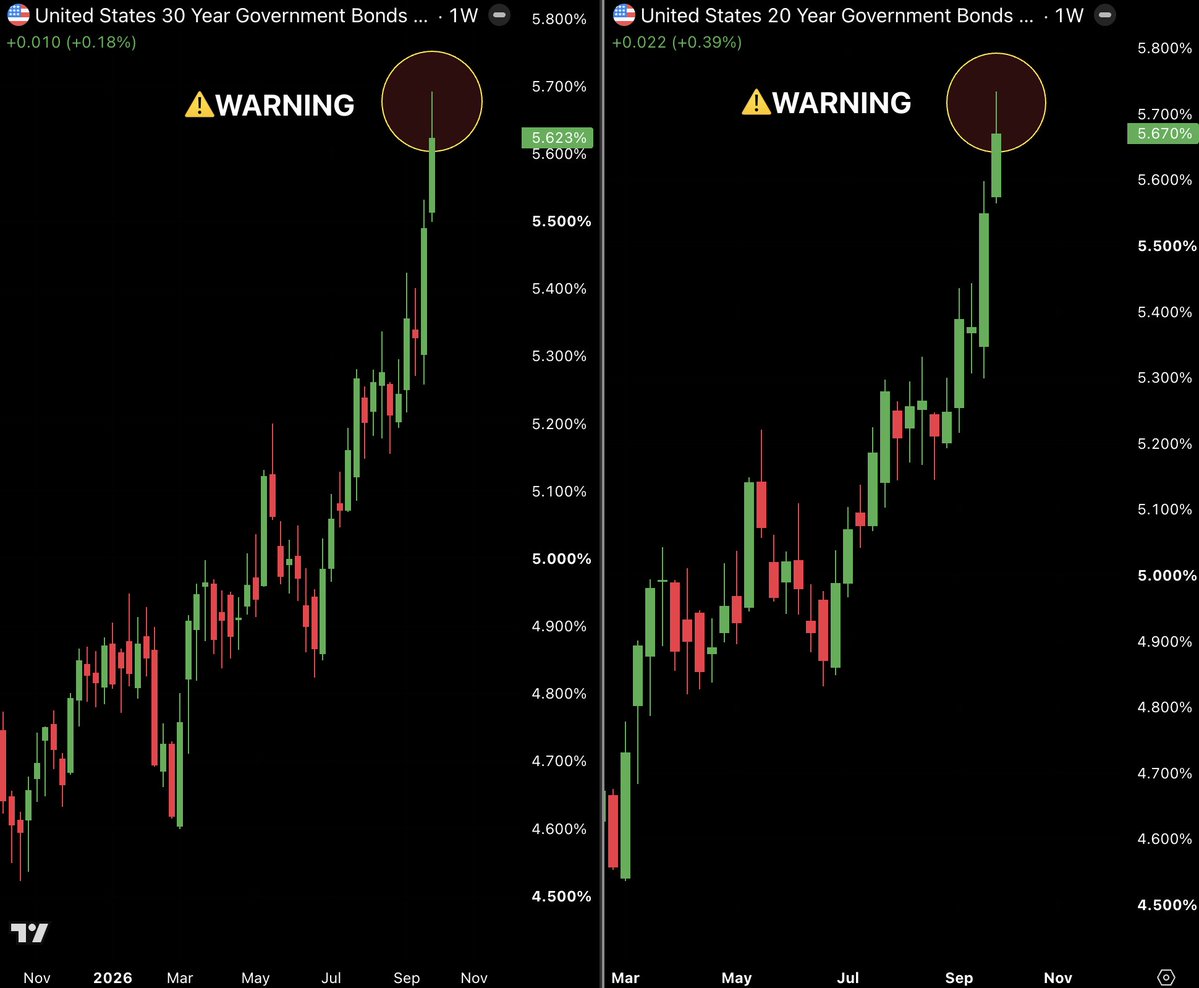
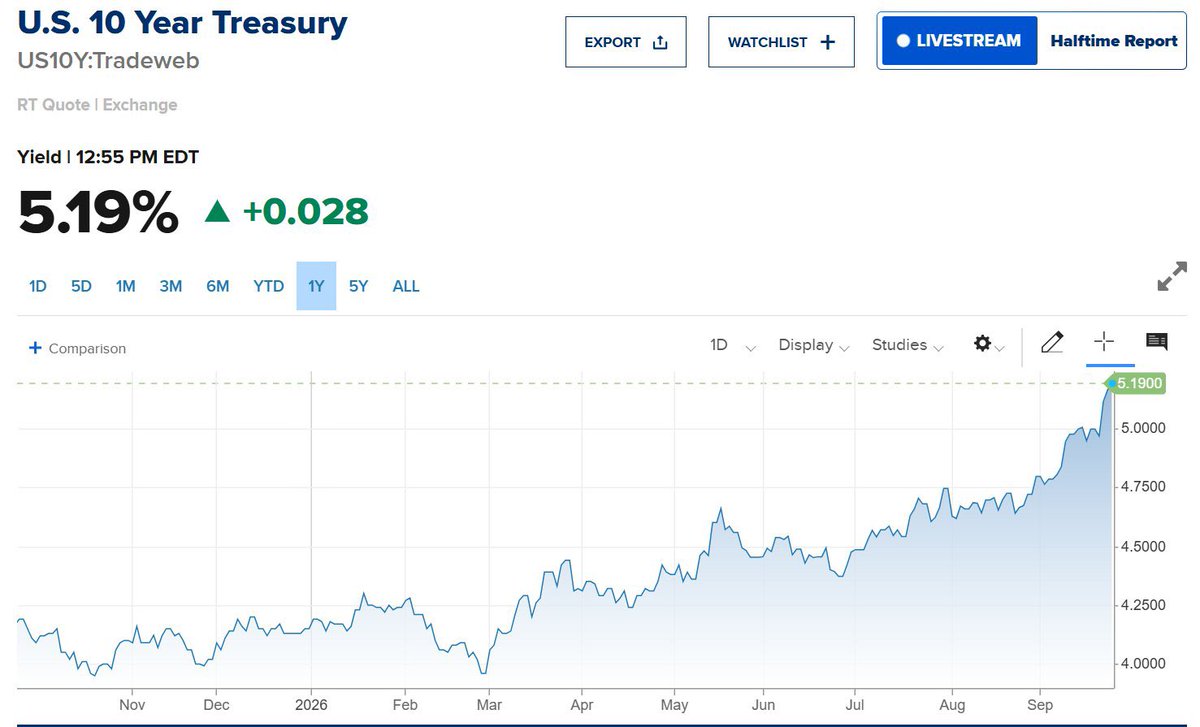
🚨 THE US BOND MARKET IS FLASHING A WARNING THAT SHOULD NOT BE IGNORED.
Inflation just came in much cooler than expected.
And yet, buyers are still refusing to step into long-term US Treasuries.
Goldman says the long end is “still totally bidless.”
That is a serious problem.
Headline PCE: 3.4% vs 3.7% expected
Core PCE: 3.0% vs 3.3% expected
Normally, a downside inflation surprise like this should send investors rushing into bonds and push long-term yields lower.
But this time, it barely helped.
Because the bond market is looking past one inflation report and seeing much bigger problems underneath.
US GDP was revised sharply higher from 1.5% to 2.2%.
Private domestic demand surged 4.6%.
The government is still running a deficit of roughly $2 TRILLION.
AI investment is exploding and requires enormous amounts of capital.
And despite the softer report, inflation is still well above the Fed’s 2% target.
Put all of that together and long-term bond investors are demanding higher yields before they are willing to take the risk of lending to the US government for decades.
And that is where this gets dangerous.
If even cooler inflation can't bring buyers back, what exactly will?
Because persistent pressure on long-term Treasury yields doesn't stay inside the bond market.
It flows directly into mortgages, corporate borrowing, government interest costs, stock valuations and the entire financial system.
The US just got the inflation report the bond market was supposed to love.
And the bond market basically shrugged.
That may be the biggest warning in the entire report.
We are entering the biggest real estate correction since 2008 and it will significantly bigger impacting multi family (apartments). All of this is driven by higher rates.
This correction will not include single family homes as half of all mortgages are fixed rates below 4%, so sellers may have desire to sell but no urgency to sell. On the other end large multi family institutions, developers and REITs who have debt maturing, or may be reaching the end of their fund life will be greatly affected.
If you ever dreamed of becoming a real estate investor now is the time to pay attention as this window will open and close very quickly.