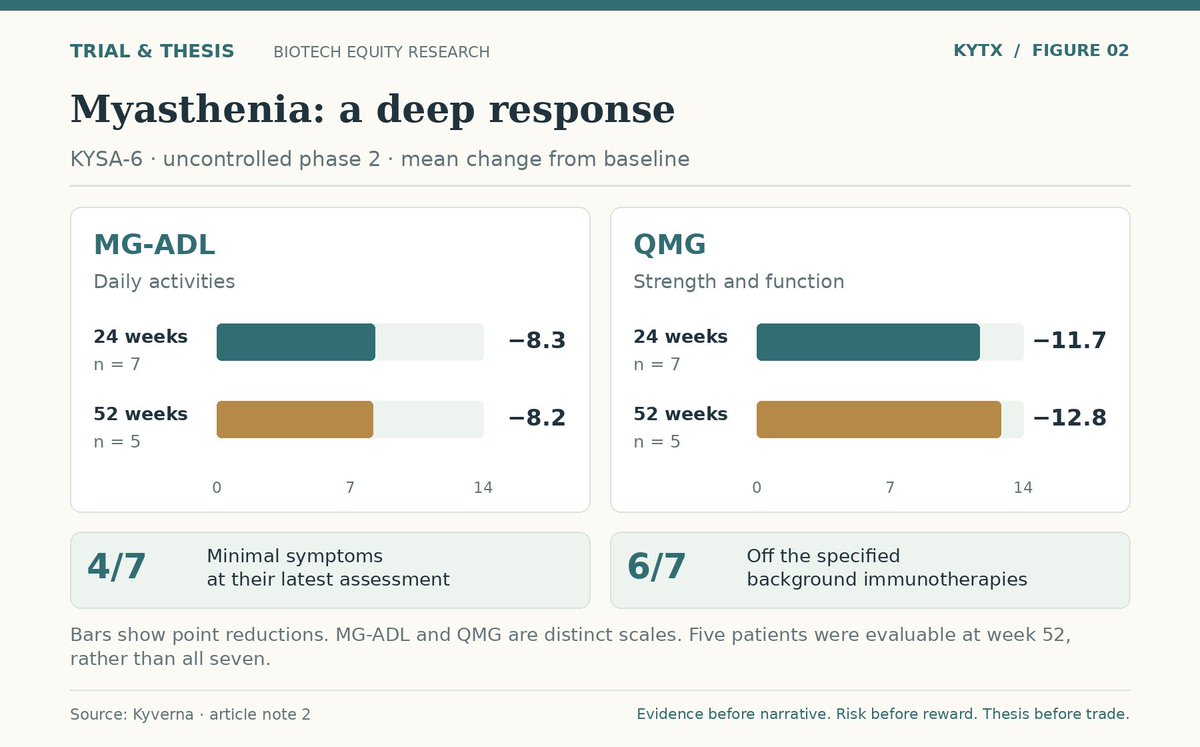
Our deep dive on Kyverna $KYTX is now live.
Writing these pieces helps us organize our own thinking as much as anything else. This one took us through SPS, gMG, safety, competition, cash, the pipeline and ultimately what the company could be worth.
As always, different views are very welcome. That’s part of the reason we publish our work.
https://t.co/qHKYfZiREl
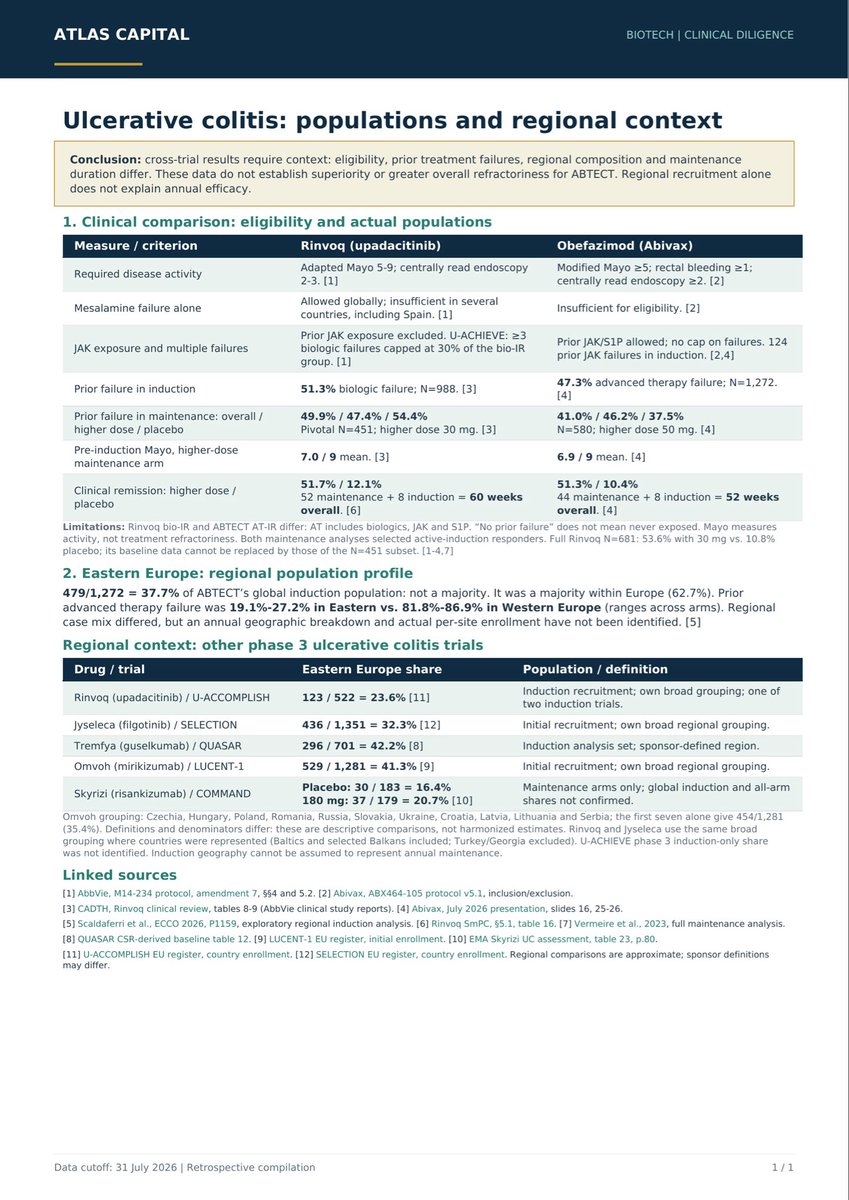
I actually agree with you on Eastern Europe. It matters, and we’ve seen geography affect UC trials before. But I think you have to go a bit deeper than that before calling the $ABVX data a “trick.”
We looked at this months ago. ABTECT had 37.7% of its global induction population from Eastern Europe. That’s meaningful, but it’s not something unique to obefazimod.
We also went back and looked at the regional mix across other major UC Phase 3 programs — Rinvoq and Skyrizi $ABBV, Tremfya $JNJ, Omvoh $LLY and Jyseleca. Depending on the trial and definition, Eastern European enrollment ranged from ~16–42%. These aren’t perfect apples-to-apples comparisons, but that’s exactly the point: geography needs context.
Then look at who ABTECT actually enrolled. It included 124 patients with prior JAK failure, while prior JAK exposure was excluded with Rinvoq. In higher-dose maintenance, prior advanced-therapy failure was 46.2% with obefazimod vs 47.4% prior biologic failure with Rinvoq. Different definitions, yes. Baseline Mayo was also 6.9 vs 7.0.
And the remission delta vs placebo was 40.9 pts for obefazimod vs 39.6 pts for Rinvoq. I don’t see an unusually high placebo response explaining away the result either.
I genuinely like having a thesis challenged. Before putting money into any biotech, I usually try to break the thesis first.
I’m not defending $ABVX blindly because I own it. We’ve spent a lot of time on this company, and the Eastern Europe question was something we’d already looked at months ago. The deeper I’ve gone into obefazimod, the trial design and the patients enrolled, the more solid the data look to me.
So yes, Eastern Europe matters. We agree on that. I just think you have to look at the whole picture before jumping from “Eastern Europe” to “$ABVX tricked investors.
This post sent me down a bit of a rabbit hole — thanks @DoodadDoctor.
We started digging through the full ESMO LBA program and found something I honestly didn’t expect:
29 of the 84 LBAs we identified involve a Chinese company. 34.5%.
At a European oncology congress.
Looking at this, I can’t help thinking that some investors saw this wave coming much earlier than I did.
China isn’t just supplying molecules anymore. It’s becoming a major force in global drug development — and I think it’s worth looking well beyond oncology too.
Quite a few datasets are still under embargo, but there’s already a lot to dig into here. Probably enough for 3–4 Substack pieces.
I’ll try to get some out before ESMO, although going through all of this properly is going to take a lot of work.
Thanks Mike. We hadn’t seen the slide you posted — you actually made me open Twitter again 😂. At the later time points we’re only looking at 1 patient for MG-ADL and 2 for QMG, so we can’t extrapolate that tail of the curve to the whole cohort yet. But if this depth of response holds as more patients reach longer follow-up, it would be pretty incredible. Really appreciate you sharing this, man.
I’ve spent the last few days digging into $KYTX.
The SPS data first caught my attention. The myasthenia results made the story much more interesting.
There’s a lot to like here, but also some important questions still to answer.
Full Trial & Thesis deep dive in one hour.
Would be nice if that was the bottom and $KYTX just went straight up from here to infinity 😂. Hopefully you’re right, Mike.
Technical analysis really isn’t our thing, so when we’re looking for certain entry points we sometimes ask friends who know a lot more about it than we do.
Anyway, enough Twitter for now. Too much work today.
And please don’t ask us what we think a large pharma should pay for $ABVX or for obefazimod. We obviously think the number could be substantial, but an acquisition price depends on far too many variables: competitive interest, timing, deal structure, strategic fit, remaining development risk and ultimately what a buyer is willing to pay. We simply can’t put a serious number on that today.
What should be clear from everything above is that we believe the fundamental value of this asset is significantly higher than what the market is currently assigning to it.
This is, of course, our view. If you see it completely differently or think we’re missing something, we’d genuinely like to hear it. Different views are always welcome. That said, IBD is a market we know particularly well, and this is where our analysis leads us today.
Well… this somehow turned into half a Substack article 😂
Hope it helps. Or at the very least, gives you something to think about.
Seeing a lot of nervousness around $NKTR and $ABVX lately, so a few thoughts.
I’ve looked at Nektar, but not deeply enough to have a real investment view. Rezpegaldesleukin looks interesting, particularly in atopic dermatitis. But when I haven’t done the work, I’d rather say nothing than pretend I have an opinion.
Our current estimate for $ABVX obefazimod peak sales in ulcerative colitis alone is roughly:
Bear: ~$2.5B
Base: ~$5.0B
Bull: ~$7.0B
Exceptional: ~$8–9B
We tend to be quite conservative with our assumptions whenever we publish an article or discuss a company. In this case, I’m deliberately not trying to be conservative. I’m trying to be as realistic as I can about what this asset could actually achieve if everything falls into place.
The simplest way to explain our thinking is this.
What makes obefazimod so compelling to us is that the Phase 3 efficacy looks Rinvoq-like, in the territory of what we see with 45 mg induction and 30 mg maintenance, while the safety profile so far looks much closer to what you would want from a drug like Entyvio (vedolizumab).
That combination could be exceptional: Rinvoq-level efficacy without the JAK baggage.
Rinvoq has set an extremely high efficacy bar in UC, but that efficacy comes with meaningful baggage. It carries a boxed warning in the US, and in Europe JAK inhibitors should only be used when no suitable alternatives are available in patients ≥65 years, patients with cardiovascular risk factors, current or long-term former smokers, and patients at increased risk of malignancy.
There is also the acne issue. Published IBD data show that acne is particularly common with upadacitinib, and real-world experience suggests that in some patients it can become significant enough to require dermatologic treatment, dose modification or even discontinuation.
Then there is Velsipity (etrasimod), Pfizer’s oral S1P modulator. We mention it because it is another oral UC therapy, not because we currently view it as meaningful competition to obefazimod. In our framework, we essentially discount it as a major competitive threat. It also introduces its own prescribing friction, including ECG, laboratory and ophthalmic assessments before treatment, with additional cardiac evaluation in selected patients.
This is why we think the eventual obefazimod label may be almost as important commercially as the efficacy data themselves.
Our Base/Bull scenarios assume a genuinely clean label: no boxed warning, no major cardiovascular monitoring burden, no major prescribing restrictions and no treatment-limiting safety signal emerging with broader exposure, while maintaining the efficacy and safety profile seen in Phase 3.
If the label confirms what the clinical program is currently showing, we may be looking at a once-daily oral drug with Rinvoq-like efficacy, Entyvio-like cleanliness, no boxed warning, minimal prescribing friction and potentially much broader freedom of use across the treatment sequence.
Yes, these are cross-trial comparisons, not a head-to-head study. But we have seen the Phase 3 numbers, and we shouldn’t pretend they are anything other than extremely strong.
If two oral therapies deliver highly competitive efficacy, but one is substantially easier to prescribe and can be used comfortably across a broader patient population, we believe that difference can become a major driver of physician choice, patient persistence and ultimately market share.
That is what supports our ~$5B Base and ~$7B Bull, not simply the response rates.
There is one more important condition: commercial execution.
Getting to $5–7B+ would require world-class market access, physician reach and launch capabilities. Most likely, that means having the infrastructure of a major pharma behind the asset, whether through a partnership or acquisition. We think reaching those numbers as a standalone $ABVX would be very difficult.
And importantly, these estimates are for UC only. We assign zero value to Crohn’s disease in these peak-sales numbers.
If Crohn’s ultimately works as well, that would be additional upside on top of everything above.
What the share price does in the short term doesn’t really concern us. It can go up 20% or down 30% and it wouldn’t materially change the way we think about the asset……..
One last thought.
If a 20–30% move in either direction makes you completely rethink your biotech thesis, maybe it’s worth going back to the data.
Know what you own. Know why you own it. And, most importantly, know what would actually break the thesis.
Everything else is mostly noise.
And back to $ABVX: I still think some of the peak-sales estimates I’ve seen for obefazimod in UC are too conservative.
An oral drug with this efficacy, endoscopic activity, durability and safety profile has the potential to become a very meaningful product.
That’s my view. I may be wrong. Time will tell.
@_imhamzah Honestly, I don’t know. I wouldn’t know what to tell you. I certainly wouldn’t dare short it here, and short-term trading isn’t really something I know well enough. I’d rather just wait for the data. That said, I still find the valuation pretty hard to justify at these levels.
I’m really looking forward to seeing the full $MRNA melanoma data. We know the Phase 3 is positive, but we still haven’t seen the magnitude of the benefit, and Moderna has already added tens of billions in market cap. And remember, the economics are shared 50/50 with Merck $MRK. Maybe the data will fully justify the move. Right now, I personally find it hard to make sense of it. We don’t short stocks, so there’s no position behind this. I’ve been investing long enough to know that the market has done things I didn’t understand hundreds of times. Sometimes I eventually understood why. Sometimes I didn’t. Let’s see which one this is.
Thanks Yuval. Really appreciate you bringing these points into the discussion.
The >3-year durability in the first gMG patient is important, and I agree the early naSPMS data are very interesting. The RMAT based on 11 patients certainly adds to that.
We deliberately give MS very little value in our current valuation. Not because we don’t see the potential, but because we prefer to be conservative and let the evidence build before putting too much value on it. Sometimes we may see considerably more upside than what we actually put on paper.
I’m also genuinely impressed by how many people following Kyverna $KYTX have done serious work on the company. Comments like yours are incredibly valuable and are one of the reasons we enjoy sharing our research publicly.
Thanks again for adding this to the discussion.👍🏻👍🏻
Our deep dive on Kyverna $KYTX is now live.
Writing these pieces helps us organize our own thinking as much as anything else. This one took us through SPS, gMG, safety, competition, cash, the pipeline and ultimately what the company could be worth.
As always, different views are very welcome. That’s part of the reason we publish our work.
https://t.co/qHKYfZiREl
@jfais20 Completely agree. Beyond $COGT, I’d add $CELC, $INSM, $MIRM, $BBIO, $CYTK, Kardigan and quite a few others.
Would I buy them today or wait a little longer? I’m no fortune teller. Wish I was.
I think you may be right. CAR-T has historically started in very sick, later-line patients, and I’d expect something similar here. I’m not assuming miv-cel takes the whole gMG market. For me, the interesting question is whether the depth and durability of response in severe refractory patients are enough to build a meaningful market there first, and then potentially move earlier over time.



![DoodadDoctor's tweet photo. ESMO 2026 (Oct. 23-26) Late Breaking Abstracts
$PFE $MRK $MRNA $AZN $AMGN $BMY $BNTX $RHHBY $SMMT
[source: ESMO, Barclays] https://t.co/IjuJKKROWp](https://pbs.twimg.com/media/HT5oc2vXIAAUIVA.jpg)