☯☯☯oh let the sun beat down upon my face, stars✦☆✦to fill my dreams♡, travelers of both time⏳and space✨
libra♎by the sun☀gemini♊by the moon⚪cancer♋rising↗
MD➡FL
I know authenticity is the highest frequency, because sometimes I’m in a terrible mood and good things still happen to me. Cuz I’m keeping it real- duh.
Going to leave you with this tonight:
The best thing you can do for yourself is actively increase your surface area for luck to hit you. Go outside, travel more, go to new cates, museums, events, take a new route home, go for hikes, see cities, countrysides, take your notebook, speak to people, ask questions, start businesses - go on more side quests. You can literally just do things, and the more you do, the more serendipity and synchronicity will find you.
@applebees thought i was supposed to get a free appetizer when signing up. but you can see here i just made an account, ive never ordered and yet have no promo code 🤦♀️
thats false advertising bro
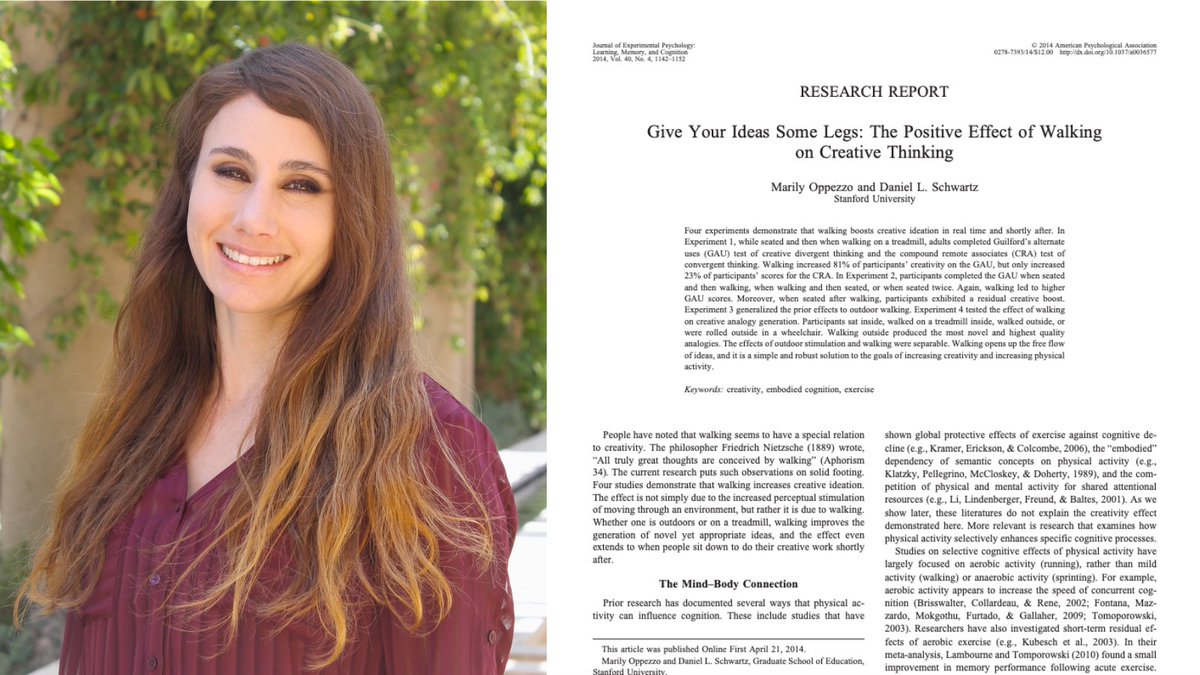
A Stanford psychologist spent 4 years proving that the simple act of walking generates 60% more creative ideas than sitting, and the experiment she designed to kill every alternative explanation is one of the most decisive findings in modern psychology.
Her name is Marily Oppezzo.
She got the idea for the study while walking with her advisor at Stanford to discuss her thesis topic, and the paper she eventually published in the Journal of Experimental Psychology in 2014 is sharp enough that it should have ended the seated meeting on the day it came out.
She ran 4 experiments on 176 people. Same person tested twice. Once sitting, once walking. The creativity tasks were the standard ones psychologists have used for decades to measure how good a brain is at generating novel useful ideas.
The result was almost too clean to publish.
81% of participants in the first experiment produced more creative ideas while walking than while sitting. In the second experiment, 88%. In the third, 100%. Every single person walked into a more creative version of themselves.
On average, people generated 60% more novel useful ideas the moment their legs started moving.
The skeptical question is the obvious one. Maybe it was the fresh air. Maybe it was the scenery passing by. Maybe it was the change of environment doing the work, not the walking itself.
Oppezzo killed every one of those explanations with one experimental decision.
She put people on a treadmill facing a blank wall. No scenery. No fresh air. No environmental change. Just legs moving in place while staring at white drywall. The 60% boost held.
Then she ran the experiment that closed the case completely. She took participants outside in two conditions. Half of them walked through a Stanford courtyard. The other half were pushed through the exact same courtyard in a wheelchair. Same outdoor stimulation. Same scenery passing at the same speed. The only difference was whether the legs were moving.
The walkers produced dramatically more novel high-quality ideas than the wheelchair group. The outdoors did almost nothing on its own. The walking did everything.
This is the part of the study that hit hardest when I read it the first time.
She also tested the opposite kind of thinking. Convergent thinking. The kind where there is one right answer and you have to narrow down to it.
Word puzzles where 3 words share a hidden fourth word that connects them. The seated participants did slightly better on these. Walkers got slightly worse.
Walking is not a general intelligence enhancer. It does one specific thing. It opens up the divergent search inside your brain. The part that generates options. The part that produces unexpected connections. The part that takes a problem and finds five ways into it instead of one.
When you need to converge on the single right answer, sit down. When you need to find the answer in the first place, get up.
The mechanism is now well understood. Walking selectively activates what neuroscientists call the default mode network, the system inside your brain that runs when you are not consciously focused on anything. The DMN is where mind-wandering happens. Where memories cross-reference each other. Where ideas that have been sitting in separate folders inside your head finally bump into each other.
When you sit at a desk and force yourself to concentrate, you suppress the DMN. When you walk at a natural pace, the executive part of your brain gets just busy enough handling the walking that the DMN comes online and starts doing the work that focus was blocking.
The most useful finding in the entire paper is the one almost nobody quotes.
The boost did not turn off the moment people stopped walking. Participants who walked first and then sat back down stayed elevated. Their next round of seated creativity work was still significantly better than people who had been sitting the whole time. The rest lingered for at least several minutes after the legs stopped moving.
You do not need to do creative work while walking. You need to walk before the creative work. The brain holds the state.
The history of this is the part that should haunt anyone who still does meetings in chairs.
Charles Darwin built a gravel loop behind his house in Kent called the Sandwalk and walked it 3 times a day for the rest of his life. The theory of evolution was developed one lap at a time on that path.
Nietzsche walked up to 10 hours a day during the years he wrote his most important books and openly said the work was conceived on his feet.
Beethoven composed for the morning and walked for 5 hours every afternoon with a pencil in his pocket for when something landed.
Kahneman said the best thinking of his Nobel Prize-winning career happened on leisurely walks with Amos Tversky. Steve Jobs refused to take important conversations sitting down. He held them on foot.
Every one of them was using the system Oppezzo would not measure until 2014. They just did not know what to call it.
The question worth sitting with is the one almost nobody asks.
Every meeting you have ever attended sitting around a table was a meeting held at a fraction of the brain power that was actually available to the people in the room. Every brainstorm that got stuck inside a conference room. Every problem you tried to solve at a desk and gave up on. Every idea you could not quite get to.
The intervention is the easiest one in modern science. No supplement. No app. No subscription. No training program. Just a pair of legs and 15 minutes.
The Stanford lab proved it. The philosophers knew it. The neuroscience explains it.
And almost everyone reading this is still trying to think their way out of problems sitting completely still.
You swear you’re in love with somebody… until life forces you to see the parts of them that aren’t pretty. It’s easy to love a person when they’re smiling, stable, and put together. But try loving them when you’re wiping their face after they’ve been sick, or sitting beside them at 3 a.m. while they break down in your arms.
You think you know love… until you meet the version of them the world never sees: exhausted, fragile, distant, hurting.
Anyone can love the easy moments. Real love is staying when life gets heavy, the colors fade, and they’re hardest to hold.
you have spirit guides whether you acknowledge them or not. ancestors, guardians, energies assigned to your path that have been with you since before you were born. they communicate through synchronicities and gut feelings, through the dreams that warn you. start asking them questions before you sleep and watch how quickly they begin to answer
PLEASE don’t talk about discernment if you cannot recognize when someone needs compassion more than criticism and correction. There is a time to guide and a time to simply hold space for a person who is hurting. Wisdom knows the difference. And kindness knows it even faster.
Officially 1 month since I switched to a flip phone.
- Everyone is more severely addicted to their smartphones than I thought. Once you have a dumbphone, you'll frequently find yourself as the only person in the room not on their phone. It's not just teenagers, it's parents and adults of all ages. It's like everyone is stuck in a trance. 75+ year olds might be the only exception.
- All the objections I previously had for getting a dumbphone have turned out to be overblown and/or solvable. My iPhone addiction had fed my brain excuses to not do this earlier. If you really want to make the switch, you can.
- I've felt embarrassed to pull out my flip phone in public at times, for fear of being different or drawing too much attention to myself. But I have learned to just own up to it. Most people end up saying something like "Oh, I probably should do that too."
- I am using my brain more. Even though my flip phone has Waze, I find myself memorizing maps and roads. I'm more bored and get lost in my thoughts. I'm using paper and pen more. Increased desire for tangible things > digital things.
Overall, it has been a great experience and I plan on never going back.
Mercy is when you can't even explain how you're surviving, but you are. You don't have it all figured out, but each day, God sends help right when you need it. Hallelujah.
Human approval is unstable. Someone may praise you today and criticize you tomorrow, so it's wiser to anchor your life in deeper principles than in other people's opinions.
The challenge is allowing yourself to love and participate in the play anyway, knowing it will eventually dissolve. It takes a lot of courage to hold something gently, fully aware that it is already slipping away.
~ 12th house experience
Because the 12H is also the house of spiritual transcendence, this painful trait carries a profound gift.
You are uniquely equipped to understand the concept of vairagya (detachment). You know, at a cellular level, that nothing in this physical realm can be truly possessed.
I’m starting to feel that Uranus feeling. Like the last shoe is about to drop any minute. It’ll get stronger into Friday. By tomorrow night we’ll all probably be hanging on by the edge of our seats. The sensitive yet uneducated ones will say it’s anxiety. So prepare for that conversation, about “how bad my anxiety is right now, blah blah”. I’m not being insensitive. I’m being realistic. You aren’t anxious Marsha, Uranus is just square the nodal axis.