Deep Waters Capital published a 5-year SOTP model on (Pre-HIP 149) $HNT.
The entire financial model runs Blockworks tokenholder reports, Blockworks Research coverage, and Blockworks Analytics.
Just use @Blockworks data
https://t.co/HwKlTinv2Q
On the Helium proposal, I don't work there anymore but here's my take:
Helium made two large, parallel bets:
(1) Carriers will pay to offload to a decentralized network that fills coverage gaps.
(2) Helium can build its own carrier, Helium Mobile, that offers cheaper prices than others due to the offload
It was never explicitly stated, but (2) acted as a nice hedge for (1) being incorrect. If carriers won't use us, we'll use ourselves!
So what happened? Well, this is a startup. Some bets win and some do not. The carrier offload bet won, there is massive PMF. Carriers agree to pay Helium more and more every year.
On the other side, the Helium Mobile bet didn't go asymmetric. Free subscribers are expensive, but were the best subsidized bet to grow. Think about when Uber used to have $3 pools, nobody thought that was real but it grew them to the point of being unstoppable. HM made that bet, and all along the way it seemed like it could go parabolic. In places like New York with dense coverage, the Helium Network did meaningfully save HM money. Unfortunately, the expenses and distraction of running an MVNO do take a toll. It split focus. Helium Mobile was a swing for the fences, and while it didn't outright fail it was becoming a distraction from the bet that already had PMF; carrier offload! Leadership identified this gap and took action. HM was acquired, and the focus is now fully on offload and Noble Mobile is just another carrier using Helium.
Now on to the proposal. Helium has PMF. We know this. But the age of subsidy is over, no more $3 Ubers. Hotspots need to get paid what carriers pay the network. I don't think this is controversial.
The real controversial part is the one-time inflation. A network whose token is built on scarcity rightfully does not want a large inflation event. But here's the thing, Helium is at a meaningfully different stage. You can see it in the leadership change. Amir is the guy you want making large bets to find PMF. He's ruthless, driven, and not afraid to make controversial decisions. He's your 0 to 1 guy.
Now look at Mario. He's smart, calculated, and has an MBA. He's your 1 to 100 guy.
It's no longer a matter of "will this work" it's a matter of "put more money in to grow the network, yield more revenue." Mario knows how to do this scaling, and this scaling will not work without the inflation. Growth is not free. A business has operational costs that need to be covered. You want a navy seal team of salespeople onboarding hundreds of thousands of brownfield hotspots, and expanding to new countries? That costs money.
So the network has a big decision here. It can stay in the scarcity mindset, mint no new tokens, and fizzle out as growth slows. Or it can take a risk and give the fire the fuel it needs to grow.
I’ve been reading through the proposed HIP and I think there are some legitimate questions the community should be discussing.
If I understand the numbers correctly, this proposal would introduce approximately 141M additional HNT over the next 36 months. With roughly 196M HNT currently circulating, that’s a substantial increase in supply.
The concern isn’t whether Helium needs capital to grow. Every network needs resources to expand. The concern is whether the value created by this new issuance will exceed the dilution experienced by existing holders and network participants.
At today’s price of roughly $0.51, simple supply math suggests that if network revenue, burns, and market valuation remain unchanged, the token could face meaningful downward pressure over time. That’s not FUD. That’s how dilution works.
The key question is not “Does Helium need funding?”
The key question is:
What measurable outcomes should the community expect in exchange for issuing 141M additional HNT?
Revenue targets?
Subscriber growth targets?
Data Credit burn targets?
Enterprise partnerships?
Geographic expansion milestones?
More importantly, should the release of these funds be tied to achieving those milestones?
If the network delivers on predefined success metrics, unlock the next tranche of funding. If it doesn’t, the community should have the opportunity to reassess before additional dilution occurs.
That’s how capital is typically deployed in the private sector. Investors don’t usually write a blank check on day one. Funding is often released in stages as milestones are achieved and value is demonstrated.
If token holders are being diluted, there should be a clear framework for measuring success and accountability. Otherwise, the community is being asked to accept significant dilution based largely on future expectations.
Many of us invested in Helium because we believed network usage would eventually drive token demand. If supply is increasing significantly faster than demand, the burden of proof shifts to demonstrating how this issuance ultimately creates more value than it extracts.
I hope the conversation focuses less on personalities and more on economics.
How much value does 141M HNT need to create for this proposal to be considered successful, and should the community require that value to be demonstrated before the full amount is distributed?
Some thoughts on @helium and solana:hntyVP6YFm1Hg25TN9WGLqM12b8TQmcknKrdu1oxWux
1) Network wide revenue is up roughly 4x y/y from $13k / day to $50k / day. The asset is currently trading at an 8x PE
2) Based on the current buy and burn, more than 10% of the float is being systematically purchased from the open market per year. About 90% of the FDV is already floating, and inflation is low single digits per year.
3) The network offload business - selling capacity to Tmobile, Verizon, Att, and international carriers such as Telefonica. Obviously, this business will continue to grow nicely both with general internet growth, and by signing more carriers
4) Selling the consumer facing business - Helium Mobile - to Andrew Yang's new mobile business, Noble Moble, that will further accelerate growth of Helium/Noble. The biggest challenge that Helium Mobile faced was CAC. Andrew Yang is a repeat successful entreprenuer, has raised a ton of money for Noble, and has a fresh mandate to invest in growth with a balance sheet. Also, he's super famous and loved and has a big platform
I bought some more HNT yesterday.
just a reminder that millions of daily users from major carriers like AT&T and Telefonica use the @helium network every single day
$HNT is burned for every gigabyte they consume, at a rate of $330k+ per week right now
🔥🔥🔥
Always separate @helium_mobile (the carrier) from the decentralized @helium network — education prevents FUD! 🚀 solana:hntyVP6YFm1Hg25TN9WGLqM12b8TQmcknKrdu1oxWux
I might have to take back everything I said criticizing Ethereum rainbows and unicorns. Sometimes rainbows and unicorns are exactly what a community needs.
Very surprised this all came together through donations. Big learning moment for me.
Brandon is one of the best founders in the industry and he is doubling down on the L3 token.
FYI the situation with L3 tells me nobody is looking at the small cap space: legendary CEO, good attempt at PMF with the new product, and trading below cash value.
My thoughts are aligned with this article. Insider trading of uncertain info on the edge of reality is good for more accurate predictions (think trading weather, elections, etc)
But privileged trading of certain, sealed MNPI is another that erodes confidence in teams and markets; no one wants to be guaranteed exit liquidity.
DBA plans to participate in the @P2Pdotme ICO on @MetaDAOProject
The future of finance is permissionlessly raising capital on the internet
To support a protocol which allows people to permissionlessly move capital on the internet
Futardio
🎙️ New @edge_pod
🐻 Why The Token Bear Market Is Ending | Theia on Valuations, Token Rights, and Contrarian Investing
0:00 - Intro
2:00 - Who is Theia?
4:02 - AI tools accelerating research
10:37 - Mental models for investing
18:46 - The 4-year token bear market
24:15 - Tokenholder rights: Why they matter
28:37 - Thoughts on Across token buyout
32:08 - Signs liquid token bear market is ending
35:23 - Do you believe in the four-year cycle?
39:19 - What is MetaDAO and futarchy?
49:56 - What Theia looks for in liquid tokens
56:18 - The bear is where you make money
58:12 - The case for high integrity founders
1:01:14 - Real RWAs vs. narrative RWAs
1:04:40 - Why we need underwriters, not engineers
1:06:35 - The investment manager of the future
1:11:28 - Why some VCs pivot away from crypto
1:16:57 - Why being contrarian and right matters
1:21:25 - Finding edge when DeFi is all duopolies
1:26:35 - Closing
🙏 Thanks to @TheiaResearch Founder & CIO Felipe Montealegre for joining us!
Circle of Competence is the best mental model for long term investing.
You just need to relentlessly improve your knowledge of a particular sector every day for years and the best deals / 'value' will become increasingly obvious as you continue learning.
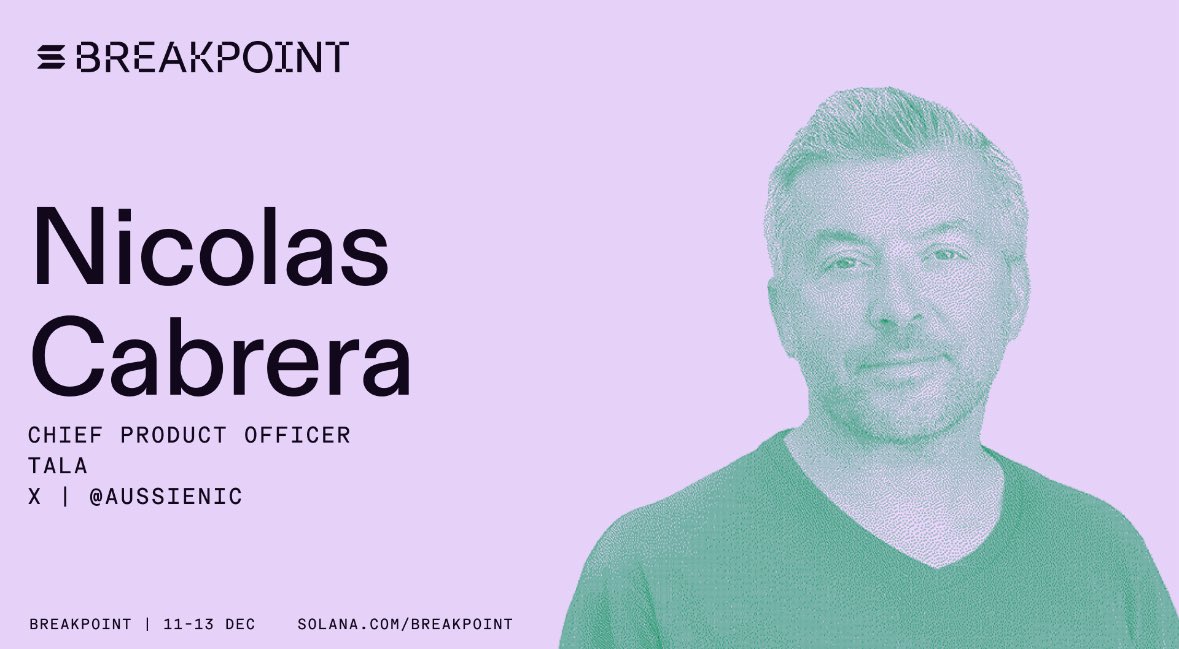
I’ll be speaking at @SolanaConf Breakpoint next week in Abu Dhabi!
Excited to see some familiar faces and discuss the latest developments in tokenized lending, onchain finance and global payments from @talamobile. Reach out if you’ll be around!
Very bullish for ownership coins
Ranger:
- Launched via MetaDAO
- Raised $8M, instant $2M buyback
- Price was headed down anyway
- Community uncovered false revenue claims, team admitted fault
- Many think it was intentional
Liquidation proposal is live, ~74% likely to pass