Enhance your reading experience by building an Obsidian vault that maintains and improves itself.
The agent writes every note. Links every concept into what you read. Fixes its own search when it misses. You just read.
Most note systems rot because you maintain them. You hit a word you don't know, tab out, lose the thread. The note never gets written.
Flip it. The agent owns upkeep. You read and ask.
Before you open anything, the key concepts are already linked in the text. Hover a term. A plain English primer appears, with an analogy. No tab switching.
Six small skills, one per moment:
INGEST. url to clean note.
PREP. links concepts before you read.
WIKI. resolves terms you flag mid read.
TAKEAWAY. a thinking note after.
ASK. queries the graph.
GARDEN. keeps it healthy.
PREP is the core. It finds the load bearing concepts, writes a one line primer for each, drops the links into the text, hands back a warm page.
Miss a term? Type ?term and keep going. WIKI resolves it later.
TAKEAWAY writes a note, never a summary. Summaries rot. It forces four things. The lesson. Where it leads. Where it breaks. What you do with it.
Four rules keep the graph clean.
Split by what changes it. Vocabulary is data. Rules are a doc. Execution is a script. You extend it by editing markdown, not code.
Never explain what you know. A known list stays unlinked. Gaps get links, not noise.
Never fabricate. A short true primer beats a long wrong one. Can't verify it? Leave a flagged stub.
Search is weighted. Every note opens with one line. That line is the index. Title and summary outrank the body.
Now the self improving part. A search misses. The agent saves that query as a permanent eval test. Fixes the summary behind it. It has to pass the new test and break no old one. It gets sharper from its own misses.
So reading compounds. Every read leaves linked concepts, a thinking note, a smarter index.
How my own Wiki system in my Obsidian has identified the similar concept from this article to the other ones I've read. Feeling really powered by my obsidian library agent.
I’m building an agent that answers data questions through charts instead of long blocks of text.
Here’s what I learned while building it with Fable:
Start with the smallest core feature you want to prove.
Do not overdesign the first version. The more you build before validating the core idea, the more you may need to revise later.
Build a prototype around that core feature.
Focus on proving that the main interaction works and that the final output is genuinely useful.
Build the skeleton.
Once the core flow is clear, define the structure, components, and data flow that will support it.
Enhance everything else.
Only then should you improve the styling, interactions, edge cases, and additional features.
My biggest lesson was that once a project starts moving in the wrong direction, even a powerful tool like Fable may keep building on that direction. The existing design, structure, and context can reinforce the wrong assumptions.
When that happens, stop building.
Step outside the current implementation and ask:
What should the final output actually look like?
Once the destination is clear, it becomes much easier to rebuild the right path towards it.
Building in public ≠ posting your changelog.
Nobody cares that you shipped dark mode. People care why you picked it, what you rejected, and what a user said that changed your mind.
I got tired of opening food apps every meal, so I tried something else.
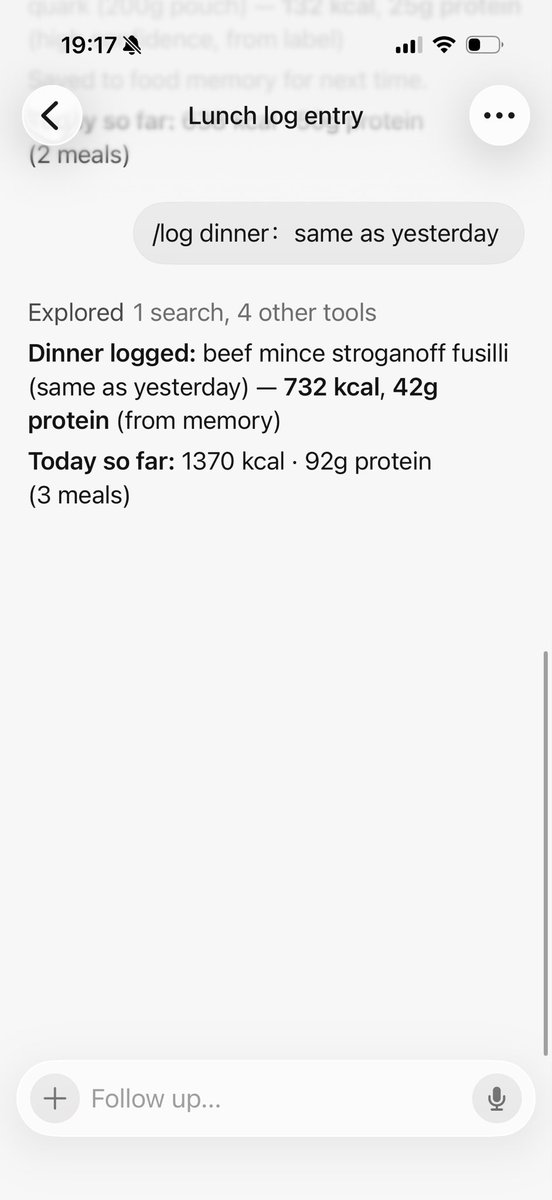
I put a tiny GitHub repo on Cursor for iOS. When I eat, I snap a photo, type /log, and the agent estimates calories + protein, appends one line to a JSONL file, and pushes straight to master.
No extra app.
Also we added a foods.jsonl memory. If I correct a portion once (like my small apple is 120g), it remembers. Next time I don’t re-explain the size.
Basically, it’s a personal agent loop:
photo → estimate → append-only log → learn my usual foods → score against my goals.
I’ve been using it for a few days. Still rough on portions. Weirdly good for something that took an afternoon.
I run several Claude Code agents at once. I often get lost about which one to switch to, and end up forgetting one of the sessions I opened. Agent-hud sorts every session by who needs me first. So no more clicking through chats to find the stuck one.