1/ Take antibodies from someone with fibromyalgia, put them in a healthy mouse, and the mouse becomes hypersensitive to pain too 🧠
Antibodies from healthy people did nothing. That 2021 experiment did more to end the "all in your head" myth than most.
9/ This is one map, of one system. Your body runs on dozens more, and most were never explained to you. Learn how yours works, free 👉 https://t.co/xCBQ6Il6gA
The neuroscience of being doubted: why your brain learns to hide its own pain 🧠💭
Almost everyone has done it. Said "I'm fine" when you were not. Downplayed how much something hurt. We call it being tough, or not wanting to be a burden. For many people it is neither. It is a nervous system that learned, through being doubted, that speaking up was not safe.
Here is how the body learns to silence itself 👇
🧠 Being doubted registers as a threat, not an insult. When you are not believed, the brain processes it as social rejection, which runs through the same circuitry as physical pain, the anterior cingulate cortex and anterior insula. Disbelief lights up the brain's threat and pain systems directly.
🔥 Threat turns the volume up on the very thing being dismissed. Cortisol climbs, the nervous system tightens, the body becomes more sensitive. Research shows invalidation is associated with higher reported pain, greater disability, and worse mental health. Not being believed physically worsens the condition being doubted.
🤐 So the body adapts by going quiet. Studies show people who experience invalidation begin to under-report their own pain. The nervous system learns that expressing pain brings rejection, so it conceals it, even when help is available. Authenticity itself gets coded as unsafe.
��� This is why "high pain tolerance" is often not toughness. Many people who seem to handle pain effortlessly are not built differently. Their nervous systems were trained, through being doubted, to suppress the signal before it reaches their mouth. The silence looks like strength. Underneath, it is a survival adaptation that leaves real suffering untreated.
🩹 Nowhere is this crueller than in chronic illness and chronic pain. People with fibromyalgia, long COVID, ME/CFS, and central sensitisation are doubted constantly, often because their scans come back clean. But a clean scan does not mean nothing is wrong. The problem is in how the nervous system processes signal, not in tissue an image can catch. So they are told they are fine, the threat system fires, the pain worsens, and they learn to stop speaking, right when being heard is what they most need.
🤝 And this is the way back. Feeling believed is not a comfort, it is a physiological event. Being understood lowers cortisol, calms the threat response, and is linked to oxytocin and reduced pain sensitivity. When the body registers that it is safe to be heard, the nervous system can step down out of protection, and that is often where healing starts.
This is one of the reasons we built Recalibrate. The app lets you track and learn about multiple biological systems, sleep, neuroscience, then brings that record to your care team through a clinician dashboard, so the conversation starts from evidence instead of doubt 💜 With over 500 Lessons, Tools, Brain Games and Exercises, Assessments and more.
https://t.co/3IG4IQ6CI2
#Neuroscience #ChronicPain #BrainHealth #Fibromyalgia #LongCOVID #Recalibrate
Scientists Map 110 Quadrillion km of Underground Fungal Networks…
A billion Times The Distance From Earth to the Sun!
Earth’s Vast Underground “Carbon Superhighway”
A groundbreaking new study published today in the journal Science has revealed, for the first time, the global scale of one of Earth’s most important but hidden biological infrastructures: the networks of arbuscular mycorrhizal (AM) fungi.
These thread-like fungal structures, known as hyphae, form symbiotic partnerships with roughly 70% of land plant species—including major crops like wheat, corn, and rice.
In exchange for sugars from the plants, the fungi deliver essential nutrients (such as phosphorus and nitrogen) and water, while also playing a massive role in storing carbon underground.
Mind-Boggling Scale
Using data from more than 16,000 soil cores worldwide, machine-learning models, and high-resolution robotic imaging of fungal hyphae, researchers estimated:
•Total length: ~110 quadrillion kilometers (1.10 × 10¹⁷ km) of living hyphae in the top 15 cm of global soils—enough to stretch nearly a billion times the distance from Earth to the Sun (or about 10% of the diameter of the Milky Way if laid out in space).
•Biomass: ~300 megatons of carbon, equivalent to 4–6 times the biomass of all humans on Earth.
•These networks move about 1 billion metric tons of carbon per year into soils, acting as a critical “carbon circulatory system” that helps regulate the planet’s climate.
Densities are highest in grasslands, with notable hotspots in places like the Sudd wetlands in Africa and the Everglades.
The “Wood Wide Web” at Planetary Scale
This research builds on the popular “Wood Wide Web” concept, where fungi connect plants in shared resource networks.
The new global maps (available for exploration via the Society for the Protection of Underground Networks, or SPUN) show these connections operating at an ecosystem-wide level, supporting plant health, resilience to drought and disease, and food security.
These fungi are vital allies in the fight against climate change and for sustainable agriculture. However, they face threats from soil disturbance (like tillage), pesticides, and land-use changes.
The study also highlights gaps in sampling, particularly in undersampled ecosystems that need further research.
Read the full research paper (paywalled, but abstract freely available): https://t.co/6cu4UUFgxU
Global density and biomass of arbuscular mycorrhizal fungal networks
Explore interactive maps and learn more at https://t.co/P35alXz06O.
This discovery underscores how much of Earth’s life-support systems remain invisible to the naked eye yet operate on a truly planetary scale.
Protecting these underground networks could be one of the most effective ways to sustain healthy soils, productive crops, and a stable climate.
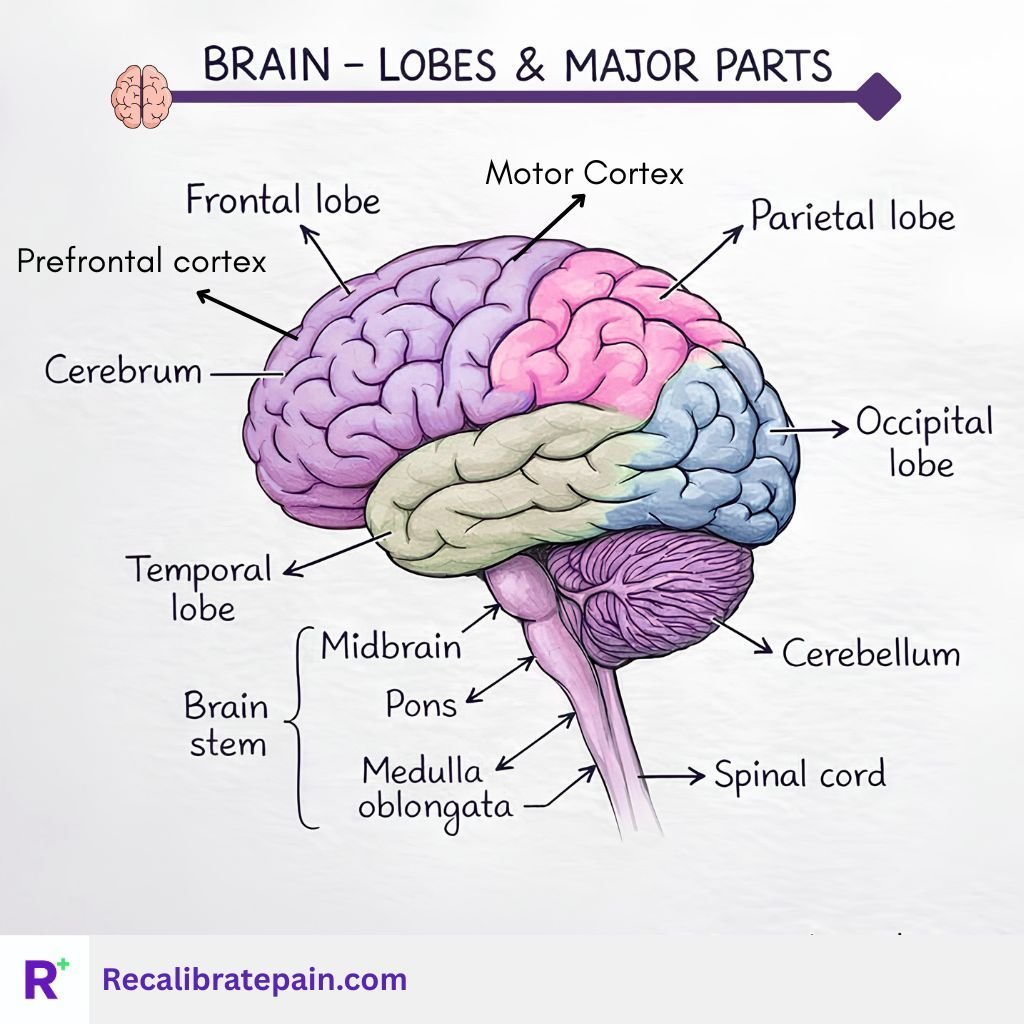
🧠 💭 The parietal section is the most interesting part of this. The brain literally redraws the body's map in chronic pain conditions like CRPS, and that single fact explains more of what patients feel than almost anything else in neuroscience 💜
Inside Your Own Brain: What School Left Out 🧠💭
The lobes of your brain are usually taught as a boring list to memorise. The real story? Each section runs a highly specific operating system that dictates exactly how you experience reality.
Here is what each part is actually running 👇
🧠 Frontal Lobe | The ExecutiveHome to your personality, decision-making, and sense of self. The prefrontal cortex manages focus, working memory, and impulse control. When you feel "not like yourself," this region has likely gone quiet. It finishes maturing around age 25, which is why teenagers feel things far more intensely than they can regulate them.
📡 Parietal Lobe | The MapmakerYour spatial and sensory integration hub. It handles navigation and holds the somatosensory cortex—the brain's internal map of your body. In chronic pain conditions like CRPS or phantom limb, this neural map physically distorts. The brain literally redraws the body in response to persistent pain.
👁️ Occipital Lobe | The ArchitectAlmost entirely dedicated to vision. Your eyes merely capture light, but this lobe builds the physical world you see. Around 30% of your cortex is tied up in visual processing, meaning your reality is a construction project.
🎧 Temporal Lobe | The VaultProcesses hearing, language, and meaning. Because the hippocampus (memory) and amygdala (emotion) both live here, your past memories and emotional weight are permanently braided together.
🪶 Cerebellum | The Dark HorseLong dismissed as just a motor coordinator, we now know it shapes attention, language, and emotional regulation. It holds roughly half of all the neurons in your entire brain, packed into just 10% of its volume.
⚡ Brainstem | The Life SupportThe oldest, deepest structure. It automates breathing, heart rate, blood pressure, and consciousness itself. Everything keeping you alive while you sleep runs through this small column.
🧬 Spinal Cord | The GhostwriterNot just a cable. It processes reflexes and modulates pain, making physical decisions milliseconds before your actual brain even registers what happened.
The strangest part? You are sitting inside this system right now, reading this in complete silence. Three pounds of tissue running every thought, memory, and emotion on just 20 watts of power. The most complex object in the known universe, and it’s yours 💜
Graphic adapted from @Supporting_classes
#Neuroscience #BrainHealth #BrainAnatomy #Recalibrate #BrainScience #Biology
Harvard Medical School's #1 longevity researcher named one of TIME's 100 most influential people in the world says he can reverse a 92-year-old's skin cells back to age 20:
"We've been using mostly artificial intelligence to screen billions of molecules in silico."
"We know OSK works, the gene therapy works and we're looking for molecules that do that."
"We already have a proof of concept, a cocktail of molecules that we hope to put into a clinical trial into humans within the next couple of months."
PS. If you found value in this post make sure to like and repost the first tweet + follow @uncover_ai to stay updated with the latest AI news.
See you in the next one:
🚨 SCIENTISTS JUST REPROGRAMMED MATTER AT THE ATOMIC LEVEL
MIT researchers have shattered a 40-year-old record by moving tens of thousands of atoms inside a material using a focused electron beam.
Not in simulations.
In real physical matter.
The breakthrough allowed scientists to generate over 40,000 quantum defects in just 40 minutes compared to the famous IBM experiment in the 1980s that moved only 35 atoms.
But this changes far more than speed.
For the first time, researchers can precisely reposition atoms:
• In 3 dimensions
• At room temperature
• Inside solid materials themselves
Using a beam controlled with picometer precision, they literally “push” columns of atoms through a crystal like swiping icons on a phone screen.
Why this matters:
• It could enable programmable matter
• Build stable quantum devices
• Create entirely new material properties
• Unlock exotic quantum states on demand
• Rewrite how future computers and sensors are built
The wildest part?
The defects themselves become the technology.
Scientists are no longer just discovering materials.
They are beginning to engineer reality atom by atom.
Follow for more future physics and quantum breakthroughs.