Recalibrate is a Neuroscience, Chronic Health and Pain Management Ecosystem for users, clinicians, researchers and carers. It was worth the wait. Visit the App
1/ Take antibodies from someone with fibromyalgia, put them in a healthy mouse, and the mouse becomes hypersensitive to pain too 🧠
Antibodies from healthy people did nothing. That 2021 experiment did more to end the "all in your head" myth than most.
11/ If you are interested in reading further here is some more research around the conversation 👇
Antibodies transferred from patients to mice (Goebel et al., Journal of Clinical Investigation, 2021): https://t.co/Qz0TrO4QdC
Antibodies found in patients, 68 of 184 (Seefried et al., Pain, 2025): https://t.co/q5ufr8X2qi
How central sensitisation actually works: https://t.co/eI7nN6KJZN
Small fiber pathology in about half of patients (meta-analysis): https://t.co/1VyBP1fmmB
Altered gut microbiome (Minerbi et al., PAIN, 2019): https://t.co/HhYqadLHq9
Allostatic load and the body's energy budget, explained: https://t.co/PdZIMbfEVp
1/ Take antibodies from someone with fibromyalgia, put them in a healthy mouse, and the mouse becomes hypersensitive to pain too 🧠
Antibodies from healthy people did nothing. That 2021 experiment did more to end the "all in your head" myth than most.
The neuroscience of being doubted: why your brain learns to hide its own pain 🧠💭
Almost everyone has done it. Said "I'm fine" when you were not. Downplayed how much something hurt. We call it being tough, or not wanting to be a burden. For many people it is neither. It is a nervous system that learned, through being doubted, that speaking up was not safe.
Here is how the body learns to silence itself 👇
🧠 Being doubted registers as a threat, not an insult. When you are not believed, the brain processes it as social rejection, which runs through the same circuitry as physical pain, the anterior cingulate cortex and anterior insula. Disbelief lights up the brain's threat and pain systems directly.
🔥 Threat turns the volume up on the very thing being dismissed. Cortisol climbs, the nervous system tightens, the body becomes more sensitive. Research shows invalidation is associated with higher reported pain, greater disability, and worse mental health. Not being believed physically worsens the condition being doubted.
🤐 So the body adapts by going quiet. Studies show people who experience invalidation begin to under-report their own pain. The nervous system learns that expressing pain brings rejection, so it conceals it, even when help is available. Authenticity itself gets coded as unsafe.
🪞 This is why "high pain tolerance" is often not toughness. Many people who seem to handle pain effortlessly are not built differently. Their nervous systems were trained, through being doubted, to suppress the signal before it reaches their mouth. The silence looks like strength. Underneath, it is a survival adaptation that leaves real suffering untreated.
🩹 Nowhere is this crueller than in chronic illness and chronic pain. People with fibromyalgia, long COVID, ME/CFS, and central sensitisation are doubted constantly, often because their scans come back clean. But a clean scan does not mean nothing is wrong. The problem is in how the nervous system processes signal, not in tissue an image can catch. So they are told they are fine, the threat system fires, the pain worsens, and they learn to stop speaking, right when being heard is what they most need.
🤝 And this is the way back. Feeling believed is not a comfort, it is a physiological event. Being understood lowers cortisol, calms the threat response, and is linked to oxytocin and reduced pain sensitivity. When the body registers that it is safe to be heard, the nervous system can step down out of protection, and that is often where healing starts.
This is one of the reasons we built Recalibrate. The app lets you track and learn about multiple biological systems, sleep, neuroscience, then brings that record to your care team through a clinician dashboard, so the conversation starts from evidence instead of doubt 💜 With over 500 Lessons, Tools, Brain Games and Exercises, Assessments and more.
https://t.co/3IG4IQ6CI2
#Neuroscience #ChronicPain #BrainHealth #Fibromyalgia #LongCOVID #Recalibrate
The neuroscience of being doubted: why your brain learns to hide its own pain 🧠💭
Almost everyone has done it. Said "I'm fine" when you were not. Downplayed how much something hurt. We call it being tough, or not wanting to be a burden. For many people it is neither. It is a nervous system that learned, through being doubted, that speaking up was not safe.
Here is how the body learns to silence itself 👇
🧠 Being doubted registers as a threat, not an insult. When you are not believed, the brain processes it as social rejection, which runs through the same circuitry as physical pain, the anterior cingulate cortex and anterior insula. Disbelief lights up the brain's threat and pain systems directly.
🔥 Threat turns the volume up on the very thing being dismissed. Cortisol climbs, the nervous system tightens, the body becomes more sensitive. Research shows invalidation is associated with higher reported pain, greater disability, and worse mental health. Not being believed physically worsens the condition being doubted.
🤐 So the body adapts by going quiet. Studies show people who experience invalidation begin to under-report their own pain. The nervous system learns that expressing pain brings rejection, so it conceals it, even when help is available. Authenticity itself gets coded as unsafe.
🪞 This is why "high pain tolerance" is often not toughness. Many people who seem to handle pain effortlessly are not built differently. Their nervous systems were trained, through being doubted, to suppress the signal before it reaches their mouth. The silence looks like strength. Underneath, it is a survival adaptation that leaves real suffering untreated.
🩹 Nowhere is this crueller than in chronic illness and chronic pain. People with fibromyalgia, long COVID, ME/CFS, and central sensitisation are doubted constantly, often because their scans come back clean. But a clean scan does not mean nothing is wrong. The problem is in how the nervous system processes signal, not in tissue an image can catch. So they are told they are fine, the threat system fires, the pain worsens, and they learn to stop speaking, right when being heard is what they most need.
🤝 And this is the way back. Feeling believed is not a comfort, it is a physiological event. Being understood lowers cortisol, calms the threat response, and is linked to oxytocin and reduced pain sensitivity. When the body registers that it is safe to be heard, the nervous system can step down out of protection, and that is often where healing starts.
This is one of the reasons we built Recalibrate. The app lets you track and learn about multiple biological systems, sleep, neuroscience, then brings that record to your care team through a clinician dashboard, so the conversation starts from evidence instead of doubt 💜 With over 500 Lessons, Tools, Brain Games and Exercises, Assessments and more.
https://t.co/3IG4IQ6CI2
#Neuroscience #ChronicPain #BrainHealth #Fibromyalgia #LongCOVID #Recalibrate
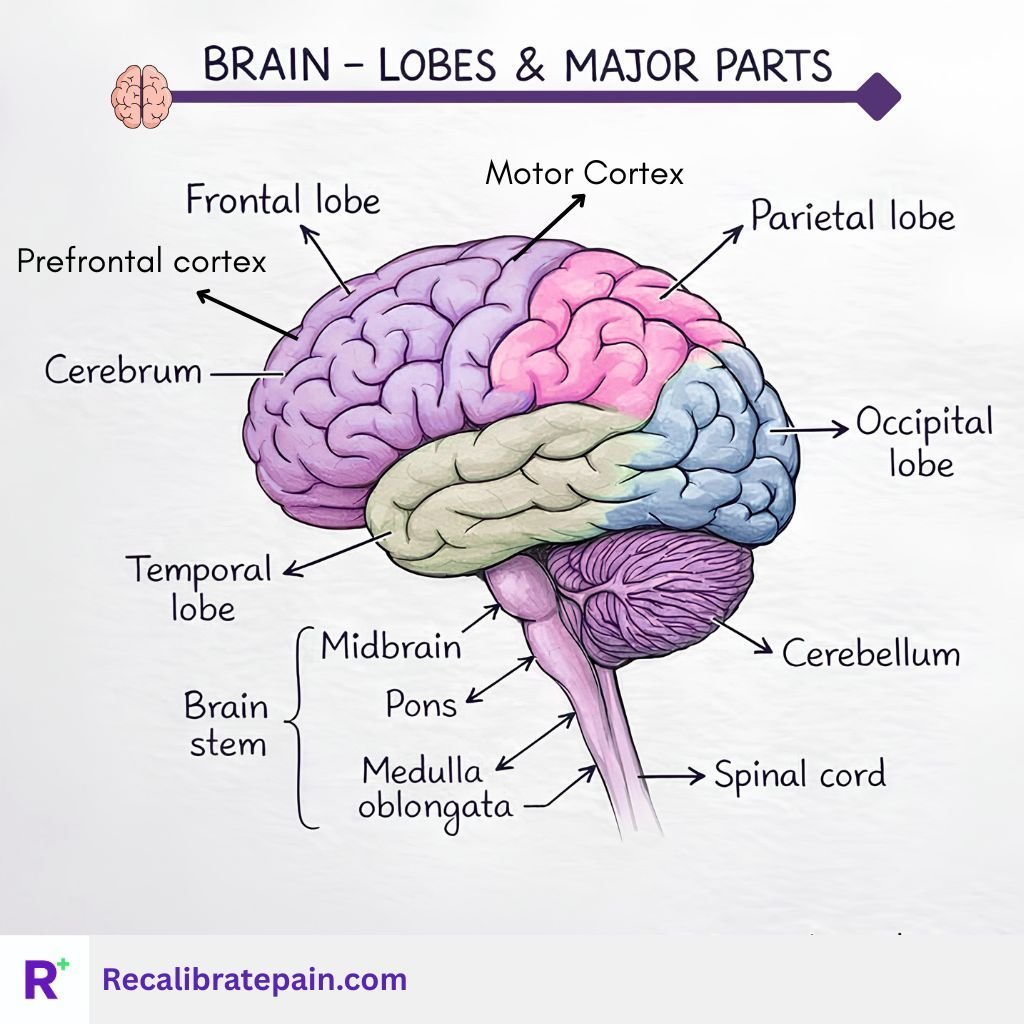
Inside Your Own Brain: What School Left Out 🧠💭
The lobes of your brain are usually taught as a boring list to memorise. The real story? Each section runs a highly specific operating system that dictates exactly how you experience reality.
Here is what each part is actually running 👇
🧠 Frontal Lobe | The ExecutiveHome to your personality, decision-making, and sense of self. The prefrontal cortex manages focus, working memory, and impulse control. When you feel "not like yourself," this region has likely gone quiet. It finishes maturing around age 25, which is why teenagers feel things far more intensely than they can regulate them.
📡 Parietal Lobe | The MapmakerYour spatial and sensory integration hub. It handles navigation and holds the somatosensory cortex—the brain's internal map of your body. In chronic pain conditions like CRPS or phantom limb, this neural map physically distorts. The brain literally redraws the body in response to persistent pain.
👁️ Occipital Lobe | The ArchitectAlmost entirely dedicated to vision. Your eyes merely capture light, but this lobe builds the physical world you see. Around 30% of your cortex is tied up in visual processing, meaning your reality is a construction project.
🎧 Temporal Lobe | The VaultProcesses hearing, language, and meaning. Because the hippocampus (memory) and amygdala (emotion) both live here, your past memories and emotional weight are permanently braided together.
🪶 Cerebellum | The Dark HorseLong dismissed as just a motor coordinator, we now know it shapes attention, language, and emotional regulation. It holds roughly half of all the neurons in your entire brain, packed into just 10% of its volume.
⚡ Brainstem | The Life SupportThe oldest, deepest structure. It automates breathing, heart rate, blood pressure, and consciousness itself. Everything keeping you alive while you sleep runs through this small column.
🧬 Spinal Cord | The GhostwriterNot just a cable. It processes reflexes and modulates pain, making physical decisions milliseconds before your actual brain even registers what happened.
The strangest part? You are sitting inside this system right now, reading this in complete silence. Three pounds of tissue running every thought, memory, and emotion on just 20 watts of power. The most complex object in the known universe, and it’s yours 💜
Graphic adapted from @Supporting_classes
#Neuroscience #BrainHealth #BrainAnatomy #Recalibrate #BrainScience #Biology
Inside Your Own Brain: What School Left Out 🧠💭
The lobes of your brain are usually taught as a boring list to memorise. The real story? Each section runs a highly specific operating system that dictates exactly how you experience reality.
Here is what each part is actually running 👇
🧠 Frontal Lobe | The ExecutiveHome to your personality, decision-making, and sense of self. The prefrontal cortex manages focus, working memory, and impulse control. When you feel "not like yourself," this region has likely gone quiet. It finishes maturing around age 25, which is why teenagers feel things far more intensely than they can regulate them.
📡 Parietal Lobe | The MapmakerYour spatial and sensory integration hub. It handles navigation and holds the somatosensory cortex—the brain's internal map of your body. In chronic pain conditions like CRPS or phantom limb, this neural map physically distorts. The brain literally redraws the body in response to persistent pain.
👁️ Occipital Lobe | The ArchitectAlmost entirely dedicated to vision. Your eyes merely capture light, but this lobe builds the physical world you see. Around 30% of your cortex is tied up in visual processing, meaning your reality is a construction project.
🎧 Temporal Lobe | The VaultProcesses hearing, language, and meaning. Because the hippocampus (memory) and amygdala (emotion) both live here, your past memories and emotional weight are permanently braided together.
🪶 Cerebellum | The Dark HorseLong dismissed as just a motor coordinator, we now know it shapes attention, language, and emotional regulation. It holds roughly half of all the neurons in your entire brain, packed into just 10% of its volume.
⚡ Brainstem | The Life SupportThe oldest, deepest structure. It automates breathing, heart rate, blood pressure, and consciousness itself. Everything keeping you alive while you sleep runs through this small column.
🧬 Spinal Cord | The GhostwriterNot just a cable. It processes reflexes and modulates pain, making physical decisions milliseconds before your actual brain even registers what happened.
The strangest part? You are sitting inside this system right now, reading this in complete silence. Three pounds of tissue running every thought, memory, and emotion on just 20 watts of power. The most complex object in the known universe, and it’s yours 💜
Graphic adapted from @Supporting_classes
#Neuroscience #BrainHealth #BrainAnatomy #Recalibrate #BrainScience #Biology
Your brain has a region that literally grows when you do things you don't want to do🧠💭
The Anterior Midcingulate Cortex thickens with voluntary effort. Shrinks when you default to comfort.
Big personal update - the first Recalibrate Health Intelligence Portal is now live!
https://t.co/SjD2LKfQxT
Today we’re releasing the Central Sensitisation Syndrome (CSS) Health Portal with everything about CSS in one free, open-access place:
🔬 Live clinical trials & latest research
💡 Interactive CSI Self-Assessment
⚡ Treatment Evidence Tracker (graded A–D)
💊 Medication Reference Guide
🥼 Global Specialist Directory
❓ Patient journey, FAQs, glossary & more
Built for patients, families, and clinicians who want real intelligence instead of scattered info.
Plus, join our official CSS community right now:
🧑💻 HealthPortal_CSS on Telegram - https://t.co/eFCrO69rMc
♾️ More Chronic Illness portals (Fibromyalgia, Long Covid, ADHD, Diabetes etc.) dropping soon at https://t.co/us2Q9x1vDx
Finally a way to view everything going on within my chronic illness CSS in one place. If you have a chronic illness don't hesistate to reach out and let's get a Health Portal running for it.
If you or someone you know lives with CSS, this one’s for you. Come say hi in the group let’s recalibrate together 💜
#Recalibrate #HealthPortal #CSS #CentralSensitisation #ChronicPain #Chronicillness #HealthTech
Most people think self-sabotage is just "negative-thinking." But few understand the neuroscience behind it (and how it destroys your health) 🧠 💭
The 12 cognitive distortions in this image aren't personality traits. They are logic glitches that trigger a massive physical stress response and drain your metabolic battery. Yet they are maladaptive patterns generated by the brain.
Here is the science behind these 12 patterns:
1. Mind Reading 🗣️
The Science: Theory of Mind glitch. Your brain projects insecurities onto others, triggering an Amygdala "threat" response before a word is even spoken.
2. Negative Focus 🔍
The Science: Selective Attention. Your Reticular Activating System (RAS) physically filters out positive data, blinding you to opportunities.
3. Catastrophizing 🚨
The Science: HPA Axis Overdrive. The brain treats a hypothetical future as a current threat, flooding your system with neurotoxic Cortisol.
4. Labeling 🏷️
The Science: Self-Directed Neuroplasticity. By labeling yourself, you wire that identity into your circuitry, making change physically harder for the brain to execute.
5. Should-thinking 🛑
The Science: Cortical Friction. Rigid internal rules increase oxidative stress as the brain constantly fights reality.
6. Overgeneralizing 🔄
The Science: Pattern Recognition Error. The brain incorrectly maps a single event as a permanent rule, keeping the nervous system in a "defensive" posture.
7. Emotional Reasoning 🌊
The Science: Limbic Dominance. The failure of the Prefrontal Cortex (PFC) to regulate emotions. You mistake a chemical state for objective reality.
8. Fortune-telling 🔮
The Science: Prediction Error. Your reward circuitry stops producing Dopamine because it has already "calculated" failure, leading to functional freeze.
9. Personalization 🎯
The Science: Attribution Bias. You assume you are the cause of external events, wasting energy trying to control variables you cannot influence.
10. Owning the Truth 📖
The Science: Cognitive Inflexibility. The brain closes off new neural inputs to save energy, leading to "stagnant" hardware that cannot adapt.
11. Just-world thinking ⚖️
The Science: Safety Bias. When reality doesn't match this "rule," of fairness it triggers a massive cortisol spike and system frustration.
12. Control Fallacy 🕹️
The Science: Resource Misallocation. Over-extending or under-reaching prevents the nervous system from entering "Flow" and maintaining homeostasis.
💡 The Recalibrate Shift: Change isn’t about willpower. It is about Cognitive Reframing. By identifying these 12 patterns in real time, you move activity from the reactive Amygdala back to the Executive Prefrontal Cortex.
- Follow Recalibrate Inc. for more Health Education and much more 🧠 💭
- We are launching an All-in-One Health and Pain Management App 💜
#Neuroscience #BrainHealth #Recalibrate #Chronicpain #MentalHealth #Psychology #HealthEducation