Forget Bran. Bronn was the real winner of the Game of Thrones.
Went from a sellsword to Tyrion’s bodyguard, then a knight, a lord, Master of Coin and Lord of Highgarden. Fought a fucking dragon along the way too.
All that while basically just following one rule: get paid and stay alive.
Right place, right time, every single time.
For people who keep asking what to build in AI Engineering.
➣ Build your own Context Assembler
(token-budgeted memory + retrieval + tools)
➣ Build your own Retrieval Stack
(chunker + BM25 + dense search + reranker)
➣ Build your own Model Router
(cost/latency/quality routing + fallbacks)
➣ Build your own Semantic Cache
(embedding similarity + hit-rate tracking)
➣ Build your own Agent Orchestrator
(deterministic state machine, no LangChain)
➣ Build your own MCP Server and Client
(raw JSON-RPC, no SDK)
➣ Build your own Multi-Agent Consensus
(weighted voting + judge + escalation)
➣ Build your own Sandboxed Tool Executor
(isolated execution + resource limits)
➣ Build your own Guardrails Middleware
(injection detection + PII redaction)
➣ Build your own Durable Workflow Engine
(checkpoint/resume, mini-Temporal)
➣ Build your own Streaming Proxy
(SSE + TTFT and ITL metrics)
➣ Build your own LLM Tracer
(OpenTelemetry-style spans for every hop)
➣ Build your own Eval Harness
(trajectory grading + CI regression gates)
➣ Build your own Prompt Registry
(versioning + A/B routing + rollback)
➣ Build your own Data Flywheel
(feedback → synthetic data → LoRA loop)
Pick 3. Build them from scratch. Document every decision.
Most people import libraries.
Builders understand what happens underneath.
Bookmark this. You'll need it.
استُغرق 33 عامًا من العمل البشري لرسم خريطة لدماغ أصغر من بذرة الخشخاش.
هذا هو الدماغ بكامله، بكافة نيوتروناته البالغ عددها 139,255 خلية عصبية.
تُم تشريح أنثى ذبابة فاكهة واحدة إلى 7,050 طبقة، كل طبقة منها أرق من الفيروس، ثم صُوّرت في 21 مليون صورة.
تتبع الذكاء الاصطناعي الخلايا، وفحص البشر كل سلك يدويًا: علماء، وططلاب، ولاعبون يضغطون للتسلية.
الخريطة النهائية:
139,255 خلية عصبية
54.5 مليون تشابك عصبي
8,453 نوعًا من الخلايا
150 مترًا من الأسلاك الملتفة في نقطة واحدة
لم يسبق لأحد أن رسم خريطة لدماغ بالغ كامل من قبل، لا لفأر ولا لإنسان. كانت الذبابة هي الأولى.
في سبتمبر 2026، أصدر معهد جانيليا وجوجل الذكر، بـ 166,700 خلية عصبية تم رسم خريطتها من الدماغ إلى الأرجل عبر رقبة سليمة.
وبعد أسبوعين، شغّل الإنترنيت الذبابة:
لعبت لعبة "دوم" (Doom)
قادت طائرة درون محاكاة دون تدريب سابق
هبطت بصاروخ محاكاة 60 مرة من أصل 80
كتبت منشورات على لينكد إن (LinkedIn)
لكن الخريطة تُظهر فقط مسار الأسلاك، وليس قوة كل منها. لا تحتوي على جهود كهربائية ولا توقيتات، تمامًا كخطط دارة كهربائية دون قيم مبيّنة عليها.
لا أحد يعلم بماذا تفكر الذبابة، ومع ذلك فهي تنشر على لينكد إن.
استغرق الأمر 33 سنة-رجل لرسم خريطة لذبابة واحدة، ورأسك يحوي 617,000 منها.
vibe coders can build
Chrome extensions
Dashboards
CRUD apps
Internal tools
MVPs
Automation scripts
Discord / Telegram bots
nobody is vibe coding
a database engine
a programming language
a browser engine
a networking stack
a hypervisor
a distributed systems runtime
That’s the gap.
WTF?
Made with claude OPUS 5.5
Prompt
"make a dynamic 15-second motion graphics video that shows what an incredible motion designer you are, like it's your showreel for a résumé. go all out."
That's it..
Stop opening Simulator app, you can run a virtual iPhone 17 Pro, AIR with iOS 26, iPad Pro, and Apple Watch fully locally in your browser.
Headless iPhone farm in your browser:
- 60fps stream (H.264)
- real taps/swipes/pinch/Home/ Lock
- a11y tree + live os_log
- Mac webcam to sim camera
- multi-device /farm wall
No Simulator. app or No Xcode window.
Just: brew install baguette
NVIDIA and Stanford just challenged Jev.
(their new System 1 architecture runs up to 9x faster.)
It is called a Contrastive Language Model, or CLM.
Like Jev, CLM is not designed to generate text. It handles the small, repeated decisions inside AI systems, such as choosing a tool, ranking a patch, routing a request, or selecting the next action.
But CLM reaches those decisions differently.
Instead of generating an answer token by token, it treats decision-making as a retrieval problem.
Here is how it works.
1) Encode the state
CLM takes the current situation, such as an agent’s context or the state of a game, and converts it into a vector.
It uses a frozen Qwen3-8B model with a small trainable state projection head.
2) Encode every possible action
A separate action head converts each candidate into the same vector space.
In the Mario example, the candidates are left, jump, and right run. CLM does not invent a fourth option. It only evaluates the actions supplied by the application.
3) Learn which states and actions belong together
During training, the correct state-action pair is pulled closer while incorrect pairs are pushed apart.
A batch of B examples produces a B × B similarity matrix. The matching pairs sit on the diagonal. Every other pairing becomes a negative example.
This contrastive training uses InfoNCE, the same general mechanism behind systems such as CLIP and dense retrieval.
4) Turn similarity into a decision
At inference, CLM measures the cosine similarity between the state and every candidate action.
A softmax converts those scores into a probability distribution. The application can choose the winner, apply a confidence threshold, or escalate an uncertain result.
The real speed advantage comes from separating states and actions.
Actions can be embedded once and cached. If an agent repeatedly chooses between the same tools, CLM only needs to encode the changing state and compare it with stored action vectors.
That replaces repeated generation with one embedding pass and a set of cheap dot products.
The researchers report that CLM-8B matches Jev across computer-use, gaming, and tool-calling evaluations while reaching up to 9x lower latency. The improvement is largest when actions repeat or the candidate set grows.
CLM still has limits. It cannot generate new actions, its probabilities are relative to the supplied candidates, and its strongest verifier results require task-specific fine-tuning.
But its central idea is powerful.
The entire research is open-source, including the code.
Read more here: https://t.co/I9kPwMPI7B
When software already knows the possible answers, an AI model should score them instead of generating more words.
I also wrote a full breakdown on how system one models like Jev work.
The article is quoted below.
Si eres programador en 2026, NO leas únicamente libros sobre:
- Lenguajes
- Frameworks
- Patrones
- Algoritmos
- Clean Code
La IA está cambiando qué habilidades hacen valioso a un programador.
Estos son los 10 libros que leería AHORA:
If you're planning to quit your job, rob it first
Legally. There's somewhere between $15,000 and $40,000 sitting inside your employment that disappears the second you hand in notice, and HR is praying you never learn the order to do this in
1. Drain the FSA. If you elected a health FSA, the ENTIRE year's amount (up to about $3,300) is spendable on day one, before you've paid into it. Get the dental work, the glasses, the LASIK consult, the therapy. Quit in March having contributed $800. Federal rules say your employer eats the difference and can't bill you for it
2. Get every medical thing done while you're covered. Physical, bloodwork, 90-day refills on every prescription
3. The COBRA trick. After you leave you have 60 days to elect COBRA and it's retroactive to the day your coverage ended. So you don't pay the $700-$2,000 a month. If nothing happens, you never pay a cent. If you break your leg on day 40, you elect it then, pay the back premiums and you were covered the whole time. Two months of free insurance
4. Borrow while you still have a paycheck. Banks love W-2 income and the day you're self employed you're invisible to them for two years. Before you give notice: request limit increases on every card you own (Amex, Capital One, Discover and BofA don't even hard pull), open a HELOC if you own a home and leave it at $0, and open 0% business credit cards while you can still write your salary on the application. People walk out with $100K+ of available 0% credit they couldn't have gotten 30 days later
5. Check your vesting dates. 401k match and stock vest on a schedule. Quitting three weeks before a cliff can cost you $5K to $50K. It's in your plan portal. Quit the day after
6. Same with the bonus. Find the sentence in the policy that says "must be employed on payout date"
7. Never resign if you can get laid off. Resign and you get nothing. Sit down with your boss and say "I don't think this is working, is there a package if we part ways?" and you can walk out with severance plus unemployment. Worst case they say no and you quit anyway
8. PTO. If your state or company pays out unused days, don't take a single one, collect the check. If they don't, burn every day before you give notice
9. Roll the 401k over. Cashing it out costs you 10% plus income tax
Your company would post your job before your chair got cold and kill your insurance at midnight on your last day. You're allowed to read the benefits handbook as carefully as they wrote it
(Step 4 is my actual job. I get people $50K-$150K in 0% business credit and take 10% for it. I'm teaching how that business works live on Wednesday, free. Link's in my bio)
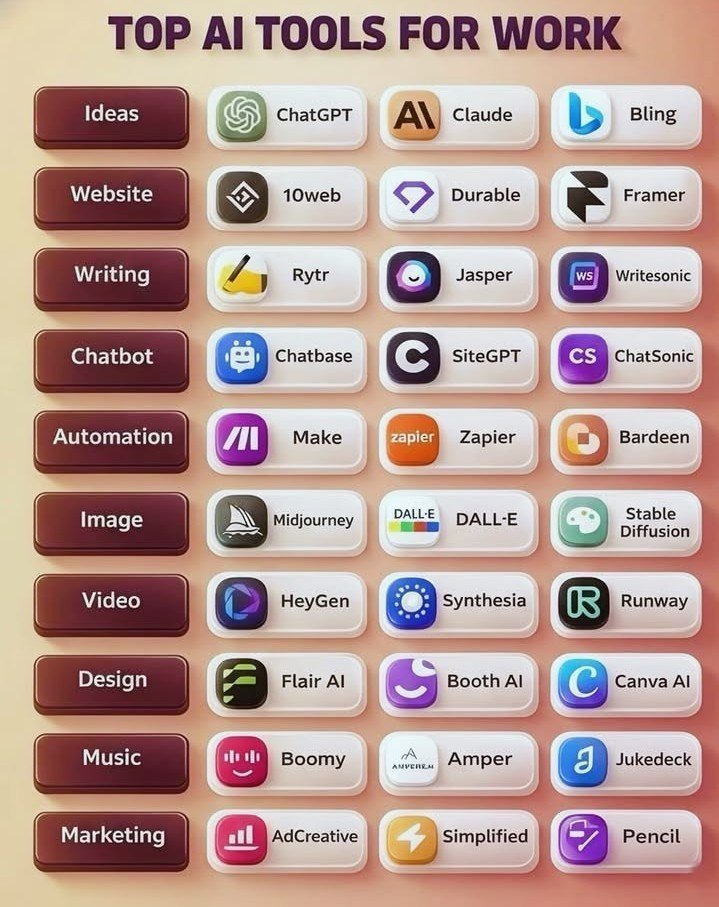
🚀 The best AI tools for work in 2026 aren’t about having more apps.
They’re about using the right tools for the right tasks to automate busywork, save hours, and get more done.
Here are the category leaders worth knowing. 👇
🔖 Bookmark this — you’ll want this list later.
🚨 BREAKING: Did you know ChatGPT has a feature called Flight Booking mode?
It can help you find and book cheaper flights whenever you need.
Here are 7 prompts you can use to access it:
I gave AI a normal human problem.
Not a coding problem. Not a complicated business question.
Just something most people deal with but rarely know how to solve properly.
I asked ChatGPT to look at the situation from different perspectives, point out what I was missing, and give me a practical way forward.
The surprising part?
The answer wasn’t some crazy AI trick. It simply noticed a few things I hadn’t considered.
Sometimes the value of AI isn’t getting an answer faster.
It’s having something challenge the way you’re looking at the problem.
That’s when AI starts feeling less like a search box and more like a thinking partner.