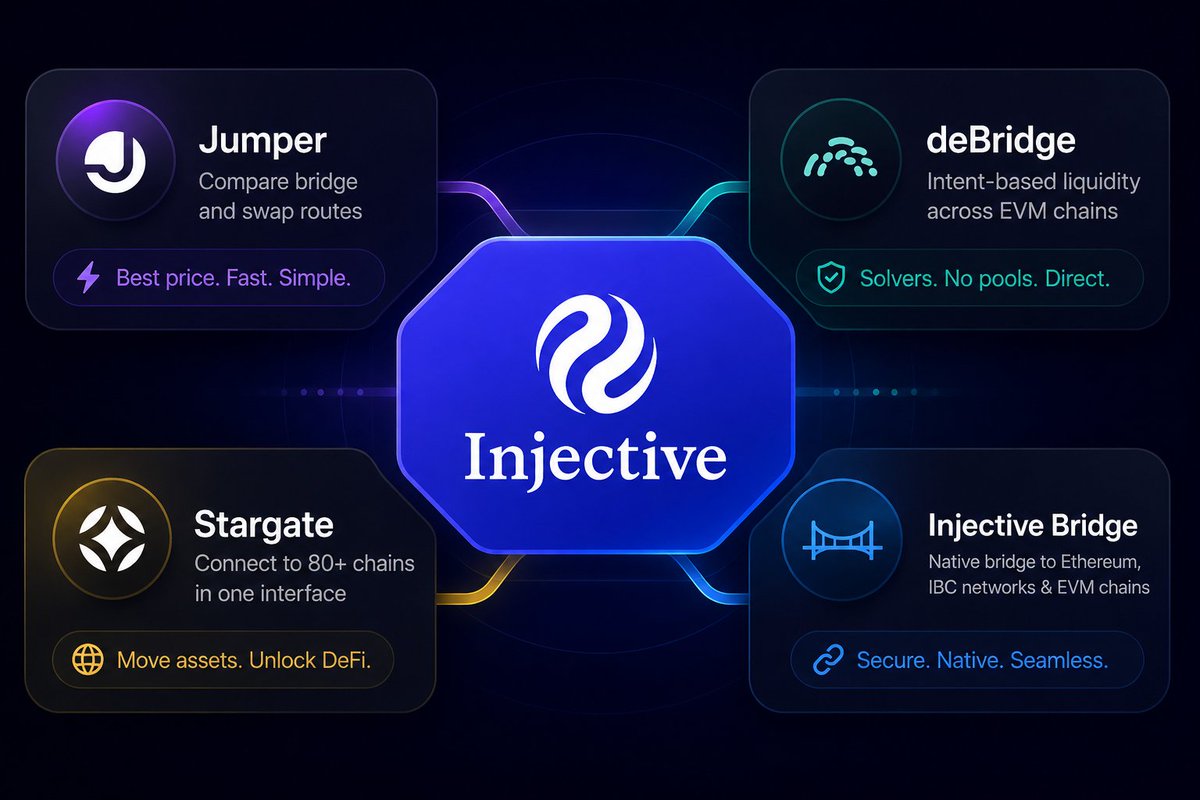
Getting into the Injective ecosystem is honestly getting way easier, and $INJ is right at the center of it.
With @jumperapp, @debridge, @StargateFinance and the native Injective Bridge, there are now multiple ways to bring assets into Injective depending on where you’re starting from.
Different routes, same destination.
@jumperapp makes it easy to compare bridge and swap routes from one interface. Pick your asset, choose Injective as the destination, check the price, speed and fees, then make your move.
@debridge takes a different approach with intent based liquidity. Solvers deliver the quoted asset on Injective, giving users a direct route from supported EVM networks without relying on shared liquidity pools.
@StargateFinance connects Injective to 80+ chains, giving assets like wETH another route into the ecosystem and allowing that liquidity to be used across trading, lending and yield protocols.
Then there’s the native Injective Bridge, connecting Injective with Ethereum, IBC networks and EVM based chains.
Four routes.
Different starting points.
One ecosystem.
The easier it becomes to move assets and liquidity into Injective, the more opportunities open up for users and builders.
And honestly, this is the kind of infrastructure that makes an ecosystem feel much more accessible.
Still early. $INJ 🔥
Ninjas, I’ve been checking where native USDC is actually being used on @injective. Honestly, it’s showing up in more places than I expected.
What caught my attention? It’s already doing more than just sitting in wallets.
𝐓𝐨𝐤𝐞𝐧𝐢𝐳𝐚𝐭𝐢𝐨𝐧 𝐈𝐬𝐧’𝐭 𝐉𝐮𝐬𝐭 𝐀𝐛𝐨𝐮𝐭 𝐓𝐡𝐞 𝐓𝐨𝐤𝐞𝐧
Putting an asset onchain is only one part of the process.
You also need an official record showing who owns that security.
──────────────
𝐖𝐡𝐞𝐫𝐞 𝐓𝐫𝐚𝐧𝐬𝐟𝐞𝐫 𝐀𝐠𝐞𝐧𝐭𝐬 𝐌𝐚𝐭𝐭𝐞𝐫
A transfer agent maintains ownership records and processes changes to them.
Injective Institutional Services is now registered with the SEC as a transfer agent, supporting functions around ownership records, transfers and securities recordkeeping.
✦ ───────── ✦
The interesting part is the connection with blockchain.
The SEC has stated that registered transfer agents may use distributed ledger technology as their official master securityholder file, or as part of it, subject to securities laws.
That means the ownership record can potentially become part of the same infrastructure as onchain settlement.
Tokenization, then, isn't simply about creating a digital version of an asset.
It’s about building the infrastructure that can issue, transfer, record and settle it.
The token represents the asset.
The ownership record tells us who actually holds it.
@injective
@Lordvibezzz@Lordvibezzz I understand u want to make it by force and everyone does but u only deceiving ur self posting these fake edited screenshot that the figures dont correspond
😆