The Pi2Day 2026 Ecosystem Quest ran from June 28 – July 13, celebrating and highlighting Pi2Day’s major ecosystem and utility-supporting updates.
The Quest guided Pioneers to complete activities that help them discover new apps, test ecosystem features, and understand how Pi’s infrastructure supports utility creation across compute, AI, and identity.
Pioneers who completed the Quest also received a special-edition in-app badge accessible in Pi Chats and Pi Social Profiles.
Learn more https://t.co/rQpgOc9oKA
The Pi2Day 2026 Ecosystem Quest saw incredible participation with over 2.56 million Pioneer participants, and over 1.78 million of them completing every step to claim this year’s special-edition badge.
Congratulations to everyone who celebrated Pi2Day by exploring the Pi ecosystem and the new Pi2Day releases: SoloHost, Pi-Sign-in, and PiVerify.
Learn more in the Pi app.
Reminder: the Pi Mainnet is upgrading to Protocol v26. All Mainnet node operators must complete the upgrade by August 11 to remain connected to the network.
Protocol v26 is a major milestone that improves contract safety, state management, interoperability, and cryptographic capabilities ahead of the final planned upgrade, Protocol v27.
Details here https://t.co/LHI1F0JHLm
The Pi Mainnet is upgrading to Protocol 26. Deadline: Aug. 11.
All Mainnet node operators must complete the upgrade before the deadline to remain connected to the network. Details here: https://t.co/ENIm1nu6S1
Protocol 26 is a major milestone ahead of the final planned upgrade, Protocol 27. With 8 successful upgrades completed over the past few months, these final two upgrades will bring the network up to date with the latest protocol features, improvements, and functionality.
In the Pi Launchpad model, projects issue tokens as tools to acquire users for their applications and integrate those tokens directly into product functionality, such as access, payments, rewards, and governance.
Instead of being taken by the issuing project, the proceeds of Pi from their token launch go to a liquidity pool with the ecosystem token, which bootstraps a healthy liquidity foundation from the start.
For the SLICE test launch on Testnet, this results in a liquidity pool containing SLICE and Test-Pi. In addition to matching individual buyers and sellers through a traditional decentralized order book on the Pi DEX, the pool uses an automated market maker algorithm to calculate swaps based on the amounts of both assets it currently holds.
Learn more about how the SLICE liquidity pool works.
https://t.co/BJEb5ijQcr
Pi Launchpad has completed the distribution of its second Testnet token, SLICE!
Explore the post-launch experience and see how liquidity pools work through the new price tracking feature!
The Launchpad app in Pi Browser shows individual allocation details, the launch and effective token prices, access to the SLICE liquidity pool, and a chart tracking changes in the SLICE price relative to Test-Pi.
Go to the Pi mining app to learn more about the SLICE launch and liquidity pool mechanics.
On July 22, Pi is scheduled to upgrade to Protocol v25, which primarily focuses on improving network stability and reliability, and supports new capabilities for more efficient, privacy-preserving smart contracts.
Go to the Pi mining app to learn more!
Take on the Pi2Day Ecosystem Quest to celebrate new feature releases and receive a special in-app badge!
The Ecosystem Quest guides Pioneers to complete activities to discover new apps, test ecosystem features, and understand how Pi’s infrastructure supports utility creation across compute, AI, and identity.
Certain steps in the Quest require completing a quiz, so remember to pay attention to the updates! You can show-off your in-app badge in Pi Chats, Fireside Forum, and Pi Social Profiles.
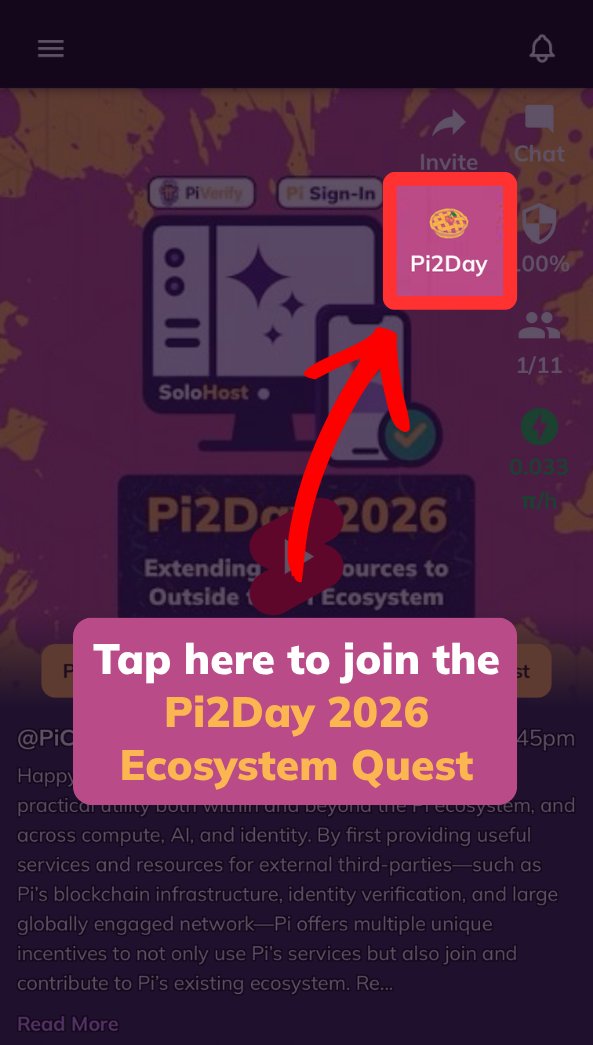
Participate in the Ecosystem Quest by tapping the “Pi2Day” icon on the top right of the Pi mining app home screen. The event will end on July 13.
New to Pi? Download the Pi mining app and get started here https://t.co/sHTvwa8Vt7
Does anyone else feel that running AI models and agents locally, on your own computer, should be much easier?
The privacy benefits are clear: your data stays with you. But while there are many open-source models and projects out there, turning them into a usable local AI agent is still far too hard for non-engineers.
As Pi2Day 2026 approaches on Sunday, June 28, Pioneers have four days left to participate in the Vibe Coder campaign with a raffle and the Pi Launchpad Testnet Token SLICE.
Both initiatives help contribute to the growth, development, and use of the Pi ecosystem and its utilities.
Pi2Day has historically been an important moment for Pi Network ecosystem milestones, updates, and feature releases. Participate in the two initiatives now, and stay tuned for Pi2day!
Learn more https://t.co/CCff3IuRQv
Reminder for all Pi Mainnet Node operators: The majority of Mainnet node operators have already successfully upgraded to Protocol v25. If you have not yet upgraded your node, please do so at your earliest convenience to remain connected to the network.
As with previous upgrades, the process is straightforward and should take only a few minutes to complete.
Details: https://t.co/ENIm1nuEHz
Pi Network has over 60 million Engaged Pioneers.
For developers, that creates an important opportunity: How do useful apps get discovered by these millions of people on Pi?
Ecosystem Directory Staking was built to help answer that.
It is a decentralized way for Pioneers and businesses to actively support and promote the ranking of Pi apps and utilities in the Ecosystem Interface. Staking through this feature increases an app’s exposure to the Pi community, helping boost visibility within the ecosystem.
This feature provides a self-service avenue for developers and creators to use Pi to tap into the attention resource of Pi Network to acquire users.
As AI makes app creation easier and easier, the challenge shifts from building products to getting them in front of people.
Ecosystem Directory Staking improves ecosystem discovery, making it easier for developers and creators to connect with users, and easier for users to discover new apps.
https://t.co/EpsNc81gOv
Ecosystem Directory Staking just got a new look and improved user experience!
Originally launched on Pi2Day 2025, staking through this feature increases an app’s exposure to the Pi community, resulting in more impressions and potentially more user traffic. By staking Pi, Pioneers can collectively support apps and services while developers and creators can promote their apps and tap into Pi’s 60M+ engaged community to acquire users.
The update prepares the feature for further utilization by developers, creators, vibe coders and Pioneers as more apps onboard to the ecosystem.
Note there are no rewards at the protocol level for staking, and the original staked amount will be returned once the staked duration has ended.
Go to the Pi home screen to learn more about Ecosystem Directory Staking and check out the recent design updates to the Ecosystem Interface.
Pi Launchpad has updated its participation flow and model, incorporating data and feedback from the first Testnet token that launched on Pi Day 2026!
The first Launchpad test token attracted over 478,000 participating Pioneers and generated valuable feedback on the Launchpad mechanism. That feedback has now been incorporated into a simpler participation flow, updated Launchpad mechanics, and an improved user experience.
A second test token “SLICE” is now live on Testnet to help evaluate if the updates can achieve these goals, and to give Pioneers another chance to learn the new ecosystem token mechanics. As a reminder, SLICE is a Testnet token and will never go onto Mainnet.
To participate:
• Open Pi Launchpad in Pi Browser
• Review the SLICE test token and project
• Choose a commitment amount in Test-Pi
• Confirm participation
• Engage with the Slice of Pi app and provide feedback
Participation will remain open until Pi2Day on June 28.
Learn more on the Pi home screen!