New economic thinking that puts the behavioral back in economics. We're BIG believers in behavioral/complexity/alternative approaches to understanding economics
What if you found out that govts don’t actually need to tax 1st before they spend & that you don’t have to “pay back” today’s fiscal spending in the form of future taxes? How would this change your perspective & evaluation of policy feasibility? #GE2020SG https://t.co/XKkVORTnUT
"The myth that holds that the great corporation is the puppet of the market, the powerless servant of the consumer, is, in fact one of the devices by which its power is perpetuated."
-John Kenneth Galbraith
George Box once famously wrote, “All models are wrong, some are useful.” (1976) But how useful can economic models be if their foundational assumptions aren’t just mildly wrong but are instead wildly wrong? https://t.co/SWc8Y6igDF
Obedience is rewarded.
Efficiency guarantees citizenship.
But what happens when a system forgets its purpose?
This is a transmission for the curious, the skeptical, the hopeful.
https://t.co/ZUYYuuM0UL
In mainstream microeconomic theory, the law of diminishing marginal returns plays a central role.
When additional units of a variable input (like labor) are added to a fixed input (like capital or land), marginal productivity eventually declines.
As marginal productivity falls, marginal cost (MC) — the cost of producing one more unit of output — rises.
This assumption leads to the familiar U-shaped marginal cost curve, where:
MC first declines (due to increasing returns),
Then reaches a minimum,
And rises thereafter as diminishing returns set in.
Underlying Assumptions
This rising marginal cost framework assumes:
Short-run fixed capital: Some inputs cannot be changed immediately.
Profit maximization: Firms produce where marginal cost equals marginal revenue.
Perfect competition: In many textbook examples, rising MC intersects with a horizontal price line.
Some economists — especially post-Keynesians, institutionalists, and heterodox economists — question this assumption:
Empirical studies (e.g. Hall and Hitch’s "Full Cost Pricing") found many firms do not experience rising marginal cost, and instead use mark-up pricing over average costs.
In industries with increasing returns to scale or network effects, marginal costs can fall.
System dynamics and non-equilibrium approaches often drop the rising MC assumption entirely.
So instead of judging Steve by one shot tweet, you need to go into his work more. Keen challenges the textbook U-shaped marginal cost curve:
The Law of Diminishing Marginal Returns assumes fixed capital and a single variable input (typically labor), which is highly unrealistic in modern multiproduct, capital-intensive firms.
Modern production often involves increasing returns, network effects, and automation, none of which are captured by the standard cost curves.
The marginal cost framework leads to logical inconsistencies when applied in general equilibrium models, particularly when combined with assumptions of perfect competition and profit maximization.
Monetarism wasn't a dangerous ideological experiment that got terrifyingly out of control. It was the ideological and programmatic form taken by a very deliberate and successful project to reassert the power of finance and property and to permanently weaken the unions. (4/4)
Here's the bottom line: "Bankers don’t like budget deficits because they compete with bank loans as a source of growth." https://t.co/MriIiMWNJ4
Now you understand why the Wall St. billionaire Treasury Secretary wants to "delever" the public sector and "relever" the private sector. 4/end
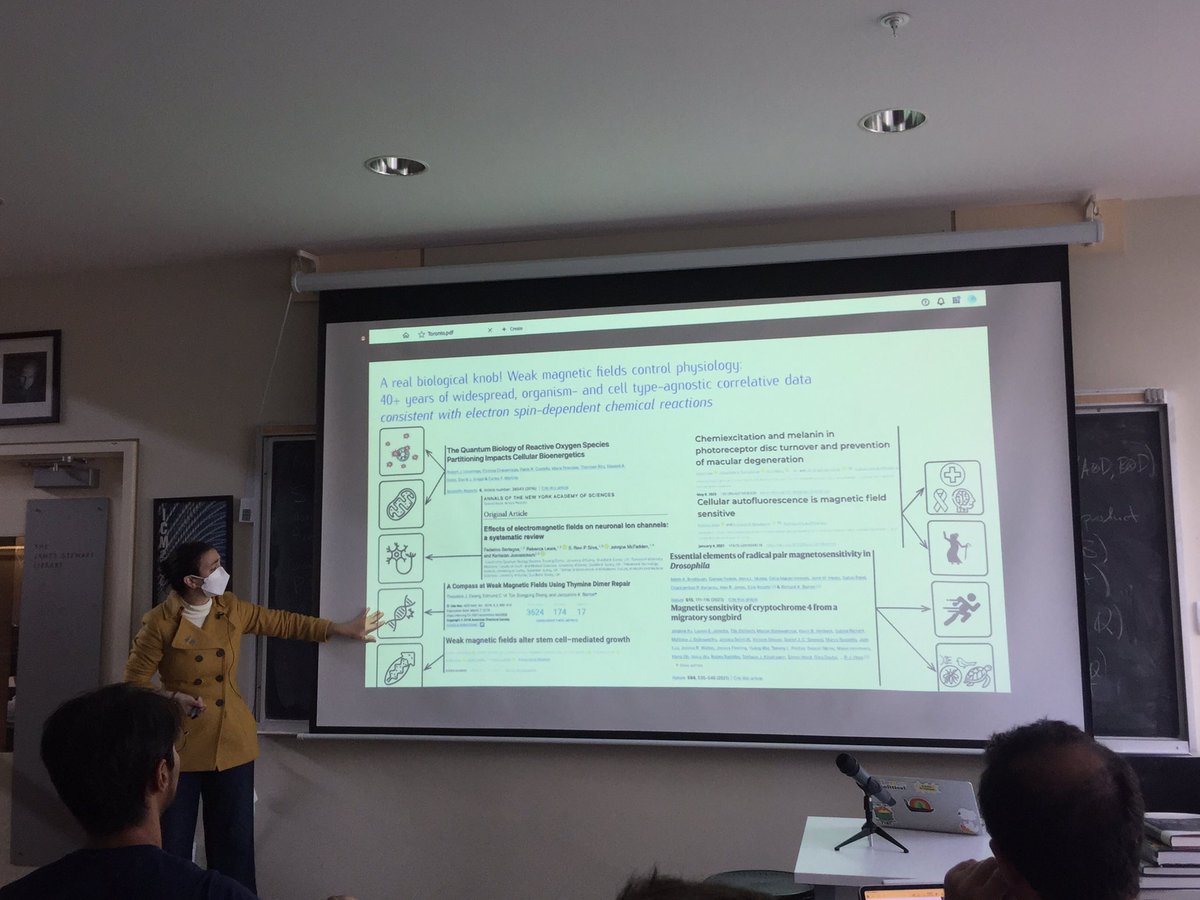
Wonderful talk by @ClariceDAiello on biological magnetic quantum sensing today at the Fields Institute, ranging from the avian compass, cryptochrome fluorescence, to biological viability considerations on Mars!👏👏Superposition viewed as a resource for bona fide quantum sensing.
@ole_b_peters Those of us trying to (deeply) understand the measurement problem in QM (foundations) would care. As it stands, quantum measurement expressed as a non-unitary process is quite as hoc and conceptually problematic in contrast to say unitary time evolution (of nested closed systems)
Here is the economics of Twitter blue ticks in one tweet:
Cornell’s degrees are very valuable. People are willing to pay for it. If Cornell decides that it will now on sell all it’s degrees for a price, the market price of Cornell degree will quickly fall to zero.
I've been getting a few DM's saying "why are you not weighing in on the bank run?" The answer is simple. I don't know what's going on and neither does anyone else. Here's why? We live in a world where opinion is instant and analysis takes time.
"A finite game is played to win; there are clear victors and losers. An ∞ game is played to keep playing; the goal is to maximize winning across all participants."
"A great deal of unnecessary suffering in the world comes from not knowing the difference." https://t.co/jZr2kfvUEG
A dogged certainty (or a pretense of it) that productivity growth is the answer to the economic growth generation conundrum (in that exclusive fwd causal direction) goes a long way in explaining today’s econ woes. That and a misunderstanding of Solow residuals and its link to TFP
Didn’t think we’d have “inability to grasp rate of change as a mathematical concept” as a Bingo card for 2022 after “inability to grasp exponential growth as a mathematical concept” in 2020/2021 but here we are with the reporting of latest inflation numbers.
Superb thread breaking down how (deliberate) confusion with causality/causal mechanism in the quantity theory of money (QT) has been invoked to justify monetarist prescriptions for dealing with current inflation without nuance.