listening to the pulse of delusion & advocating whole plant extracts to restore your body's balance. high CBD : low THC remedies 512.265.6162 call or text
Even people whose lives look relatively stable are reporting the same thing: low energy, short patience, foggy focus, reduced motivation. So what’s going on?
Learn more
https://t.co/0lgj5Q5Kbs
This isn’t “new,” and it’s being misrepresented.
The Lancet paper being cited does not isolate specific cannabinoids. It groups together very different compounds under the umbrella term “cannabinoids,” including THC-dominant drugs, mixed THC/CBD products, and limited CBD-only studies.
That’s a major issue, because these compounds have distinct pharmacological effects:
THC is psychoactive and can exacerbate anxiety or psychosis in some individuals
CBD is non-intoxicating and shows a very different safety and effect profile
So when the paper concludes there is “no evidence cannabinoids work,” that conclusion is heavily influenced by THC-dominant trials, not a clean evaluation of CBD.
It’s also worth noting:
CBD-only evidence is still limited and underpowered, not definitively negative
Dosing is highly inconsistent across studies, despite being a fundamental variable in medicine
Many clinicians are not formally trained in cannabinoid pharmacology or dosing
A more accurate take would be:
There is weak and inconsistent evidence across mixed cannabinoid interventions, particularly those involving THC — not a definitive statement that all cannabinoids are ineffective.
“Getting stoned” is not the same thing as targeted, compound-specific cannabinoid therapy — and conflating the two is where most of the confusion comes from.
We require educated medical professionals capable (or trained) in understanding DOSAGE (a fundamental concept in medicine) of CBD(s) & THC.
The FDA just moved a CBD enforcement policy forward.
That could mean cleaner products… or tighter control.
Read more👇
https://t.co/102NaewVON
✍️ @JavierHasse
@Rainmaker1973@red_pill_junkie I found plasmalogen(NEUROREGAIN-thanks Cliff High), PBN(phenyl-N—test-butylnitrobe) alpha lipid acid, ROSEMARY RESIN (cold processed/carsonic acid) and a ton of CBG helps.
@CincyKidd1977 @MonicaPerezShow We are in the process of making a botanical cannabis drink with no preservatives… I have tried Mild Irish Rose, but I would think there is less possibility of a hangover. Thank you for your patience;)
We’re approaching mental health all wrong, argues professor David Cohen.
We’re told mental illness is “a disease like any other.” Yet no stethoscope, no physical exam, no bloodwork, no scans. Diagnosis is just a questionnaire — and the solution is almost always a prescription.
But if it’s a disease, why don’t we treat it like one?
A real medical workup would start by ruling out infection, metabolic disorders, autoimmune issues, brain tumors — and if none are found, we shouldn’t leap to “it’s all in the brain” and start medicating.
🚨 The biggest myth around mental health today is that mental illnesses are caused by a chemical imbalance in the brain that can be fixed by drugs—just like insulin fixes diabetes, says journalist Robert Whitaker, publisher of @Mad_In_America
That was the metaphor promoted by the American Psychiatry Association (APA) and others.
The only problem: No evidence could be found of such imbalances in the brains of people with mental disorders. Scientists looked for years. In the 1980s, NIMH did major research on this question, and they found nothing.
But the public in the United States was not told. The myth continued to this day—and now we’re seeing the terrible results of long-term consumption of psychiatric medications like antipsychotics and antidepressants.
U.S. spending on treating mental disorders has risen substantially over the past decades, from tens of billions in the late 1980s to over one hundred billion dollars per year today.
Yet mental disorders keep rising.
“We have this story that we're making great progress in diagnosing and treating mental disorders,” he told me. But it is just a story, a narrative that is told to the public to sell psychiatric drugs, he says.
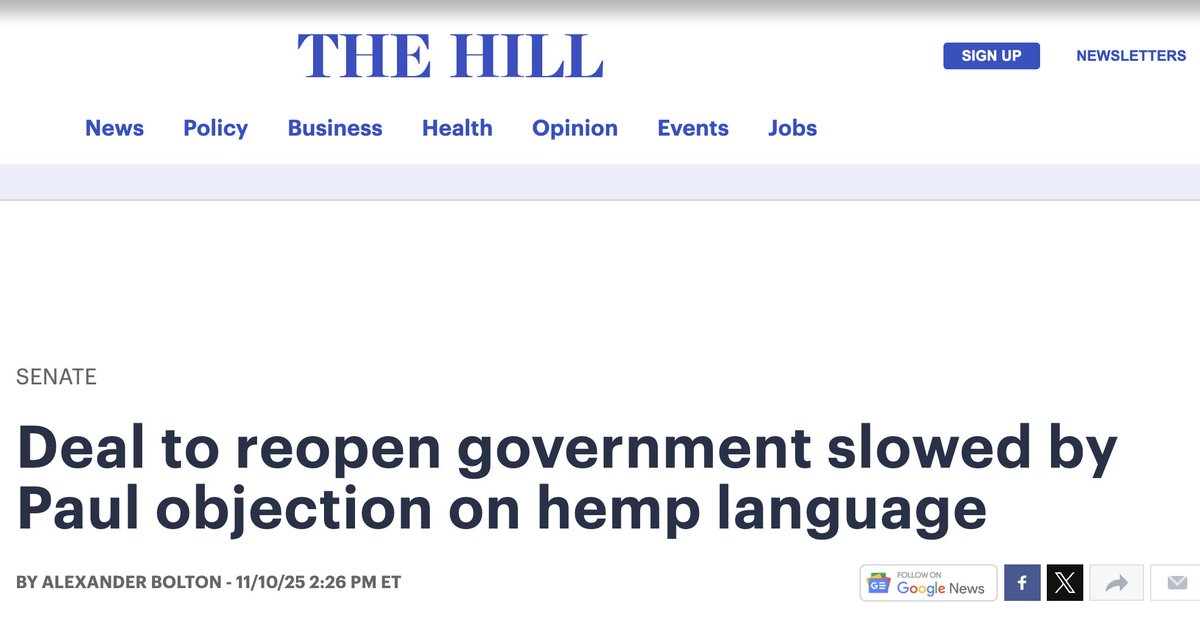
The government is open, but a hemp industry shutdown has just begun.
In true Washington swamp fashion, this hemp ban is not being debated on its own. Once again, Congress created a crisis, then conveniently used the crisis to jam through new laws without debate.
https://t.co/N8jYjHFKpJ
Just to be clear: I am not delaying this bill. The timing is already fixed under Senate procedure. But there is extraneous language in this package that has nothing to do with reopening the government and would harm Kentucky’s hemp farmers and small businesses.
Standing up for Kentucky jobs is part of my job.
@MonicaPerezShow@KithabUmar59430@JohnnyWoodard@paleochristcon I’ve been thinking the same thing.
HEMP or cannabis was far more prevalent in our diet and medications until 1939. It wasn’t these weapons grade products we see out in our culture now. The strains were perfect by nature, higher in CBD or other cannabinoids.
President Trump's campaign proposal to reclassify cannabis from Schedule I to Schedule III is a pragmatic step forward that deserves bipartisan support. Cannabis should not be deemed more dangerous than substances like fentanyl.
Texas Legislators are ignoring your rights. #sb3 is a de facto ban on THC. This basically outlaws all of our federally compliant #hemp products. Under the proposed law possession of CBD is a misdemeanor and sale a felony. Have your voice heard!
https://t.co/iITUlTImUN
Tired, lazy, dysfunctional, we can't help you. We can get you started on the path back to your body and functionality. We promote products which MAY help balance your nervous system. Try our Synapta - nano CBG, fast-acting clear energy which last hours.
“A trace amount of any cannabinoid…would result in a fine up to $4,000 or a year in prison”
Breaking down SB3, Texas’ newest bill that could destroy the Texas cannabis market.
What’s the current research on Cbg and glaucoma?
Anecdotal customer feedback indicates 160 mg per day. 10 drops of FOCI.
——————
Medical research on the effects of cannabigerol (CBG) on glaucoma has explored its potential to lower intraocular pressure (IOP) and provide neuroprotection. Here's an overview based on available studies:
- Intraocular Pressure Reduction:
- Studies, including those from 2008, have indicated that CBG can effectively reduce IOP, which is a primary factor in glaucoma management. For instance, research has shown CBG might be particularly effective because it acts as a vasodilator and reduces eye pressure, similar to the effects observed with other cannabinoids like THC. However, CBG is non-psychoactive, making it a potentially preferable option for long-term treatment.