Great play by @canonpress to try and get Kevin DeYoung onboard. Oh well. But I’m confused… isn’t this the guy who took “cyber courage” shots at Moscow from afar and then was too chicken to come to Moscow and sit down for a video conversation with @douglaswils, @joe_rigney, @JaredLongshore and friends? Then again, maybe he has already done that and I would love to see it! Would love to see him answer actual questions related to his article from 2023.
We don't need more Church programs...
We need strong family and corporate worship.
These are statistically proven to better mold, form, and strengthen the faith of children raised in Church.
Family integrated worship beats peer segregated worship and programs hands down. Not even close.
Ok fine, I take it back, if he wasn’t out-coached, you think his game plan worked? Sub-20 shots on goal and zero effective offensive zone time in the third period. If not for Skinner, they lose 6-2 giving up that many breakaways. Dumb penalties and no sustained pressure all game. Muse was clearly not ready. Neither was his team.
Far too many modern pastors spend far too much time explaining what the text of the Bible is NOT saying rather than what it IS saying. A few examples:
I've been in conservative paedobaptist churches where, when an infant gets baptized, the pastor spends far more time explaining what is not happening than what is happening. 1 Peter 3 says, "baptism now saves you," but by the time the pastor is done with the text, it means "baptism most certainly does not save you." The language of the Bible is not explained in a way that we could make it our own and speak like the apostles did about the sacrament; instead, the language is completely negated. The pastor is not at home in the language of the Bible, so his people never will be either. Paul calls baptism "the washing of regeneration" in Titus 3, but by the time the pastor gets done with the text, the one thing baptism is not is "the washing of regeneration." Romans 6:3ff, Acts 2:38, Galatians 3:27, 1 Corinthians 12:13, and other passages likewise get explained away rather than explained. This even happens in churches where the pastor has sworn to uphold the teaching of the Westminster Standards which explicitly call the sacraments "effectual means of salvation." Sadly, in far too many such churches, baptism gets redefined as an ineffectual symbol.
Here's another test case: When Jesus blessed the children who were brought to him in Matthew 19, he said "for to such belongs the kingdom of heaven." But by the time the pastor gets done with the text, he has argued for the exact opposite position: children are not actually members of the kingdom, and the kingdom does not actually belong to them. The pastor might point out that being born into a Christian home does not automatically save, that grace cannot be transmitted by natural reproduction, and so on. All well and good. But then why did Jesus say what he said and what did he mean? The pastor never actually gets around to that. The result is that the pastor is not training his people to embrace the Bible's way of speaking about covenant children. He is training them to explain the Bible away when the text is controversial or cuts against the grain of cultural sensibilities. In this case, a text that has rich and powerful implications for Christian mothering and fathering is drained of its force and application. A text intended to train believing parents in how to view and treat their children leaves them confused rather than encouraged.
Likewise, when some pastors teach on a wife's submission to her husband, it's qualification after qualification: "Submission does not mean obeying him when he tells you to sin." "Submission does not mean enduring physical abuse." "Submission is does make the wife a doormat who never gets to share her own thoughts with her husband." All perfectly reasonable qualifications to make, of course. But far too many pastors never actually explain what it does mean. Instead, the text gets paper cut to death -- it dies the death of 1000 qualifications. The pastor never plainly restates what the text says so plainly (and repeatedly). The pastor never does what Paul does -- command wives to submit to their husbands in a straightforward way. Thus, the Christian wife is given no concrete, practice guidance in how to be a wife. Her positive duties are never driven home. The pastor apologizes for the Bible more than he applies the Bible. By contrast, when the same pastor teaches on husbands loving their wives, all the positive duties are stressed, and usually in an unconditional way. There is all too often an asymmetry in the way way roles and duties are taught in marriage: wives are only told what they do not have to do, while husbands are told what they ought to do. A simple, straight-forward text gets mangled and silenced.
A final example: James 2 says, "You see that a person is justified by works and not by faith alone." Again, many pastors explain this away. The pastor explains what the text is not saying -- that good works cannot earn salvation - which is a fine point to make. But the congregation is never told, in no uncertain terms, what James meant and why he said what he said. The pastor balks when it comes to insisting on works as a necessary component of salvation, flowing out of faith as its fruit. He fails to make the point the text is making about the necessity of obedience in the lives of Christians -- that while we are not saved on account of good works, neither can we be saved without them. His preaching becomes practically antinomian because he is so afraid of sounding legalistic (apparently a concern James did not share). The same pattern happens with the other texts that describe a final judgment according to works - John 5:29, 2 Corinthians 5:10, etc.
The net result of this kind of teaching is that Christians never get comfortable using the Bible's own language. They are not taught what many texts actually mean and how they should be applied. The fierceness of the Bible's teaching is tamed and domesticated. The Bible is not allowed to do its challenging and convicting work in the hearts of the people. It's as if the pastor is protecting his people from the hard-edged truths of the Bible by blunting their force and impact rather than bringing the people into direct contact with Scripture''s difficult and counter-cultural truths. This kind of preaching seeks to muzzle the Bible rather than unleash it in people's lives. This kind of preaching is driven by an agenda other than exegeting and applying the plain meaning of texts.
Every pastor will admit some texts of the Bible are hard to understand. Many passages are complex. But many very plain teachings of Scripture are offensively simple and rather than letting the text stand on its own and say what it says, many pastors reshape and repackage the text so his congregation does not really have to wrestle with it. This is a form of pastoral malpractice.
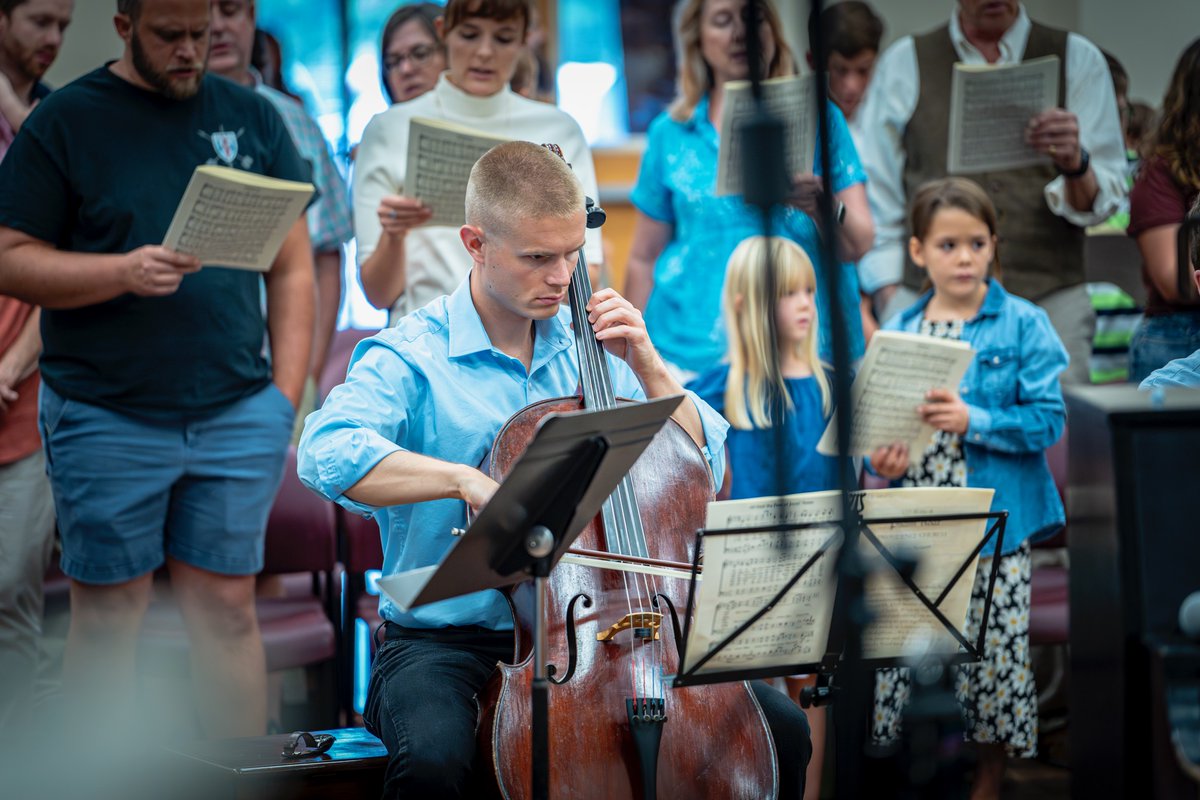
We need to reorient our understanding of music in the life of the church. Church music is not background ambiance, nor is it merely a tool for emotional warmth. It is formative and it is martial. When the church sings, she is being trained for battle. That is why the mood must match the music, and the rhythm must keep pace with the intention of the psalm or hymn. A triumphant text should not limp. A song of lament should not sound casual. The music must carry the meaning so that the congregation can vocalize God's inspired words.
As James B. Jordan has often observed, music shapes the way we inhabit the world. It teaches us how to feel rightly, how to move rightly, and how to respond to God rightly. When music is mismatched to its text, it trains the congregation poorly. But when music and words move together, the church learns courage, repentance, joy, and resolve. Song becomes discipleship.
This means the church must take musicianship seriously. Wherever possible, we should cultivate trained musicians who understand both music and worship. When such training is not already present, the solution is not resignation but investment. If there are men or women who show desire, aptitude, and a sense of calling toward church music, the church should consider budgeting for instruction. Music classes, lessons, and mentorship are not luxuries. They are long-term acts of pastoral care.
If we do not act, we will simply continue to criticize. And criticism without formation produces only frustration. The next generation of church musicians will not appear by accident. They must be taught, encouraged, and supported. Churches that neglect this will inherit mediocrity and then wonder why their singing lacks strength.
Psalm 4 gives us the posture we are aiming for: “Be angry, and do not sin; ponder in your own hearts on your beds, and be silent… Offer right sacrifices, and put your trust in the Lord.” That psalm assumes music that can carry holy intensity and reverent trust at the same time. It assumes a people trained to sing with gravity and confidence.
If we want music that leads the church faithfully, we must be willing to shape it faithfully. That work begins not with complaint, but with conviction, training, and investment.
Watch this video at the 1:10 mark, @joe_rigney with a grand slam segment. Thank you, Joe for your inspiring comments and for articulating the Christian playbook.
Really good work by my friend and colleague, Joe Rigney. So grateful for the number of opportunities God is giving us to preach the gospel so clearly. May God have mercy on our land and turn us back to Himself.
I started listening to @MarkMaddenX when I was in grad school at Duquesne over 20 years ago. Mark is a straight shooter, and I have appreciated and generally agreed with his perspective on all things Pittsburgh sports. I agree 100% with his assessment of Tomlin. Mark is right on with this article. https://t.co/DM4q7P1A3A
It’s refreshing to hear a pastor give this much attention to the importance of music in worship, and particularly Psalm singing. Pastor @douglaswils hit it right on the head with this sermon. And to preach this in his “State of the Chuech” sermon was particularly of note.
https://t.co/gAGFsg1hMz
Thanks Pastor Doug!