PhD in Public International Law | An exiled believer of human universalism finds his perpetual dismay in the world of "realpolitik" and "post-colonial revenge."
I am happy and highly honoured to be a research participant in the 2024 Centre for Studies and Research, @HagueAcademy. In this challenging time for IL, I look forward to receiving guidance and inspiration from top international legal scholars.
I hope JD Vance watches this video.
Yesterday, JD Vance complained that his 3-year-old daughter was scared by a group of protesters shouting “Slava Ukraini.” He even went so far as to call some of them “sh*t.”
The hypocrisy in his statement is staggering. His and Trump’s actions are directly leading to Ukrainian children being killed daily by russian missiles and drones. Now, what would you call a person like that?!
The girl in the video lost her leg due to a russian attack. Yet she continues to smile, she continues to live. She is a symbol of the unyielding strength of the Ukrainian people who are fighting pure evil.
After a long hiatus following my PhD graduation, I'm delighted to share a new work related to my dissertation.
In this article, published by the Dialogues blog of the @NUS_CIL , I argue that while the principle of non-recognition of unlawful situations is traditionally viewed as a tool against serious breaches of peremptory norms (jus cogens), developments in both the African Union and ASEAN suggest its potential application to Unconstitutional Changes of Government (UCGs).
Specifically, ASEAN's responses to Myanmar's 2021 coup provide compelling evidence that aligns with historical practices of non-recognition against illegitimate regimes.
I extend my sincere gratitude to the editors for their valuable input and extensive support throughout this process.
https://t.co/8wAGqluLZN
As a scholar of international law focusing on non-recognition of unlawful situations, I urge President @ZelenskyyUa to reject any UN General Assembly resolution that compromises Ukraine's territorial integrity, regardless of its source - even from the current U.S. administration.
"Not recognising as legal" the Russian occupation and annexation of Ukrainian territories seems like futile and meaningless conduct, but it signals legal consistency for future practices and evaluation. It keeps a crisis from coming to the final conclusion that the perpetrator(s) hope for, thus increasing the chance for normative stability and restoration of lawful conditions in the future.
Peace exchanged through the normalisation of fait accompli is not peace. It's "Munich appeasement". It is an invitation to potential rulebreakers that they could infer the belief that the community not only lacks the current capability to enforce the rule but also does not place value on the rule itself, incentivising further violations and escalations.
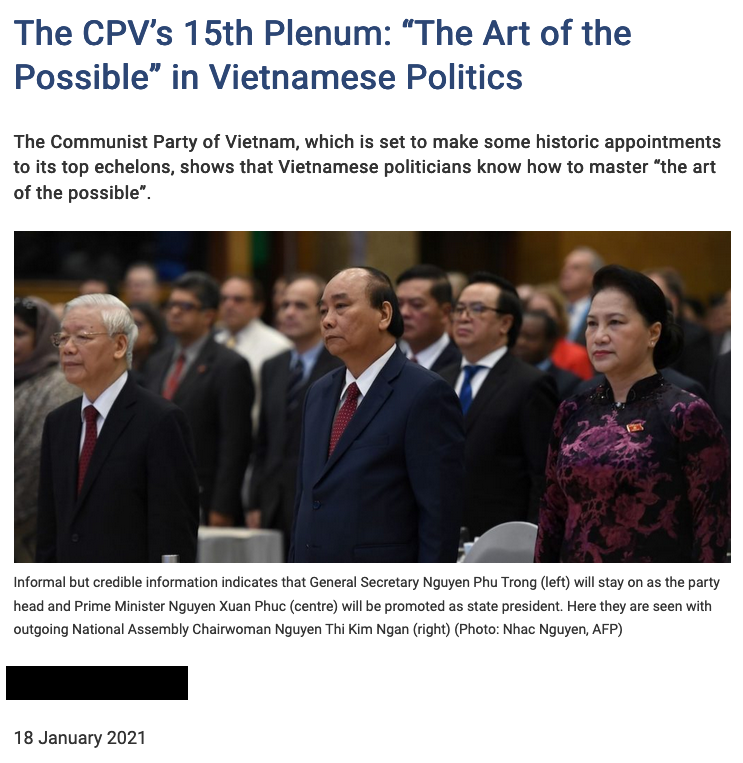
I'm unsure why Mr. Hiep's side is so focused on accusing me of not being able to read English, but I'll simply quote an important passage from the analysis:
'The leadership decisions and institutional changes made at the CPV's 15th Plenum will have important implications for the Party and Vietnamese politics in the years to come.'
Looking at the current situation, one might question whether the 15th Plenum's arrangements have made any impact at all, let alone deserve to be called 'Art.' :D
An Uncritical Tradition of Vietnam Political Analysis?
The article below is from 2021, when the author praised Vietnam's 15th Plenum as "the art of the possible." It was not. The laudatory framing of the CPV's 15th Plenum aged poorly, as three of the four top appointees faced corruption allegations and resignations.
This outcome reveals vetting failures, reactive rather than preventive governance, institutional weaknesses, and possible factional politics. Yet right after the Plenum, scholars lauded it with all the pandering language they could muster. The same pattern is repeating with recent leadership changes.
The disconnect between academic analysis and political reality raises important questions about the current state of Vietnamese political science scholarship. Are we conducting sufficiently critical analysis, or has the field become too deferential? Have scholars who actively write about Vietnam's politics for international audiences become part of the "system"?
The role of academic discourse should be to examine political processes objectively, not to retrospectively justify outcomes that proved problematic. Rigorous political analysis demands we acknowledge both successes and systemic challenges in Vietnamese governance. Only through honest scholarly discourse can we contribute meaningfully to understanding Vietnam's political development.
Thank you to Sir Michael Wood, Megan Donaldson, Harriet Moynihan and @MarcoLongobardo as well as everyone who attended my book launch yesterday. I thoroughly enjoyed engaging with your comments and questions! https://t.co/D0ffFk7fa1 @OUPLaw @UW_WLS #ilaw
@lhhiep Yes, clearly. I discussed it purely from a analysis point of view, without any condescending accusation against your "English" or say that "You clearly know nothing". But you said all that to me. I think readers can see that.
Again, I think your discussion is degenerated into a personal attacks fiesta. If you think someone with basic English can understand your points, then they can understand my points.
Again, just want to stress that "political reality" is not just the description of one political system professed from insiders.
Dead and Hiep, I think accusing each other of "deliberately" misreading does not really constructive. You can say that about me reading your piece and I can say the same to you. It does not lead us anywhere.
The problem with the system and why I think it is not artistic or masterful is reflected here: "...This outcome reveals vetting failures, reactive rather than preventive governance, institutional weaknesses, and possible factional politics."
Your appeal to authority and information from "people who know better" also demonstrate the point that I want to make: contemporary political analyses exploit their political connection and repeat the same rhetoric from the source without critically examining the source and its inherent problems.
Only few places left for my book launch this Wednesday! International law and the principle of non-intervention: history, theory, and interactions with other principles | University of Westminster https://t.co/uuI6FhSV4s
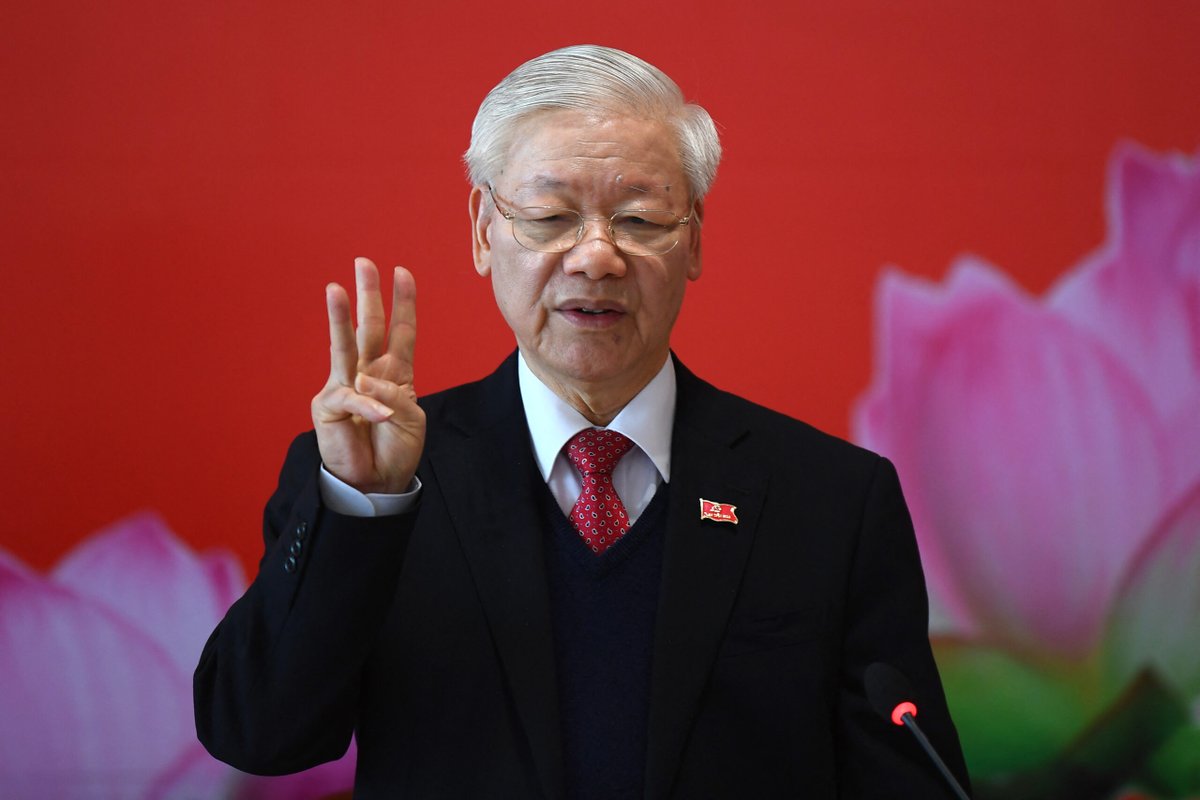
As many sources confirm that General Secretary Nguyen Phu Trong has passed away, here are some of my notes that challenge scholars' assumptions about his contributions.
1) VCP's human resources: The furnace blazed for nothing
I think Mr Trong has yet to significantly improve the quality or morality of the VCP's leading cadres.
After three official terms, in which two terms he had complete control and oversight over the party (2016 - 2024), his political selections and structural arrangements are no less problematic than those from former Prime Minister Nguyen Tan Dung's wing.
2) Creating the omnipotent/omnipresent Ministry of Public Security
Due to his overreliance on the MPS for the anti-corruption campaign, the Vietnamese now have an overpowering super ministry. The MPS is now out-budgeting, out-manoeuvring, and out-representing any other civil power branches in the Vietnamese state's superstructure.
Not only we are expecting the first-ever Minister of Public Security to become the General Secretary (Mr To Lam), but the MPS is now also the overseer of almost every aspect of people's lives (ID card, registration of residence, immigration, registration of motor vehicles, cybersecurity/personal biometric data, the upcoming online identification requirement, grassroots "security" forces...). Many of these powers are added with the blessing of Mr Trong.
I am delighted to announce that my book on the principle of non-intervention has finally been published. The book comprehensively analyses the history and theory of the principle as well as its interaction with other principles of international law https://t.co/bIpK5DKgP2
@OUPLaw
I use “analogy” to compare two things (typically for explanation or clarification).
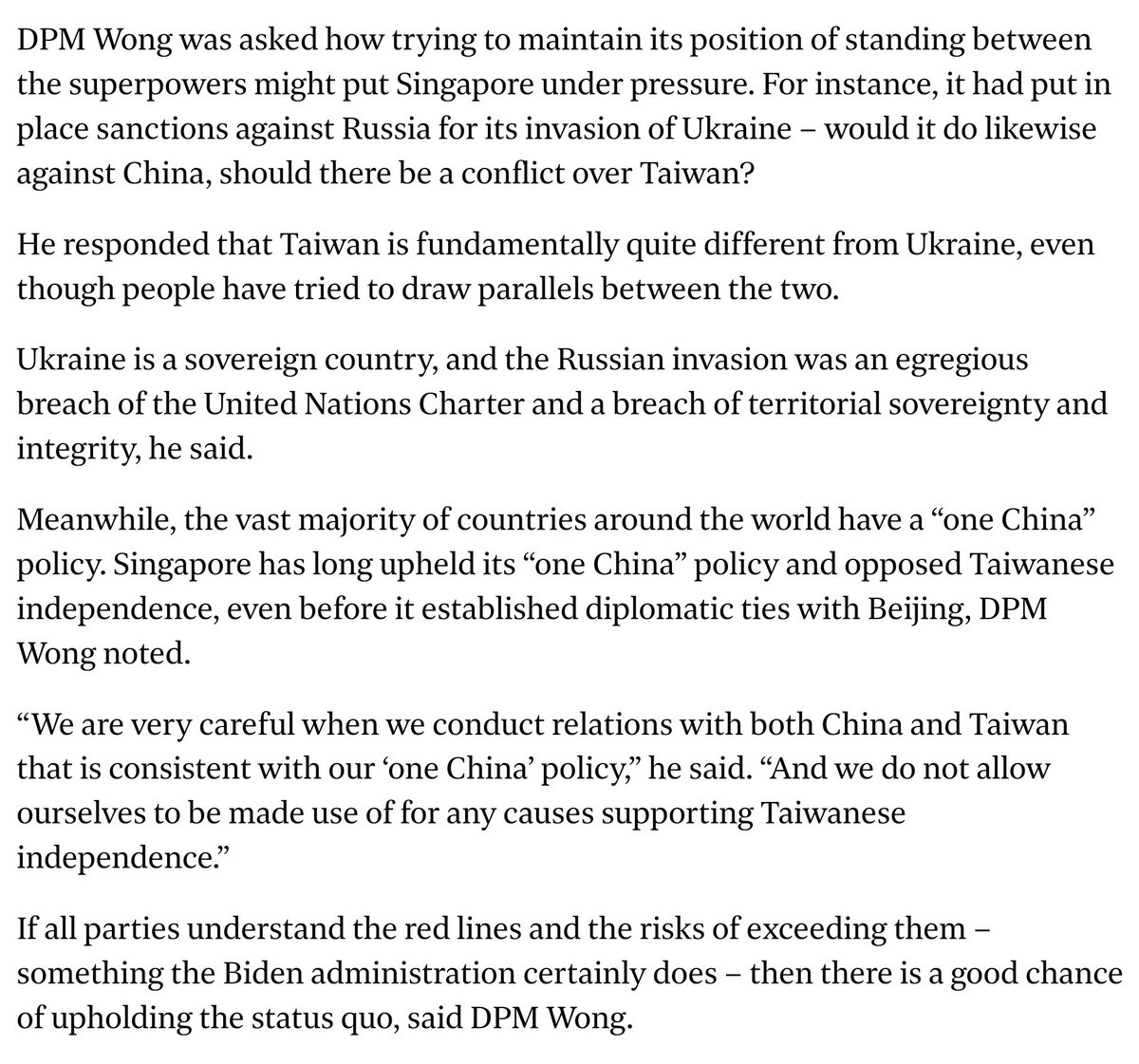
So when he is trying to say that Ukraine is “fundamentally different...” because Ukraine is sovereign and Taiwan is not, it is a theoretically descriptive analogy that paints Ukraine’s independence as a defensible concept, but Taiwan is not (in the case of an invasion). I propose that such an “analogy” is not helpful in the article.
I propose this article of mine, published in the blog of @USALINYU, to anyone who insists that the Russian invasion of Ukraine is fundamentally different from a hypothetical Chinese invasion of Taiwan just because Taiwan is not a recognised sovereign state.
The argument is that, “Is Taiwan a state?” is the wrong question when pondering the PRC’s possible use of force against the island.
https://t.co/g8SJRDkVYF
Singapore future prime minister on Taiwan:
"Taiwan is fundamentally quite different from Ukraine.
Ukraine is a sovereign country, and the Russian invasion was an egregious breach of ... territorial sovereignty and integrity, he said."
https://t.co/TIROgDDl30
@Xnarkycritic@USALINYU "De facto" independence is helpful if the actors involved want to keep the status quo. However, in this case, since the PM is making an analogy with the Russian invasion of Ukraine, I don't think that "de facto" independence is helpful.
Abstract:
Russia’s invasion of Ukraine again proves the essential role of collective non-recognition against unlawful situations, despite contentious debates concerning the status of the principle of non-recognition in the international legal system. However, an old but unsettled question also resurfaces: How should we perceive the relationship between the practice of non-recognition and economic sanctions?
Some scholars contend that the practice of non-recognition must entail economic punishments and isolation and be ‘as oppressive as possible’. For quite some time, the economic language has dominated as the only language that matters facing any unlawful situations. Unfortunately, this tendency also undermines a long history of innovative development of other forms of declaratory and institutional non-recognition.
This article, by examining the current non-recognition campaign in the case of Ukraine, together with case studies of Manchuria and of the South African apartheid regime, endeavours to provide more perspectives concerning the relationship between non-recognition and economic sanctions. The article argues that, compared to other forms of non-recognition, economic sanctions have never been a reliable factor in demonstrating international attitudes and the legal beliefs of the international community.
I am happy to share that the Journal of Conflict and Security Law @j_csl (OUP) has officially published my article on non-recognition and economic sanctions.
Titled The Practice of Non-recognition and Economic Sanctions: The Case Study of Ukraine, Manchuria and South Africa, the article is a mini case-study effort to understand the practice of non-recognition of unlawful situations and how it should be differentiated from economic sanctions. (1/2)
Here is the toll-free link for reference if anyone is interested in the article: https://t.co/XmBT7lDa98