@binishmatheww@Zhuinden Several parts of @arrow_kt are "feature complete". This means we don't expect big changes in the API, and most releases are about bug fixing.
This is a good thing: if you use @arrow_kt in your project, we won't pull the rug in 3 months. We want it to be a stable mature library.
@Zhuinden I don't think that's a fair conclusion. Yes, I take care of most of the "maintenance" stuff like releases, and I have this role in agreement with other co-maintainers.
But there's more to coding to the project: giving talks about it, helping people, writing integrations.
@Zhuinden Also, after a push for the new `Raise` implementation, most of the libraries are sort of "feature complete". This is not a bad thing; in fact this means that you can build using @arrow_kt without the risk of the floor falling under your feet.
@Zhuinden I don't think that's a fair conclusion. Yes, I take care of most of the "maintenance" stuff like releases, and I have this role in agreement with other co-maintainers.
But there's more to coding to the project: giving talks about it, helping people, writing integrations.
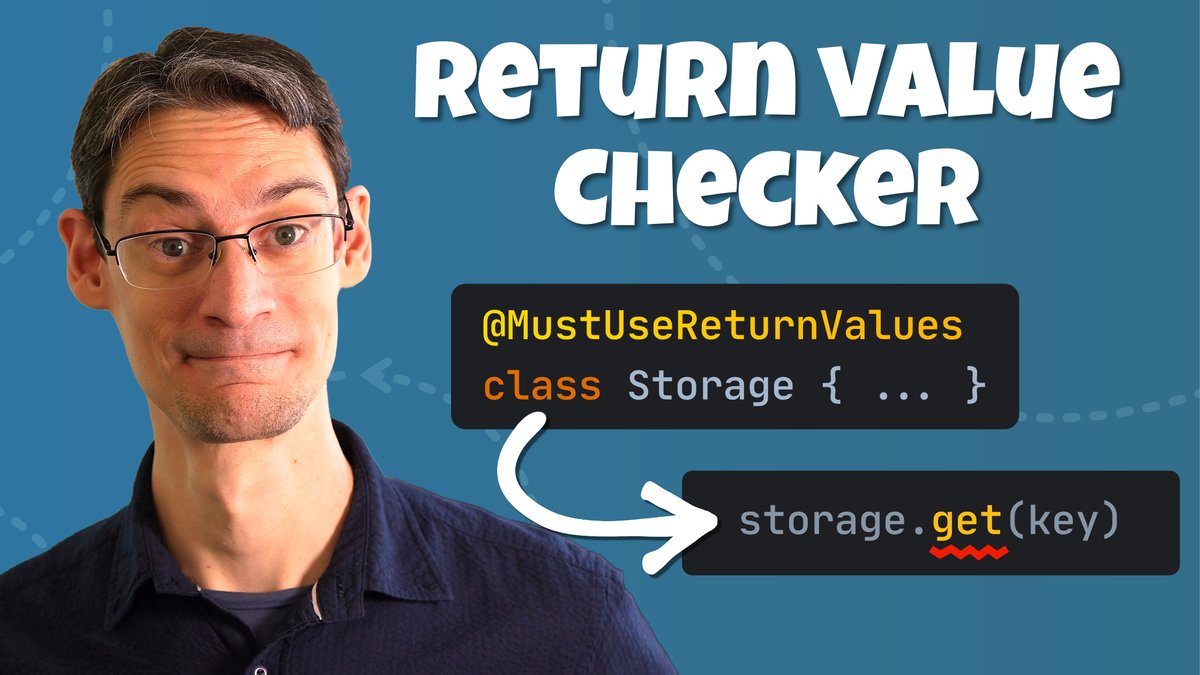
Kotlin's return value checker - lots of developers missed this one. In this video, I show how you can use it to expect call sites to use the values returned from your functions. See you at KotlinConf this week!
https://t.co/FTSTATj3LH
The Full Lineup for #LambdaWorld26 is HERE!
Where: Torremolinos, Malaga. Spain
When: October 29-30, 2026
How: https://t.co/FMKfBqDaAP
Get your tickets NOW!
Great roadmap! Love it. One underrated lesson from Kotlin: positional destructuring by default was a design mistake. Functional ideas are great and useful, but pragmatic languages for industry should be careful about importing too much academic baggage.
Happy to share that we have folks from the language design team blogging about new features!
Check out this post by @trupill about how Kotlin is moving to a safer, Name-Based Destructuring syntax:
https://t.co/6kP3chbfeD
After years of waiting for this feature, we finally have it in Kotlin! Collection literals are supported as an experimental feature since Kotlin 2.4. The idea is simple: You can create a collection using a box bracket. Based on the specified type, a different collection type might be created, like a list or a set. If no type is specified, a list is created by default.
Collection literals associated with the of operator on a companion object. You can make them work for custom types by defining this operator. It mustn’t be an extension.
Collection literals require Kotlin 2.4 (such as "2.4.0-Beta2”), "-Xcollection-literals” compiler argument, and IntelliJ IDEA 2026.2 (which should be released in EAP around May 5th).
Here you can see them used in the KotlinConf application: https://t.co/lNjqfyIPkp
Last day to purchase your early camaron tickets and submit a proposal to our Call For Papers!
https://t.co/PafxJFehwD
@CFP_Bot@WikiCFP#FunctionalProgramming
We encourage undergraduate, master’s, and early-stage PhD students interested in programming languages to apply for PLMW at PLDI 2026. It is a great opportunity to learn from researchers, build connections, and explore future directions in PL. Apply here: https://t.co/SmbDEyTZL6
We just open-sourced lean4-json-schema: derive JSON Schema from Lean 4 types, with a compile-time proof that serialization always validates against it.
No more trusting. The compiler checks it. 🧵
https://t.co/U7Rr9HdHa2
Destructuring has been a popular feature in Kotlin, but since it's been based on position, it comes with some risks. But with Kotlin 2.3.20, you can eliminate many of those risks! Here's what I mean...
Since destructuring is based on position, the order of your variables needs to match the order of the components (such as the data class constructor properties).
If you accidentally swap around a few of them, you could end up with some surprises, and it's easy to do, especially when several of the components have the same type!
But with Kotlin 2.3.20, you can now enable an experimental feature to use name-based destructuring instead! When activated in "complete" mode, the syntax we've been using up until now will match based on name rather than position. This means you can get them out of order, and it still works.
If you use a name that doesn't match, you'll get a compiler error. But for those cases where you actually wanted a different name, you can use a new syntax to assign the component to a different name:
val (title, cost = price, author) = book
Prefer to use the classic, position-based destructuring? You can use brackets instead of parentheses, like this:
val [author, cost, title] = book
The bracket syntax brings along some connotations of collections, which seems fitting, since position-based destructuring could still be helpful for things like Pair and List.
It's still experimental, and there's a full migration path planned out, but you can activate it today with a compiler argument.
What do you think about this feature
Do you like the new syntax?
Have you run into issues with position-based destructuring in the past?
#Kotlin #AndroidDev
@djleeds Actually, if you want to go "all in" to the return value checker, I strongly recommend adding '-Xreturn-value-checker=full' to your 'freeCompilerArgs'. That way you get checking, but also every function becomes "must use" by default, unless you mark it as "ignorable".
YO! FP Community!
Do you know who is coming to Malaga this April?
@ElixirConf EU 2026 takes place in Málaga, Spain, this April with 600+ attendees, keynotes from @josevalim and @chris_mccord , and 40+ talks on Phoenix, LiveView, AI/ML, and production systems.
As Europe's premier Elixir conference, it's the perfect opportunity to connect with the community and showcase your involvement in the ecosystem. https://t.co/Mxc2SqzW6J
🆕 The Kotlin 2.3 what’s new video is out!
Learn from Márton (@zsmb13) as he showcases the highlights of the new version, including language additions, features that became stable in this release, and improvements across all platforms 👇 https://t.co/TEreKI9lDp
Catch up with everything that's new in Kotlin 2.3 in our latest video!
We have some really cool new features (explicit backing fields and unused return value checker!), previously announced features that are stabilizing, neat stdlib updates, and more!
https://t.co/gm8iVHmtJ7
Here's our overview and links to our initial materials to help you with AGP 9.0 migrations of your Kotlin projects!
https://t.co/ElNNt3w9lX
More to come later still, such as updates in the KMP wizard and in our samples.








![djleeds's tweet photo. Destructuring has been a popular feature in Kotlin, but since it's been based on position, it comes with some risks. But with Kotlin 2.3.20, you can eliminate many of those risks! Here's what I mean...
Since destructuring is based on position, the order of your variables needs to match the order of the components (such as the data class constructor properties).
If you accidentally swap around a few of them, you could end up with some surprises, and it's easy to do, especially when several of the components have the same type!
But with Kotlin 2.3.20, you can now enable an experimental feature to use name-based destructuring instead! When activated in "complete" mode, the syntax we've been using up until now will match based on name rather than position. This means you can get them out of order, and it still works.
If you use a name that doesn't match, you'll get a compiler error. But for those cases where you actually wanted a different name, you can use a new syntax to assign the component to a different name:
val (title, cost = price, author) = book
Prefer to use the classic, position-based destructuring? You can use brackets instead of parentheses, like this:
val [author, cost, title] = book
The bracket syntax brings along some connotations of collections, which seems fitting, since position-based destructuring could still be helpful for things like Pair and List.
It's still experimental, and there's a full migration path planned out, but you can activate it today with a compiler argument.
What do you think about this feature
Do you like the new syntax?
Have you run into issues with position-based destructuring in the past?
#Kotlin #AndroidDev](https://pbs.twimg.com/media/HDk4kC5WMAANy0k.jpg)