Think about it:
We’re asking you: What if we tell you, you can now compare the price of that bag you saw online to other vendors rate in just one tap?
Abi we told you with that same tap, you can see the confidence level of that vendor before you pay? You go like am abi😉🤩
Think about it:
We’re asking you: What if we tell you, you can now compare the price of that bag you saw online to other vendors rate in just one tap?
Abi we told you with that same tap, you can see the confidence level of that vendor before you pay? You go like am abi😉🤩
Entry 2: Boring First Principles
After getting @tryPricePoint to a point where I finally felt the business was structurally sound, I decided to do something uncomfortable this week.
I wanted to stress-test the very foundation of what we were building. That led me to a question:
“How do we know we’ve actually found the problem or did we convince ourselves that we have?” I mean, we have results from our customer discovery process. It revealed more than we initially thought.
While validating ideas with potential users, I kept coming back to something I had learned. The first answer is almost always the most obvious one, and obvious answers are rarely where the biggest opportunities are.
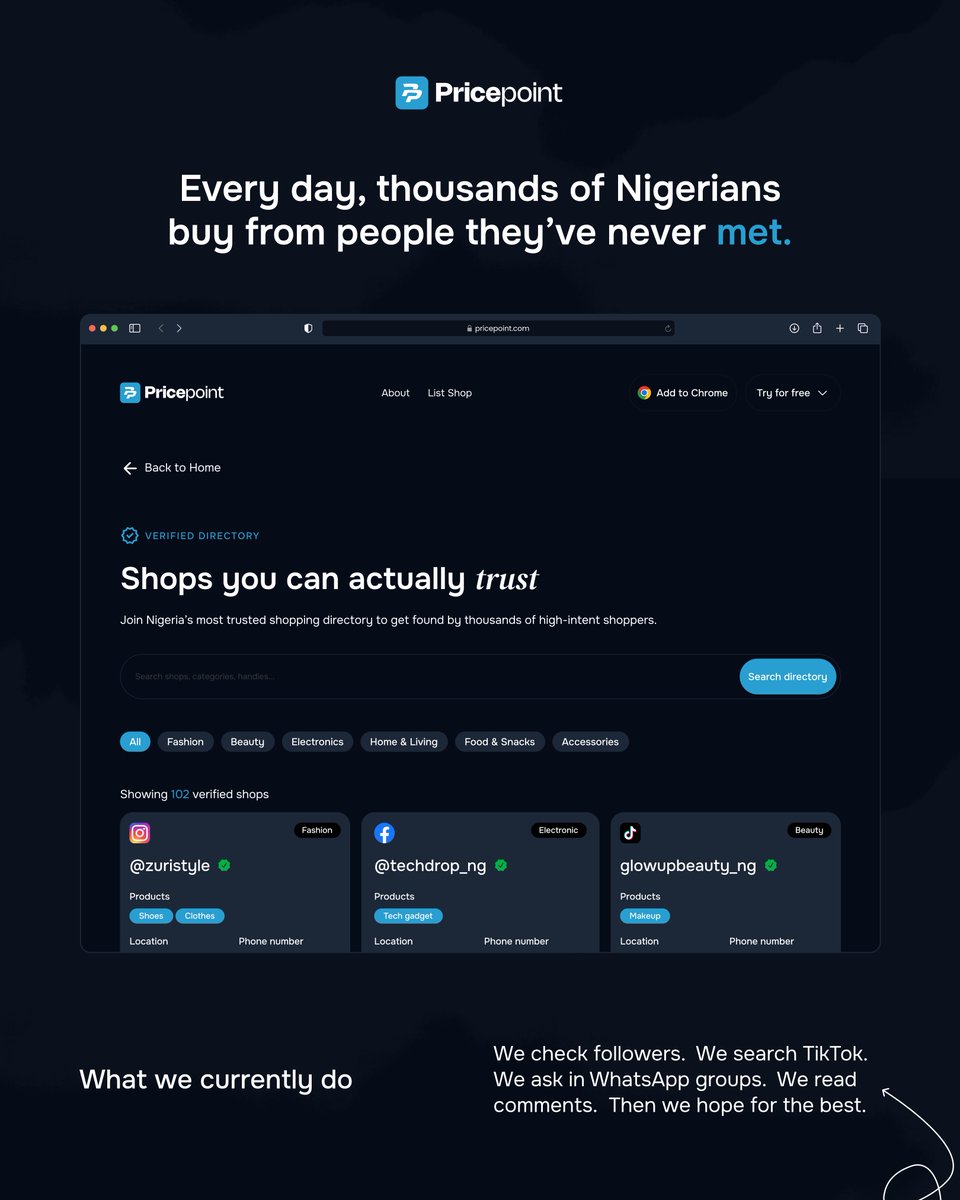
Somewhere in the middle of that process, I found myself thinking about concepts like Inertia Risk and the Pain/Gain Ratio. What struck me wasn’t the frameworks themselves, but the realization that people are remarkably good at adapting to broken systems. Exempli Gratia, Most buyers don’t complain about investigating sellers anymore. They check followers, scroll comments, ask friends, search TikTok, and move on. It’s become muscle memory.
The question quickly became: Is what we’re solving actually painful enough that people want a different way?
I’m beginning to think that’s where the most interesting companies are built. Not by solving the loudest problems, but by noticing the quiet behaviours everyone else has accepted as normal, and questioning whether they should be.
That was my biggest takeaway this week. Validation continues. It ends at PMF.
Today, I take the first step out of my shell and pledge to stay consistent with posting on X.
I finally subscribed to X Premium.
Not in totality about the blue tick.
Mainly because I want enough room to document what we're building properly.
Over the next few months (and hopefully years), I'll be building @tryPricePoint in public, but probably from a different angle than you're used to seeing.
I've always enjoyed watching engineers build in public. You get to see architecture decisions, technical trade-offs, bugs, breakthroughs, and the thinking behind the code.
But building a company is much bigger than building just software.
I'll be sharing the business side of building a startup and leaving the tech side completely to one of my amazing co-founders @ogokimin.
The customer discovery.
The fundraising.
The strategy debates.
The mistakes.
The pivots.
The financial models.
The pitch decks.
The market research.
The textbook vs. reality moments.
The uncomfortable decisions that rarely make it into launch announcements.
If you're interested in startups, venture building, business development, fundraising, or simply want to follow the journey of building PricePoint from the ground up, I'd love to have you along and for you to repost 🙏.
The goal isn't to pretend we have all the answers.
It's to document the process honestly as we figure them out and hopefully inspire other founders.
Good morning people, and Happy New Week🤩!
We’re asking a question nobody seems to be
Over the next few months, we’ll be exploring how trust actually works in social commerce.
The good.
The bad.
The scams.
The merchants doing things right.
And why buying online still feels like a gamble.
interests you? Follow us
We’re asking a question nobody seems to be
Over the next few months, we’ll be exploring how trust actually works in social commerce.
The good.
The bad.
The scams.
The merchants doing things right.
And why buying online still feels like a gamble.
interests you? Follow us
When deploying the py architecture for one previous project, meeting security and data guidelines for mobile app audits on Day 1 taught me the value of data design.
As I map out the pre-build phase for @tryPricePoint, I am applying some of those infrastructure principles to solve a common BE problem like normalising unstructured data from external platforms.
To ensure this app scales smoothly from hundreds to hundreds of thousands of records, the technical methodology will prioritise a decoupled ingestion pipeline
The Dream 🩵
The Promise?
To make sure all online shoppers have all the right information they need before making a purchase.
So help us, God🙏
Happy New Month!
The Dream 🩵
The Promise?
To make sure all online shoppers have all the right information they need before making a purchase.
So help us, God🙏
Happy New Month!
5 signs that online vendor is about to scam you 🚩
1. No refund stated in bio
2. New page, no real reviews
3. “Pay now now, limited availability”
4. Price is too good to be true
5. Gets angry when you asks questions
Save this one.
5 signs that online vendor is about to scam you 🚩
1. No refund stated in bio
2. New page, no real reviews
3. “Pay now now, limited availability”
4. Price is too good to be true
5. Gets angry when you asks questions
Save this one.