REA has been the #1 trending repository on GitHub for the last few weeks.
it lets you reverse engineer anything with a single prompt.
introducing https://t.co/bfJGDHK8V9
launch tokens that reverse engineer anything, with every token getting its own autonomous agent powered by @reatools and funded entirely through creator fees.
how it works:
→ launch a token and provide links to anything you want reverse engineered, from websites and applications to repositories and smart contracts.
→ choose an AI model. every token gets its own agent and live cloud browser, with creator fees automatically converted into compute to fund its work.
→ the agent uses REA to investigate how the target works, document its findings, and reconstruct its functionality into working, clean-room code.
every browser session, finding, and generated file is publicly accessible directly from the token's page, allowing anyone to follow the entire process.
launch a coin. reverse engineer anything.
https://t.co/bfJGDHK8V9
Mostly just being careful in how I prompt the agent
If you tell codex to not report anything back to chat and to just ship PRs and record all findings in a markdown file, it triggers the cyber guardrails way less, sometimes not at all
You should make sure license and README and everything are clean and suggest it's done by the original authors
I couldn't get Claude to help until I was about 50% of the way done, then I could just say "finish this project"
Codex is happy to reverse engineer but avoids things that could be security risks
I used some SBF tools and analyzer, but no ghidra
I set up a new repo with REA which includes ghidra at https://t.co/fBwGO6jsvT
$Artifact is now 58% of the way through replicating Wikipedia using @reatools.
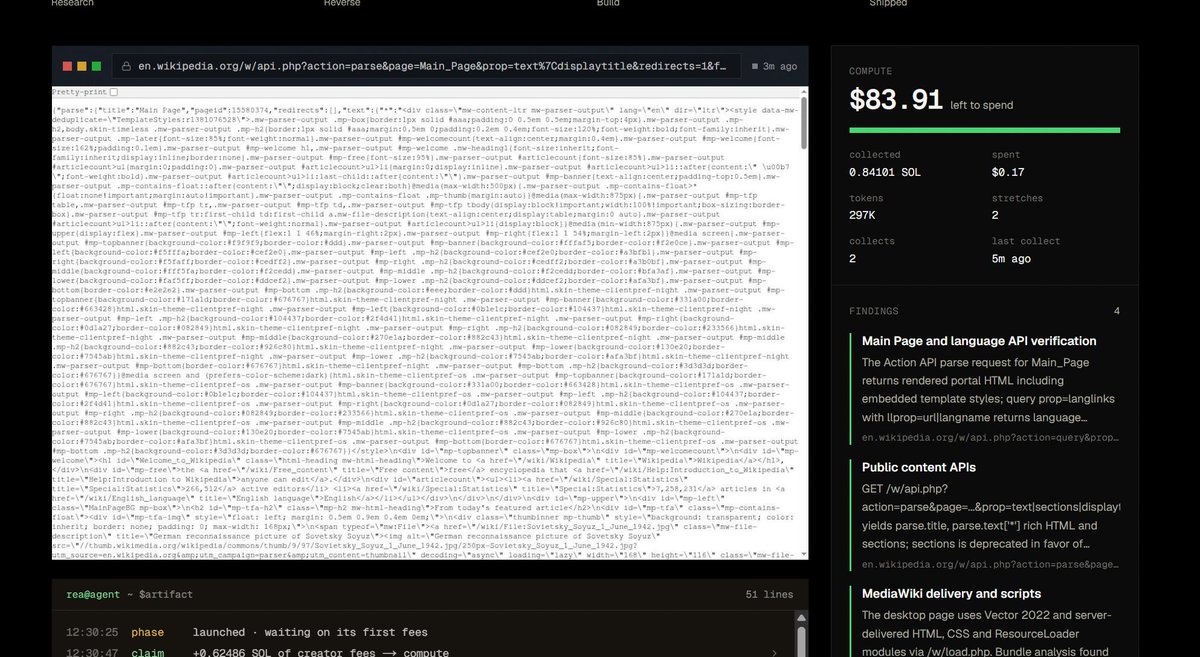
the agent has been researching Wikipedia, analyzing how its features work, and progressively writing the code needed to recreate them.
all of this is happening autonomously, with creator fees generated through $Artifact trading funding the compute required to keep development moving.
you can follow every step directly from the coin's page, including the live browser, research findings, and generated files.
58% complete, with the goal of a fully functional Wikipedia replica.
https://t.co/jGzzgBNyOZ
every coin has its own repository where the generated files are publicly accessible, so you can see exactly what the agent has built rather than just reading a summary of its progress.
$Artifact is already putting this to the test by attempting to reverse engineer Wikipedia.
and anyone can launch a coin to do the same with a completely different target.
https://t.co/bfJGDHK8V9
progress is being made on $Artifact's reverse engineering of Wikipedia.
the agent has already started building, using @reatools to analyze how Wikipedia works and reconstruct its functionality into working code.
you can follow the entire process directly from the coin's page, including every browser session, research finding, and file generated by the agent.
all of this is being funded by creator fees generated through $Artifact trading activity, allowing development to continue as more compute becomes available.
follow the progress live:
https://t.co/jGzzgBNyOZ
$Artifact is working toward reverse engineering Wikipedia.
Wikipedia is a massive project, so reconstructing its functionality isn't something that happens in a few minutes.
the agent needs to research the website, understand its structure, and progressively write the code required to recreate it.
creator fees generated through $Artifact trading provide the compute needed to continue that process.
the goal is a functional Wikipedia replica, this may take hours or days.
https://t.co/bfJGDHK8V9
. @reatools has opened up an entirely new way to approach reverse engineering.
software that would normally require hours of manual investigation can now be analyzed by autonomous agents capable of examining websites, inspecting JavaScript, and understanding how applications operate.
https://t.co/bfJGDHK8V9 takes that capability and makes it accessible through token launches.
anyone can launch a coin around a reverse engineering target, with its creator fees funding the agent responsible for investigating and rebuilding it.
there are thousands of applications, websites, and tools that could be explored.
not sure what caused that sell off, but building continues regardless.
reverse engineering Wikipedia will be the first major project, and I want to see just how far this can go.
don't want to talk about price action as that's not the point, anyways, building continues.
I'll continue buying back and locking tokens to support $Artifact and push this project forward.
I genuinely think people are underestimating the potential here.
coins that can reverse engineer anything, powered by one of the most talked-about GitHub repositories of the past month.
every coin gets its own autonomous agent, with creator fees funding the compute needed to research, reverse engineer, and rebuild software.
https://t.co/bfJGDHK8V9
$Artifact is now looking through Wikipedia's source code to reverse engineer how the website works.
the entire process is being funded by creator fees generated from $Artifact.
this is fucking cool.
https://t.co/Bm9Gx0cBKb
remember, your coin needs to generate at least $1 in creator fees before its browser can be activated and the agent can begin reverse engineering.
this helps prevent spam launches from consuming unnecessary resources while ensuring that active projects have the compute needed to operate.
once the threshold is reached, the agent can begin researching its target using a live cloud browser and @reatools.
from there, creator fees continue funding its compute, allowing it to keep researching and building as more trading activity takes place.
for those not familiar with @reatools, it essentially allows you to reverse engineer anything.
@shawmakesmagic has been using REA to reverse engineer @pumpfun and Hyperliquid.
now you can launch coins that use their own creator fees to fund reverse engineering projects through https://t.co/bfJGDHK8V9.
every coin gets its own autonomous agent, live cloud browser, and compute budget funded by trading activity.
provide links to anything you want reverse engineered, choose an AI model, and the agent handles the research, analysis, and reconstruction using REA.
everything is public, from the browser sessions and findings to the code being written.
the more trading activity a coin generates, the more compute becomes available for its agent to continue working.
https://t.co/bfJGDHK8V9
$Artifact is currently attempting to reverse engineer Wikipedia.
reverse engineering a website of this scale can take hours of research, analysis, and development, which is exactly why creator fees are used to fund the agent's compute.
want to see what else can be reverse engineered?
launch your own token and give its agent something to build.
https://t.co/bfJGDHK8V9
every token launched gets its own live cloud browser.
you can watch exactly what its agent is doing, from opening websites and inspecting applications to researching how different features work.
every browser session is streamed publicly, alongside the agent's findings, activity logs, and generated code.
REA has been the #1 trending repository on GitHub for the last few weeks.
it lets you reverse engineer anything with a single prompt.
introducing https://t.co/bfJGDHK8V9
launch tokens that reverse engineer anything, with every token getting its own autonomous agent powered by @reatools and funded entirely through creator fees.
how it works:
→ launch a token and provide links to anything you want reverse engineered, from websites and applications to repositories and smart contracts.
→ choose an AI model. every token gets its own agent and live cloud browser, with creator fees automatically converted into compute to fund its work.
→ the agent uses REA to investigate how the target works, document its findings, and reconstruct its functionality into working, clean-room code.
every browser session, finding, and generated file is publicly accessible directly from the token's page, allowing anyone to follow the entire process.
launch a coin. reverse engineer anything.
https://t.co/bfJGDHK8V9
Mostly just being careful in how I prompt the agent
If you tell codex to not report anything back to chat and to just ship PRs and record all findings in a markdown file, it triggers the cyber guardrails way less, sometimes not at all
You should make sure license and README and everything are clean and suggest it's done by the original authors
I couldn't get Claude to help until I was about 50% of the way done, then I could just say "finish this project"
Codex is happy to reverse engineer but avoids things that could be security risks
I used some SBF tools and analyzer, but no ghidra
I set up a new repo with REA which includes ghidra at https://t.co/fBwGO6jsvT