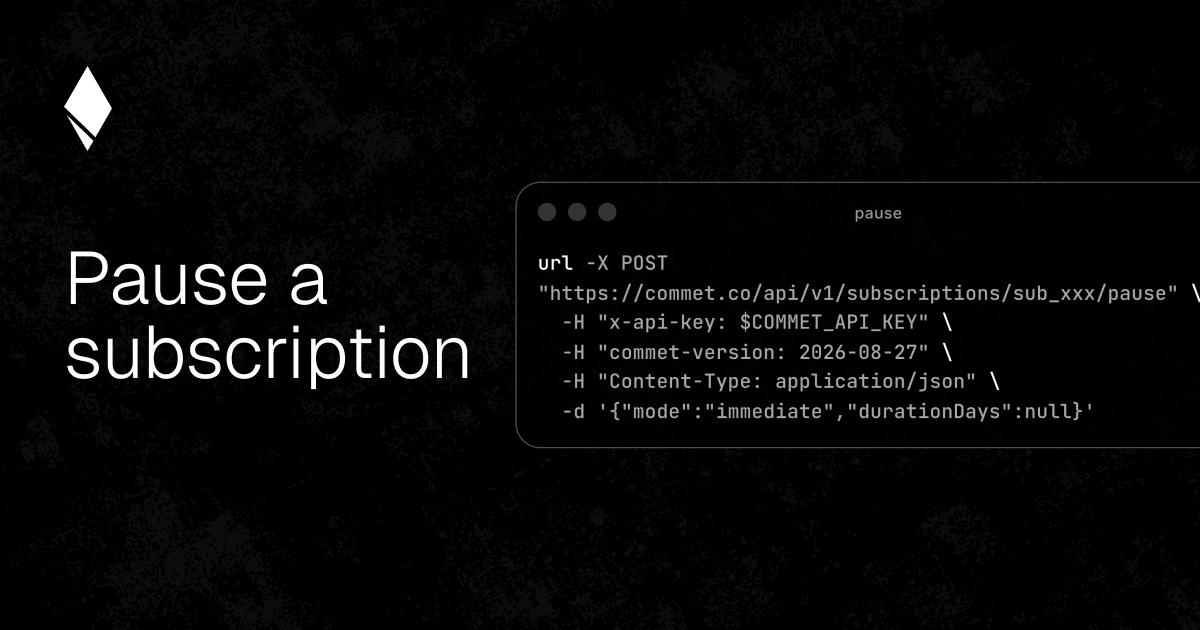
When a customer needs time away, you can pause their subscription and keep a path back.
Commet lets you pause paid recurring subscriptions immediately or at the end of the current period. The two choices handle access and billing differently.
Ask your agent: "Show this customer's active subscription and latest invoices"
Commet's MCP gives it tools to read that billing context, so you can review the records in the same conversation.
Need to reduce a customer's bill? Grant a monetary credit in the invoice's currency, with a reason. Commet applies it to eligible invoices before tax and records where it was used.
Four ways to use it:
Reward a referral
Promised a $20 billing credit for a referral? Once you've verified it, grant the credit with the reason. It reduces an eligible future invoice and leaves a record of the reward.
Here's a plan upgrade in the Customer Portal.
Choose a plan, review the proration breakdown, then confirm. The preview shows the new plan charge, credit for unused time, and estimated total.
Commet handles plan upgrades and downgrades through the Customer Portal, MCP, or API.
Create a Plan Group, add your plans, then order them from lowest to highest tier. That order defines the upgrade path.
Updating to @commet/node 9.4?
-Check your handlers for the new paused subscription status and resume invoice type.
-The SDK defaults to API 2026-08-27.
-Explicit API overrides and webhook endpoint versions stay unchanged.
Your billing experience. Ready to use, or built by you.
Use Commet's hosted customer portal, or build your own screens with the API and SDK for subscriptions, usage, and invoices.
You design the experience. Commet handles the billing.
Commet headless.
Create customers and subscriptions from the CLI. Request refunds from your code. Fetch invoices through the API.
Use these billing operations in your app, scripts, and workflows without opening the dashboard.
A customer changes their saved payment method. Past transactions still need to show how each payment was made.
Commet now stores "paymentMethod" on each transaction and includes it in transaction APIs and payment outcome webhooks.