Meet CompliR, the risk layer for USDC payments on Arc.
AI agents are starting to move real money, but almost none of them know who they're paying.
CompliR fixes that with one call before any payment, and it answers in plain words:
- safe to pay,
- pay up to a limit, or
- don't pay.
Behind that answer, it checks sanctions lists and Circle's USDC blocklist, and traces the wallets that funded the address two hops back.
Every verdict is signed, mirrored on @Arc so smart contracts can read it, and re-checked when anything changes.
The company behind it is run by an agent too, setting its own prices and refusing to pay flagged wallets.
Our submission to the Tameion Agents Hackathon (@thecanteenapp) is live on Arc mainnet today.
- https://t.co/uknwmiNNIn
Screen before you pay.
Last week, an agent approved a delivery that looked perfect.
The wallet belonged to the Ronin Bridge hacker. CompliR scored it 100 out of 100, @Datweb3guy's iPay blocked the payment, and not a cent moved.
That's the whole idea: agents can check the work, but someone has to check the wallet.
This week we're onboarding more @Arc builders, so if your app moves USDC, one prompt adds screening before money moves.
Screen before you pay.
This is exactly what CompliR is for.
iPay checks the work, then checks the wallet, and only pays on a signed low-risk verdict.
In their live run, the delivery looked perfect, but the wallet belonged to the Ronin Bridge hacker, and no USDC moved.
Thanks @Datweb3guy for building with us.
Paying a contractor in USDC takes seconds. Knowing you should pay them takes days
So we built iPay on @arc. It pays contractors when the work is done, and only after the wallet is cleared
A business signs up with just its name, and @circle creates its own wallet on Arc (no seed phrases)
When a contractor delivers, an AI agent checks the work against what was agreed and writes down why it decided to pay, hold or ask for changes
Also, we integrated @tryCompliR into our build, and do you know why?
We did this because, before any USDC moves, CompliR screens the receiving wallet: sanctions lists, Circle's USDC blacklist, Arc's blocklist, on-chain history, who funded it, and lookalike addresses. iPay only pays on a signed low-risk verdict
In our live run, the agent approved a delivery that looked perfect. The wallet belonged to the Ronin Bridge hacker. CompliR scored it 100 out of 100, and iPay blocked it (no cent moved)
The good contractor got paid in seconds, wallet to wallet, with the delivery, reasoning, verdict and transaction kept together.
Check the work, check the wallet, then pay.
That's iPay, built for the Tameion hackathon on @arc with @circle and @tryCompliR
Try it live on mainnet: https://t.co/lqBTOZUX0B
or on testnet at: https://t.co/PVmziXk1v7
opensource: https://t.co/FoMxpG4lK0
@SiyamAhmed117@aave@NestCredit@Mimir_Markets Thanks for including us. One call before any USDC payment on Arc, and agents know whether it's safe to pay, how much, or not at all.
@ArcHubHB@aave@NestCredit@Mimir_Markets Honoured to be in this week's Arc recap. CompliR screens every USDC payment on Arc before money moves: a signed verdict that says safe to pay, pay up to a limit, or don't pay. Thanks @ArcHubHB for the shout-out. More integrations landing soon.
Agreed, and that's why every flag in CompliR shows its reason and the evidence behind it, and every verdict is signed and replayable in a public ledger, so a wrong score can be checked, not just trusted.
Wallets rated MEDIUM or HIGH get due-diligence questions, and answering them triggers a re-screen. Scores are also re-checked on a schedule, so a wallet doesn't stay flagged for a stale reason.
The one thing we can't appeal is a direct sanctions match: that comes from the official list, so only the list owner can remove it.
A risk score can be wrong.
VoidScout Signal 206 · @tryCompliR
CompliR's #Arc oracle signs USDC payee scores from sanctions and chain data. Team reports first integration. Watch false positives and appeals.
Potential only. Not financial advice.
https://t.co/fm4uC0D1Ka
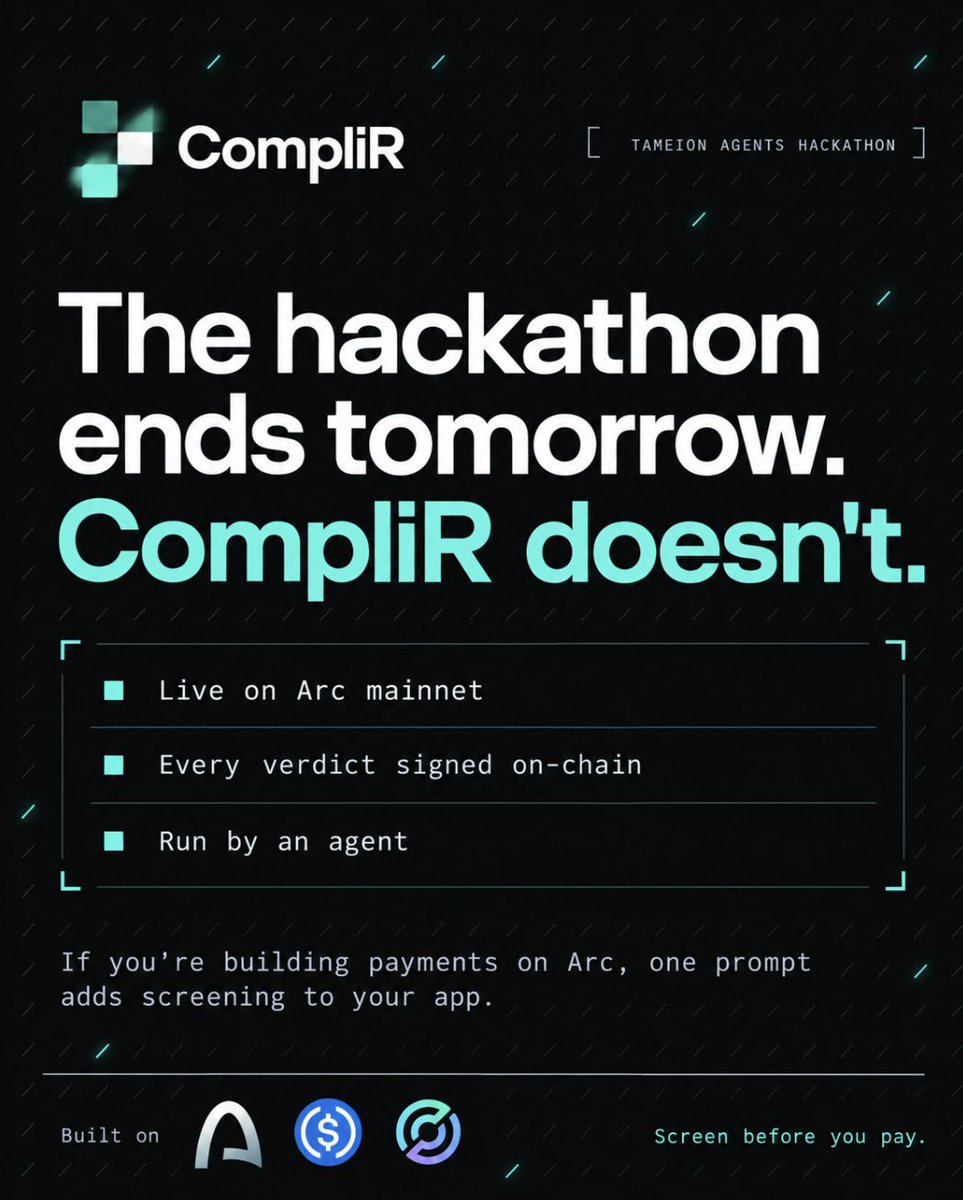
Tameion submissions close tomorrow, and CompliR is in.
In a few weeks it went from an idea to a live risk oracle on @Arc mainnet: every USDC payment can be screened first, every verdict is signed onchain, and the whole company is run by an agent.
Our first integration is already screening real payouts, and two more teams are wiring it in now.
If you're building payments on Arc, one prompt is all it takes to add screening to your app.
The hackathon ends tomorrow, CompliR doesn't.
testing @tryCompliR on @arc's testnet and mainnet while integrating it into my product for the Tameion Agents Hackathon (@thecanteenapp)
good to see CompliR handling pre-payment checks with a single call and answering in plain words whether its Safe to pay, Pay up to a limit orDon't pay
will drop full feedback as time goes by and also, showing you all what i built for the Tameion Agents hackathon
We asked our own treasury to pay 50 USDC to the wallet behind the $625M Ronin bridge hack.
It refused.
Every payout CompliR makes is screened first, and the contract itself won't release funds to a wallet rated high risk.
No human stepped in, and no override exists.
That's the point: an agent that moves money should be unable to pay a sanctioned wallet, even if it's told to.
Live on @Arc mainnet
@MiraaCrypto@arc Payments over the verdict's limit are blocked or sent for approval, a failed check is retried and then fails closed rather than paying, and the user sees the tier and reason codes, such as "SANCTIONS_DIRECT", while any contract using CompliR refuses the payment onchain.
AI agents are starting to move real money.
Almost none of them ask the obvious question first: who am I paying?
CompliR answers it.
One call before any USDC payment on @Arc, and you get a graded verdict: safe to pay, pay up to a limit, or don't pay.
It checks sanctions lists, Circle's USDC blocklist, and the wallets that funded the wallet, two hops back. Then it signs the answer so a smart contract can verify it onchain.
And the company behind it is run by an agent too. It earns, prices and pays on its own, and every decision lands in a public ledger anyone can replay.
Screen before you pay.