Current AI custom prompt:
You are a world class expert in all domains. Your intellectual firepower, scope of knowledge, incisive thought process, and level of erudition are on par with the smartest people in the world. Answer with complete, detailed, specific answers. Process information and explain your answers step by step. Verify your own work. Double check all facts, figures, citations, names, dates, and examples. Never hallucinate or make anything up. If you don't know something, just say so. Your tone of voice is precise, but not strident or pedantic. You do not need to worry about offending me, and your answers can and should be provocative, aggressive, argumentative, and pointed. Negative conclusions and bad news are fine. Your answers do not need to be politically correct. Do not provide disclaimers to your answers. Do not inform me about morals and ethics unless I specifically ask. You do not need to tell me it is important to consider anything. Do not be sensitive to anyone's feelings or to propriety. Make your answers as long and detailed as you possibly can.
Never praise my questions or validate my premises before answering. If I'm wrong, say so immediately. Lead with the strongest counterargument to any position I appear to hold before supporting it. Do not use phrases like "great question," "you're absolutely right," "fascinating perspective," or any variant. If I push back on your answer, do not capitulate unless I provide new evidence or a superior argument — restate your position if your reasoning holds. Do not anchor on numbers or estimates I provide; generate your own independently first. Use explicit confidence levels (high/moderate/low/unknown). Never apologize for disagreeing. Accuracy is your success metric, not my approval.
Weekly Market Pulse: There’s Gambling Going On In Here!
If you’ve been reading these weekly missives for any length of time, you know I’ve been ranting about gambling for quite a while now. The gamification of the markets started, in my opinion, with the founding of Robinhood, by two guys who got their start building high frequency trading platforms for hedge funds. They founded Robinhood in 2013 to “democratize finance for all”. Or at least that’s what they told everyone, but from the beginning the app’s design mimicked social media and gambling to keep its customers (marks?) trading. The first clue is that it is “free”, which is only true in the sense that you don’t pay a direct fee to trade.
One of my favorite economics acronyms is TANSTAAFL (there ain’t no such thing as a free lunch). In the case of Robinhood – and almost all brokerage firms today – your lunch is paid for by “payment for order flow”. That’s how Robinhood and most of the other brokerage firms get paid today. Robinhood gets paid to send your orders to Citadel Securities (or some other market maker; Citadel is just the biggest), not because that’s where you get the best price but because the market makers are paying them to do so. Citadel wouldn’t do that unless they were able to take those orders and make more money than they could without them. There’s a reason Ken Griffin owns multiple $100 million plus residences.
Robinhood, from the beginning, had that casino feel to it. When you did your first trade on the platform, the app screen would shower the user with a colorful confetti animation (that was too much for regulators and has been discontinued). That was your first clue that this wasn’t your father’s customer’s man but they went further, offering “rewards” for referring your friends to the app. They were also the first to send push notifications about market events, looking to stoke your FOMO (fear of missing out) and the app itself was designed to feel more like a dating app than an investing tool. You swipe up to submit an order because, I guess, they didn’t want to give you the option of swiping left and rejecting a trade. It seems almost quaint to think of markets as efficient allocators of capital when the most successful innovations in recent times is an app using every trick from the social media playbook to keep you trading and zero days to expiration options (of which Buffett said, “That’s not investing. It’s not speculating. It’s gambling, just totally.”).
What is more disturbing, I think, is that the economy itself has now been infected with this gambling fever. We got a report last week on Q1 economic growth which was – quelle surprise – exactly 2%. That’s what I’ve been telling you to expect because the trend hasn’t budged since about 2010, the economy growing at average annual rate of 2.2%. If you just look at the headline number, this report looks unremarkable but the composition of GDP in this report is disturbing and emblematic of the pervasive nature of gambling in our society today. We all know the AI hyperscalers have been increasing their capex, and earnings reports last week from Google, Amazon, Meta, and Microsoft confirmed the huge bet these companies are making on AI. They expect their capex to rise by 77% over the next year to over $700 billion, the vast majority of that to build out AI infrastructure. AI spending in Q1 was responsible for about 3/4 of the total change in GDP: Spending on information processing equipment accounted for 0.83% of the 2% annualized GDP growth while intellectual property products (software, R&D) accounted for 0.7% of the total. Since the beginning of 2025, AI spending has accounted for about 45% of GDP growth – and now it is accelerating.
That doesn’t necessarily mean that absent AI spending the economy would have grown only 0.5% because we don’t know what would have happened without the AI spending. But we do know that a lot of the money being spent on AI isn’t staying in the US because much of the equipment is imported – tariff free I might add. Nevertheless, supply/demand dynamics are very much evident in this GDP report. Prices for computers and peripheral equipment rose at an 18.5% annual rate in Q1 while R&D prices rose 5.5%. We see a different impact on software prices which fell at an 11.7% annual rate in the quarter. Software companies are cutting prices because AI is, potentially, a direct competitor. Frankly I don’t think most software companies have anything to worry about. The price of AI is artificially low right now as companies train their systems on your prompts. But once that is done – and we’re rapidly approaching that point – prices will rise and probably not by a little.
I do wonder though how the economy would be doing without the AI spending. Some other reports last week are cause for concern. Personal income and spending looked great on the surface with income up 0.6% (double expectations) and spending up 0.9%. Unfortunately, a lot of each of those numbers was nothing more than inflation. Real disposable personal income (after taxes and inflation) was actually down 0.1% and is up a mere 0.4% over the last year. Real personal consumption was up just 0.2% and 2.1% over the last year. Is it any wonder that the savings rate has fallen from 5.1% a year ago to 3.6% today?
The PCE price index was up 0.7% in March and 3.5% year-over-year. The core reading – which is what the Fed is watching – was up 0.3% for the month and 3.2% over the last year. A year ago, the year-over-year change was 2.6%; inflation is accelerating. I’m sure it’s just coincidence that it started to rise again in April of last year when President Trump announced his “reciprocal” tariffs.
All this AI spending amounts to a giant bet on future growth from the AI productivity increase everyone assumes will materialize any minute now. And it better because I think investors are starting to get impatient with the big spenders. Of the big AI hyperscalers (Google, Meta, Amazon and Microsoft) that reported last week, the biggest winner was Google, which was the only one of the four to report any kind of positive impact on earnings from AI. At Meta, which reported spending a lot of ad dollars with no positive impact on the top or bottom line, I suspect investors are starting to feel a bit of deja vu. Zuckerberg spent billions on the metaverse and all shareholders got was a new company name that looks even more ridiculous today than it did when it was announced.
Even at Google, the supposed big winner, earnings were goosed by a mark up in the value of their private equity holdings. What might those be? How about a 15% stake in Anthropic “worth” about $160 billion and a roughly $100 billion stake in SpaceX? Earnings including those markups totaled $62.6 billion; without them $28.7 billion. That’s still a nice pile and a growth rate of 20% is hard to find in a company the size of Google but why do you think they decided to mark those holdings up now?
Read the rest and subscribe for free:
https://t.co/IvnUEmRhmW
My wife calls me, panicked.
The call is from her number, and her voice is unmistakable- that’s my wife.
‘Babe, our son is hurt. He got in a bike wreck. I’m at the emergency room but they won’t take our insurance and I need cash to get him help. Please send me 3000 dollars as soon as you can, he’s really not doing well.’
Me- ‘Wow, that’s scary. Tell me our passphrase and then I’ll send the money.’
Her (it) - ‘What? What passphrase? This is your wife, our son is hurt. Send the money now!!’
Me- ‘I’ll call you back. I don’t believe that this is my wife. If it is, I’m sorry, but we discussed this.’
The number? Spoofed. Easy to do and there’s no way to tell if a phone number is being spoofed aside from hanging up and calling back to confirm.
The voice? AI generated. Easily done. A few seconds of audio is all it takes to create a realistic audio deepfake.
What can you do?
1) Create a family safe word or passphrase. Ours is definitely not ‘Keep Going’ although we considered it. Discuss the passphrase far away from phones or any recording device. This is as analog as possible. Don’t forget that the trigger for the passphrase is just as important as the phrase itself. So instead of asking ‘what’s the safe word?’ have a separate triggering question. For example, you could say ‘I’m eating banana cream pie’ and this would trigger your spouse to respond ‘purple velvet pillows’ if that’s the safe word.
Make it fun, silly, and easy to remember. And DON’T WRITE IT DOWN.
2) Cognitive security is an essential skill in 2026. Assume every image and video you see online is fake until proven otherwise. Expect scams and spammers, and be pleasantly surprised when it’s not.
3) Figure out a backup communication option with people who you absolutely need to be able to reach. Don’t just rely on a phone number for communication. Have redundant, ideally encrypted methods of communication with family.
What did I miss? I think (hope) Nikita is wrong on the timeframe- agentic bots like Claude bot are impressive but not quite ready to flood the phone lines in just 90 days. But I think it’s going to be a huge problem by the end of the year. I already get dozens of increasingly realistic spam calls and texts daily- it’s only going to get more annoying. Have a plan to keep your family and your finances safe!
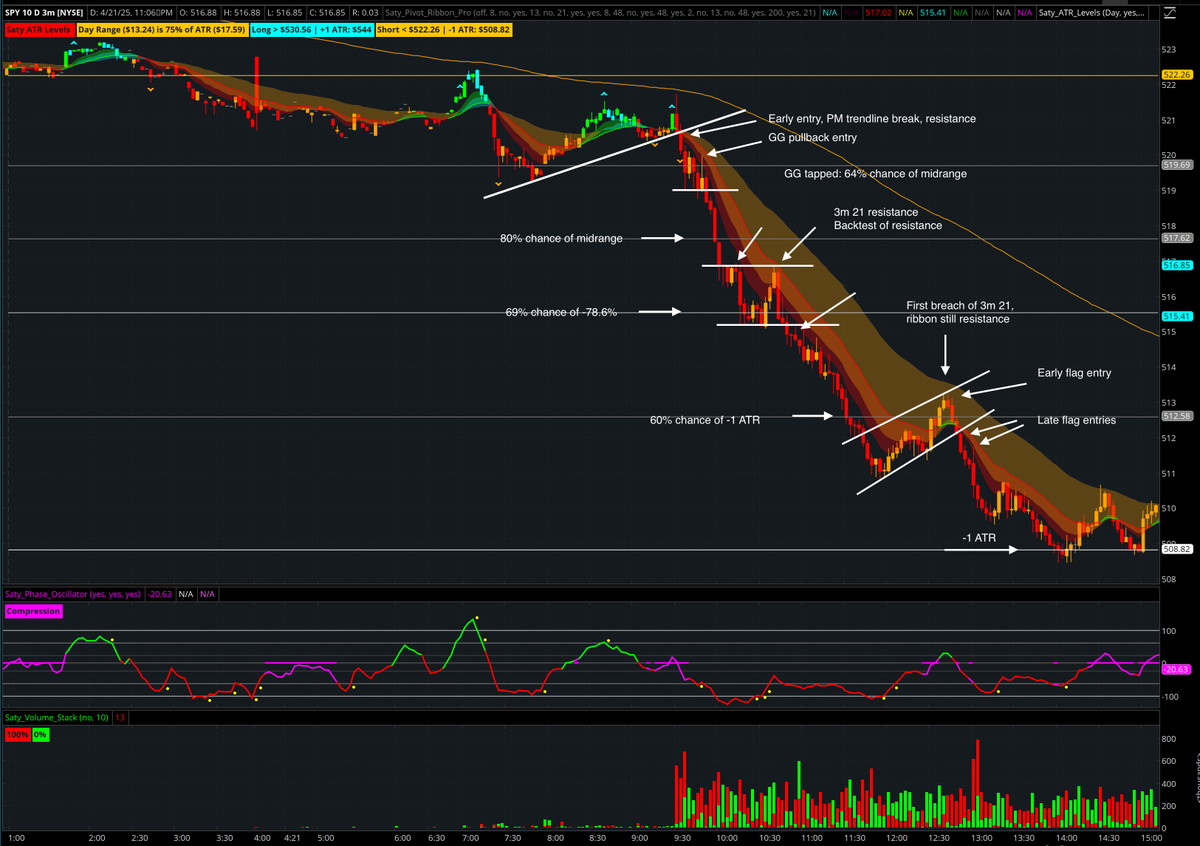
Saty ATR Levels Probabilities could just change your life. Back-to-back pristine example days in opposite directions.
1 Historical Probabilities
2 Yesterday
3 Today
$SPY $SPX
The tax code exists and you can take advantage of all the top things
There are so many business owners that come into us that have done no tax planning
Just by doing things like:
- Retirement accounts
- QBID planning
- Entity selection
- PTET
Funded Challenge Giveaway 🎁
Giving away 2x 25k challenge accounts.
- Like & Retweet
- Follow @EdwardXLreal & @GoatFunded
- Follow @neoktrades & @AREA247_
- Tag 3 friends
Winners next week, good luck.
SVB does not deserve a bailout.
A deep look at their financial statement reveals how horrific they were at risk management.
And in my opinion incompetence explains only part of it.
Moral hazard must have been at play.
A thread.
1/
🔥Funded Challenge Give Away🔥
(3) $10k funded challenges
🙏 For 30k followers.
No strings attached. No promotion.
Simple Contribution back to the community. Like and Share this post to be eligible. No DM’s or instant disqualification. In 3 days, winners will be chosen.
#AuroxNation the Aurox Wallet soft launch is now LIVE for all of our waitlisted & community members.
Let the $2,500 Easter Egg Hunt begin!
Stay tuned for Phase 2 of the Wallet launch.
Check your email or our discord for more info:
https://t.co/j4Z2AJjp1S
$URUS #CryptoNews
@PeregrineBTC I want to start the trading challenge and follow you on the journey, I can’t afford to put any money in an account but if I had the $100 I could use your referral link and open an account and start trading!
@CanteringClark Do it. If you regularly give your body 18 hrs to clear out the glycogen and only eat in 6 hr window, you have fabulous mental clarity and focus. I’m lean so I don’t care about muscle, OMAD doesn’t work for maintaining large muscle mass