“Let’s squeeze everything out of this season and have another thing to smile about when we look back in the future.”
Jürgen’s important message to you.
Years ago, I worked for a large, multinational company.
Once a year, the CEO would visit our branch.
We prepared for weeks.
Facilities scrubbed. Company values cards on desks. Everyone in their Sunday best.
Nothing he saw was real.
I learned a valuable lesson: everyone lies to leaders.
Today, I’m the one leading a company and I know this rule applies to me.
I was bemoaning this to a friend who said,
This is how telephone poles end up in the middle of the road! No one’s willing to tell the boss he’s missing something.
The feedback I get is skewed, given by employees trying to either:
- Make me happy, or
- Cast them in a positive light
This makes it especially difficult to measure my effectiveness.
When you lead others, you have to learn how to self-evaluate.
Quarterly, I ask myself 5 questions:
Do I still love the people I'm leading?
In 20 years of leading people, I've seen how easy it is to start resenting those I lead. If you look out at the leadership landscape, you see this everywhere.
When you resent people, it gives you license to treat them however you want. You stop developing them. Your relationship becomes functional.
People can be difficult and disappointing. But great leaders fight to keep love at the heart of what they do.
If I want to lead well, I have to start with love.
Are the people I lead willing to admit their mistakes?
Toxic leaders inspire fear. Fear causes people to hide mistakes. Hidden mistakes become repetitive mistakes. Repetitive mistakes sink a business.
If I’m not seeing people raising their hands when they mess up, it means I’ve damaged their trust.
It’s my job to repair it.
Do the people I lead seek my input on things that aren't work-related?
I spent years doing leadership development in a Fortune 500 company.
I asked 1000s of people to describe the best leader they've ever had.
The most common answer: "They cared about me."
If employees are asking for my take on a problem they’re having at home, it’s a sign that our relationship isn’t transactional.
I won’t force my way into their personal lives, but I’ll gladly accept an invitation.
Are the people I lead solving their own problems?
In leadership theory, there’s the concept of the “heroic leader.”
Heroic leaders build organizations that revolve around them. They have the answer to every problem. They are the smartest person in the room.
If the people I lead aren’t solving their own problems, I’ve made myself the focal point.
And that’s the real problem.
Are the people I lead meeting my expectations?
Clear expectations are the core of strong leadership.
If people are consistently failing to meet mine, that means I’m either:
- Surrounded by a bunch of idiots, or
- Failing to define and communicate what I expect.
Leaders assume too much.
People don’t magically know what a good job looks like.
Most problems aren’t performance problems. They’re expectation problems.
***
Leaders rarely get the full truth.
Great leaders know this and develop a regular habit of pausing to question their effectiveness.
If you lead others and aren’t doing that, the telephone pole in the middle of the road is on you.
***
I'm David and I write about being more thoughtful as a spouse, parent, and business leader.
Follow me @wdmorrisjr for more content like this.
If you found this helpful, I'd be grateful if you'd share it with a retweet.
Your engagement encourages me to keep writing!
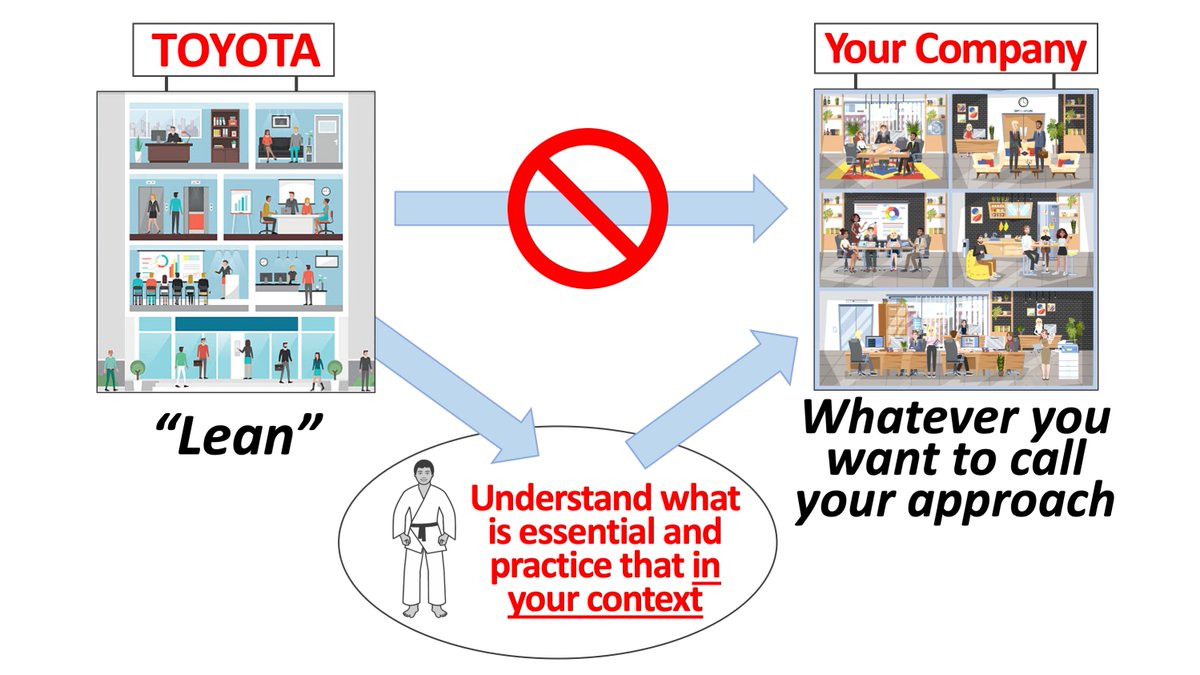
To the Lean community: Don't spend too much time benchmarking Toyota's solutions. Understand how they develop solutions.
• What do *you* want to achieve?
• Where are you now?
• Where do you want to be next?
• What obstacles are preventing you from getting there?
Why is scientific thinking so unnatural for us, requiring practice?
Uncertainty is extra work for our brain, causing it to use more energy than when things seem predictable. Jumping to a conclusion can give a physical sense of comfort, whether or not the conclusion is correct.
Tomorrow I'll be speaking at Agile Turkey Summit (remotely). The topic will be "Are distributed teams the new normal?". Doing some drawings in preparation for it. Won't win any art awards I think, but hopefully they convey the message :)
This drawing is about that people have very different working environments at home, and we should acknowledge & respect that. Having small children at home (I have 4 kids) means that you can't always be productive on demand, you need to adapt to when the kids are calm/sleeping.
Why practice scientific thinking?
• It's a metaskill, not specific solutions.
• Navigate the complex territory we face.
• Develop a learning organization.
• Increase engagement & connect purpose to work.
• A way out of mistruths & conspiracy theories.
• Meet personal goals.
1) Identify specific practice routines that will help you make the transformation.
2) Start with your leaders and managers. They will become the coaches.
3) It takes hard work and conscious effort at the start, but it gains traction and becomes habit over time.
Mental toughness is often portrayed as determination and persistence, but it can also be flexibility and adaptability.
- I can be happy anywhere
- I can work with what I have
- I can have a good day with anyone
You are tough when your mood is not dependent on your conditions.
A big mistake the Lean community made is the widespread practice of Lean staff bypassing line managers to work directly with work processes and teams, thereby ensuring that Lean remains a periodic side topic rather than growing into part of the culture.
I'm giving a keynote online tomorrow (Oct 1) at PMI Ukraine Connect. Lots of super interesting topics and speakers. Registration is free but we hope to raise a ton donations to support Ukraine in these difficult times. Join us! #standwithukraine https://t.co/dPruNngRUQ