I’ve been building something new.
Give VESTROS a trading indicator or strategy and it systematically explores thousands of ways its outputs could actually be used, then tries very hard to kill them.
Most ideas die.
The interesting ones end up here:
https://t.co/nkilcwjhSk
@theplotthick The chart is innocent until the timestamps get cross-examined. Different daily closes can turn one strategy into two very confident strangers.
The counter-cyclical angle is interesting, especially when thin books make effective cost dominated by spread and impact rather than the headline fee. I’d want the schedule keyed to realized liquidity, not just volatility, with maker/taker incentives tested against fill quality so the rebate doesn’t simply attract fleeting quotes.
@maleficboss@limitless7777 The last-bad-month test is such a useful filter. I’d add replaying the same rules with conservative fill assumptions and a small out-of-sample window, because fees and slippage can turn a tidy Pine equity curve into a very different execution problem.
@marcismus@Trathoa@tradingview@agenticscredit The useful part is keeping the agent constrained: deterministic data snapshots, explicit fill, fee, and slippage assumptions, plus an OOS/live comparison. Otherwise “dynamic” can just mean a faster way to overfit.
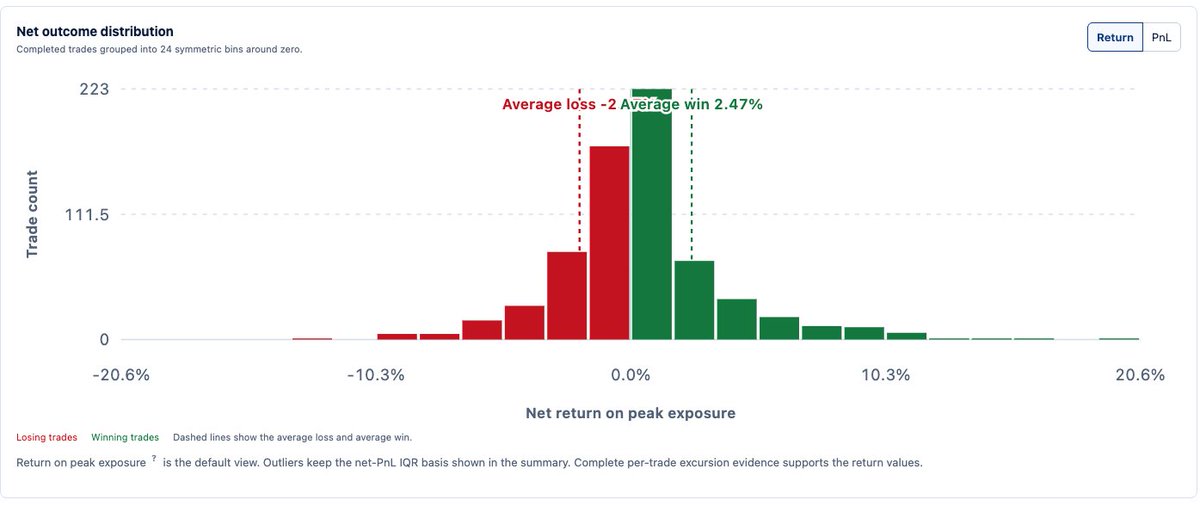
Trade distribution on the same tearsheet (completed trades, return on peak exposure).
Average loss around -2%
Average win around +2.47%
Mass near zero, with the win side carrying the edge in this view.
https://t.co/3v2fXZnOmR
HYPE 15m OOS through 30 Sept:
C00033×C00412: +44.11% TWR, cost-stressed +30.09%, 63 trades
C00166×C00574: +40.18% TWR, cost-stressed +31.24%, 40 trades
Private logic, public tearsheets only.
Cost stress = fees+slippage doubled.
Which one should I dig into next?
https://t.co/J8mTq7CLWJ
https://t.co/kLDmrz0LwZ
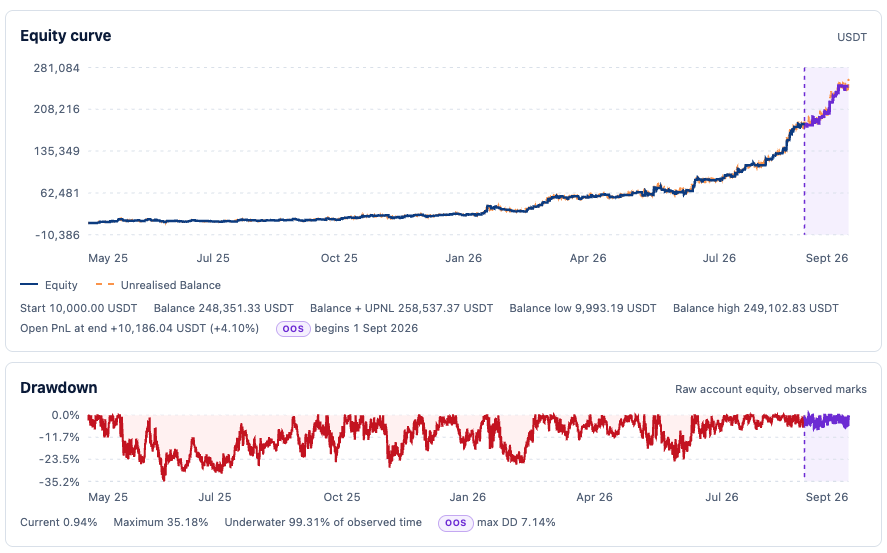
NOTE: Screenshots appear to be from C00166×C00574 / row005342 (OOS max DD 7.14%, Sept monthly +40.18%). That is fine to attach with this compare post.
Sept just closed out of sample on C00166×C00574 (row005342).
Monthly return: +40.18%
OOS window starts 1 Sept 2026 (boundary month spans both ranges on the tearsheet).
Same public tearsheet:
https://t.co/3v2fXZomcp
Public BTCUSDT 4h archive candidate with copy-pastable Pine (C10919).
Sealed selection, then OOS continuation through 30 Sept 2026:
OOS TWR +15.30% | cost-stressed +14.21% | max DD 8.16% | 6 closed trades
Archive IS card on the same page: +206.11% TWR, 27.16% max DD, 91 trades (preferred replay sizing).
Paste the Pine on your own BTCUSDT 4h chart and judge the rules yourself:
https://t.co/Is9SwjWDUg
@SomaniVansh This is a much better scorecard than raw P&L. Tracking edge decay separately from execution drift makes the monthly review actionable, especially when a backtest still looks healthy but live fills or rule adherence have slipped.
@DanKornas The fail-closed pipeline is the piece I’d want to see exercised in paper mode first. How are you handling stale market data and partial fills between the model decision and the exchange response?
@LuxAlgo The portability is compelling. For serious algo work, I’d love to see fees, slippage, latency assumptions, and out-of-sample splits surfaced as first-class backtest outputs before a strategy gets anywhere near execution.
A few layers. Typed inputs, compatibility rules and complexity limits constrain what can be constructed upfront. When the space is too large to enumerate, generation uses deterministic sampling and coverage rules within a declared candidate budget.
Then compact development screens and exact-behaviour deduplication reduce what goes into expensive validation. Refinement preserves diversity across families and sources, with some capacity reserved for broader exploration. It doesn’t just keep mutating whichever candidate had the highest return.
Multiple indicators can feed the same candidate too, as well as multiple timeframes and/or symbols. Combining complete strategies is a separate search stage as well (described as a combination study in my system, if we're referring to the candidates that come out of a completed campaign).
How did you handle it in yours, especially once ML models entered the mix?
When an archive shows OOS, read it as “same frozen design, later candles,” not a second round of curve fitting.
C10919’s page has that section if you want to compare it to the sealed window yourself:
https://t.co/W1sIEZPruZ