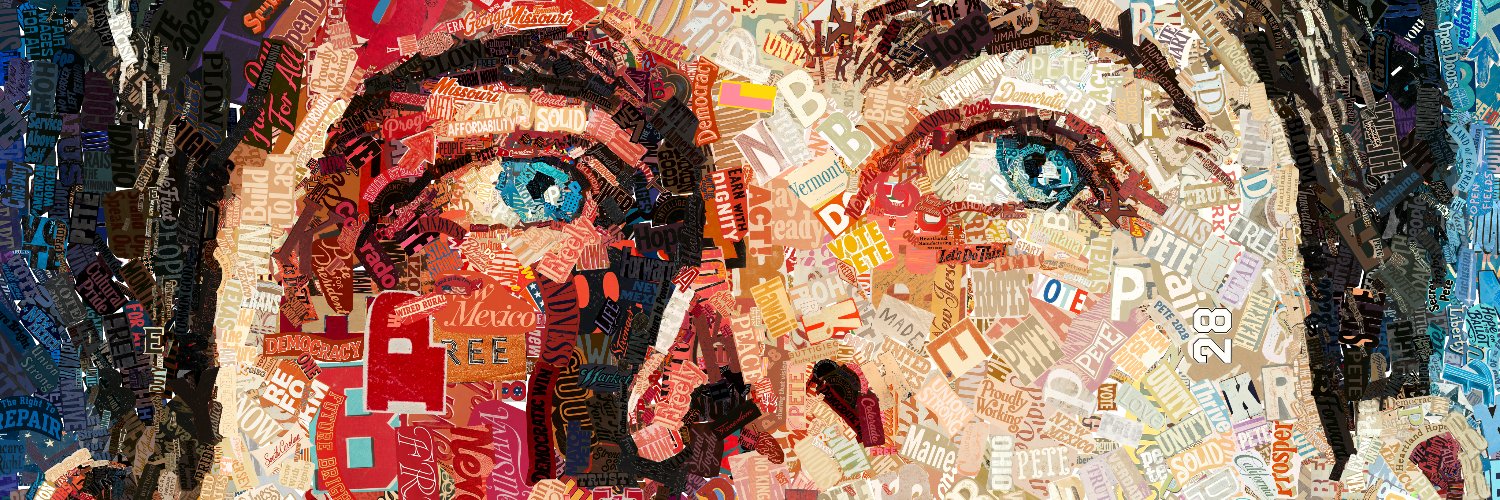
Six typographic mosaic portraits of Pete Buttigieg. From across the room, a face. Up close, his own words.
My rule: every scale of a mosaic has to carry the same message, the large picture and the smallest piece.
https://t.co/C1EVfh4fWN
Open counters, softly rounded knots: Kimya Gandhi drew the Devanagari for CoFo Sans Pro to match Maria Doreuli's Latin and Cyrillic. The 2026 family runs Hairline to Black in one variable file, with simplified matras for small sizes. via @contrastfoundry
https://t.co/clKnTF9QN6
Beyond the human eye, 7/38 · GrabCut, 2004
Carsten Rother, Vladimir Kolmogorov and Andrew Blake, at Microsoft Research in Cambridge, made cutting out a figure almost effortless. You draw a rectangle around it, and that's all.
Inside the rectangle the method models the colours of the figure, and outside it the colours of the background. It then finds the cheapest border between the two with a graph cut, refines both colour models, and cuts again until the border settles.
There is no neural network in it, and it shows. On my studio photo it kept both faces, but cut a gap through the man's glasses and kept a scrap of wall above them. 11 seconds.
It knows colours, not people. It is about the best that hand-written rules could do with a figure and its ground.
https://t.co/bYASjxTSW6
Burg Theater: A tribute to Kai's PowerShow (1998), the best presentation software ever written. Coming soon on my Github... #KaiKrause#SoftwareNostalgia
As an angelfish grows, a new stripe opens between two old ones and the spacing stays. We run that rule, reaction-diffusion, on a growing skin of numeral scales. The face of Marcus Bloch, who named the fish in 1787, shows when the flank turns.
#AlgorithmicMosaic#GenerativeArt #NaturalExperiments
Frida Escobedo's studio built the 2018 Serpentine Pavilion as a lattice of cement roof tiles. It is now design architect of the Met's new Tang wing and co-designer of the Centre Pompidou renovation.
https://t.co/sE8f7KB5YH
Webb sees only in black and white. The colours of the Cat's Paw Nebula were assigned filter by filter by Joseph DePasquale at STScI, from exposures taken on 6 September 2024. NASA released the image for Webb's third anniversary.
https://t.co/p9SVXXa7T7
This text comes from a scroll carbonised by Vesuvius in 79 AD and never opened. X-ray scans, virtual unwrapping and a machine-learning ink detector made it readable. Nader, Farritor and Schilliger won the 2023 Grand Prize.
https://t.co/maiVzCd4FM
Basketball and music are the same thing, says coach and songwriter Ryan Bisio.
For the cover of his first book, Musicality of the Game, we built a player rising to the ball out of scenes of music.
https://t.co/1LfxzVdeM5
Marketing research describes brand value as co-created by a firm and its stakeholders. Employees are one of those audiences.
For Le Monde's 70th anniversary we built a globe from portraits of its staff: the newspaper, shown as its people.
https://t.co/mReE1l9aAd
Lists, titles and rules are the material of Heman Chong's work. The survey at Singapore Art Museum covered two decades and ran from May to August 2025.
https://t.co/qjxQUa73eB
Garau Armonie, a free web app for both halves of Garau's theory: transparency, computed with Metelli's equations, and the continuum, which colors any SVG composition by his rules.
https://t.co/9Oabi1NvQS
The two articles:
https://t.co/WqW4C9xXNz
https://t.co/9HwH2uc035
Keynote is getting an open file format, .keyx: a JSON-based bundle that other tools and scripts can read and write. For anyone who builds portfolio or pitch decks, that means slides generated from your own data, then finished by hand in Keynote.
https://t.co/3A1GRbcvJo
Wauke bark beaten into kapa cloth, coloured with plant and earth dyes, printed with hand-carved bamboo 'ohe kāpala stamps. Lehuauakea's kapa was shown at the 2025 Hawai‘i Triennial.
https://t.co/sYCry48hgL
Two whole human hearts, one healthy and one diseased, scanned at the ESRF synchrotron down to 20 micrometres, half the width of a hair, without cutting them open. Each heart produced 10 terabytes of data.
https://t.co/YzJngQcj0t
Arcimboldo built heads from fruit and flowers. Here letters and numerals, born one by one like the buds of a romanesco, fly into his face: an anamorphosis, seen from one camera position only. Part of the music was generated with the MiniMax-Music3 model.
#AlgorithmicMosaic #GenerativeArt #NaturalExperiments
Weavers at the Manufacture Robert Four spent more than 8,000 hours on George, a 23-metre tapestry after an ink-wash drawing by Françoise Pétrovitch, for the 150th anniversary of George Sand's death. On show in Bourges until 30 November.
https://t.co/ZZ3S6mcMML
A megaphone striped red, orange, yellow, green and violet, each band beside a neighbor it shares a primary with. Garau's continuum, wrapped around an object.
Two articles on Garau's color theory:
https://t.co/WqW4C9xpY1
https://t.co/9HwH2ubsdx
Magdalene Odundo builds her vessels by coiling, with no wheel, and burnishes them before and after firing. A second firing with little oxygen turns the orange clay black.
https://t.co/zKA5Tir0DE
Ursula von Rydingsvard carved Ona from cedar beams, had it cast in bronze at Polich Tallix, then applied the patina herself. Every cut in the wood survives in the metal.
https://t.co/hPQIwFOCnO
Beyond the human eye, 6/38 · Canny edges, 1986
John Canny wrote down what a good edge detector must do before he wrote the method. It must find the real edges and not the noise, place them exactly, and mark each edge only once.
From those three demands came a recipe still used everywhere. Smooth the image a little, measure how fast brightness changes, thin the result to one-pixel lines, and keep weak edges only where they connect to strong ones. That last step keeps the faint parts of a real edge without keeping the noise.
On my studio photo it took 3 milliseconds.
It needs two thresholds that someone has to choose, and it draws every edge, shadows included. It has no idea what matters. Forty years on, it is still the first thing I try.
https://t.co/bYASjxTl6y