Researcher at Rhoda AI. Founding member of Cosmos World Foundation Model; core contributor to Cosmos 1, 2 & 3. Robot foundation models and world models.
Optics as code - a new paradigm in physical AI
Optical neural networks are notoriously hard to calibrate and suffer from the sim2real gap. We show that a coding agent with the hardware in the loop quickly tunes the optics and improves image classification from 35% to 96.8%.
🧵1/6
@SoumilBhandari We will see a system that has all those components like human. The question is whether is a omini model trained end-to-end or hierarchical system 0, 1, 2
Many friends at CoRL worry that frontier models like Astra and Claude will take over robot control. I want to offer a different perspective.
I see three routes:
VLA: Start with vision-language pretraining, then train on actions. Transfer semantic and spatial understanding into robot capability.
WAM: Start with video-generation pretraining, then learn actions. Transfer knowledge of how the world changes into robot capability.
Astra/Claude: Bring broader visual, language, and coding capabilities to robot control. Their 3D understanding—and how much of it transfers to manipulation—is striking. My hypothesis is that learning across code and visual domains, such as Blender tasks, contributes to this capability.
However, three questions remain for Astra/Claude:
1. Can latency fall enough to support responsive, closed-loop control?
2. How much capability remains with less chain-of-thought reasoning?
3. Can we distill that capability into a smaller, faster model without losing its generality?
These are all questions about the cost of turning impressive capability into a practical robot policy. I expect progress on all three, though how much remains uncertain. The same optimism applies to WAMs and VLAs: I expect them to improve with scale.
History tells us that the model that turns data and parameters into capability most efficiently will win. Astra and Claude show what’s possible at scale. Which approach gets there most efficiently is still an open question.
The competition is just beginning. At Rhoda, we’re betting on WAMs, and our results give us concrete reasons to believe in their data and parameter efficiency [1] [2] [3].
We’re hiring across multiple roles. Join us to build the next generation of robot https://t.co/4BZL4uBIhl
[1] https://t.co/rINyXovd20
[2] https://t.co/SFsCRfC4Z8
[3] https://t.co/Rc8fkRxHvs
At Rhoda, we care deeply about the science of pre-training for robotics.
In one of the most rigorous studies of its kind, over thousands of trials and hundreds of hours of robot evaluations, we show how scaling web-video pre-training leads to better real-world robot performance.
Thank you to everyone who joined our Video Models Meet Robotics reception at #CoRL2026 last night 🍸
200+ came through Swift’s Attic, and the conversations kept going on the sidewalk well after we closed!
Great meeting so many of you in Austin 🤖
Rhoda will be at #CoRL2026 in Austin 🤖
🍸 Tue Nov 10, 6:30–8:30 PM: Video Models Meet Robotics reception at Swift's Attic. Invite-only, request a spot: https://t.co/xIXYGuSu2f
🎤 Thu Nov 12, 11:25 AM: Vincent Sitzmann @vincesitzmann speaks at the "Do Robots Need World Models?" workshop
https://t.co/8cxdELBfoM
NVIDIA Cosmos world models have come to life with real-time interactivity! 🌎🤖🚘
We are releasing our post-training framework for real-time interactive world simulation for Physical AI. The framework builds upon Cosmos 3 through causal training, distillation, and optimized streaming inference. The post-trained models stream visual observations via autoregressive generation in response to incoming actions and scene controls.
We are also releasing example model checkpoints for robotics, autonomous vehicles, and sim-to-real transfer. The release includes optimized streaming inference code to power the models.
Cosmos world foundation models provide broad visual knowledge. Each simulation setting adds its own controls, data, and evaluation requirements. Our shared recipe and example models give researchers and developers a practical starting point for building specialized interactive world simulators.
Huge shoutout to the team for the dedication, creativity, and hard work poured into this release! I am incredibly proud of this work and feel fortunate to lead such a talented team. A special thank-you to the broader Cosmos group for building the world foundation models together. Team green 💚
I am excited to see how you build your own interactive world simulator with Cosmos!
🏠 Project website: https://t.co/RQf4ODngOf
🤗 Model checkpoints: https://t.co/Z85KTHaNqI
💻 Code: https://t.co/ZlIeDxW3lx
Today, Dream Labs is coming out of stealth with Dream-1, a robot foundation model that controls bimanual robots it has never seen, on tasks it was never shown, in places it has never been, from $3/hour.
Dream API is live for everyone, today. 🧵
Touch is essential to human manipulation. Yet, we have so far not had a tactile sensor that can do what human skin can: sense texture, firmness, vibration at a viable form factor. At Rhoda, we have built a new sensor in-house that can do all of these things, while being much much smaller than commercially available ones!
(1/n) Watch our robot search a box and find textured balls, entirely without vision!
Over the past few months, it’s been incredibly fun to work on bringing touch into our Direct Video-Action (DVA) model. Here’s how our video model is “seeing” through touch 🧵
What can a robot do without vision?
We gave our robot a sense of touch and showed it can recognize and retrieve objects with its cameras blindfolded.
Introducing Rhoda’s new tactile sensor—it feels pressure, texture, vibration, slip, and temperature, just like your fingertips.
[1/7] We trained a world model on 30,000 hours of first-person video.
It learned exactly where the hands go. What happens to the things they touch, much less so.
Going from 300 to 30,000 hours did not narrow the gap, and a 4× larger model barely did either.
Continuing our RhodaAtWork series with another look at Direct Video-Action (DVA) in action.
This time, a single model handles multiple tasks across two home appliances: refrigerator EPS foam installation and washing machine drain hose routing.
More industries. More real customer work.
Introducing RhodaAtWork, a series on the customer workflows our robots are learning to handle across manufacturing and logistics.
First up: unpacking, scanning and stacking component reels for electronics manufacturing.
At Rhoda, we care deeply about the science of pre-training for robotics.
In one of the most rigorous studies of its kind, over thousands of trials and hundreds of hours of robot evaluations, we show how scaling web-video pre-training leads to better real-world robot performance.
We are at the dawn of Superintelligence.
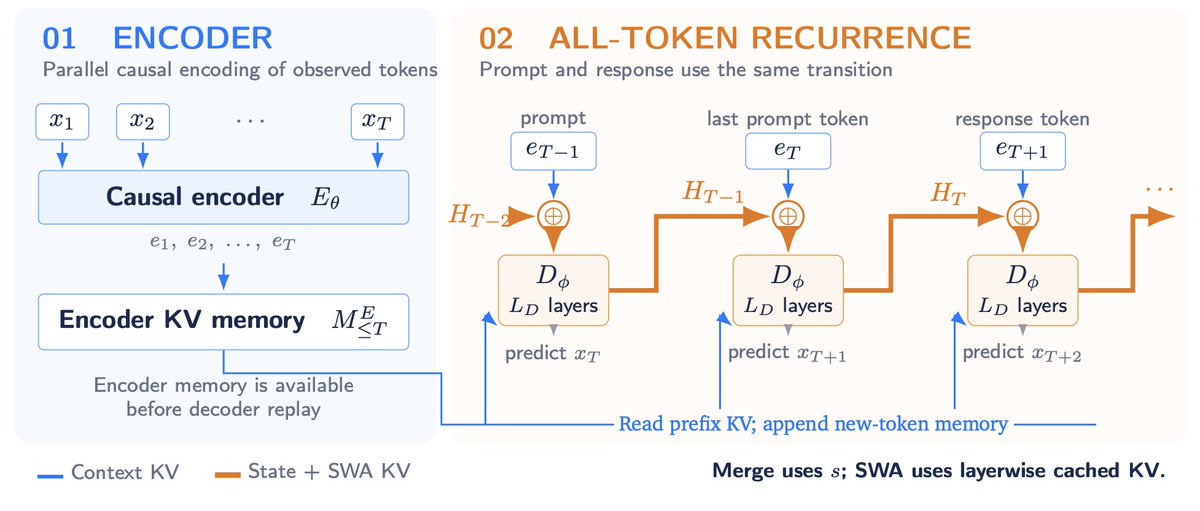
Introducing the Recurrent Looped Transformer (RLT),
We now have Transformers with Infinite Reasoning depth.
From now on, we should pace progress at the Open Frontier of Superintelligence,
Until Safe Superintelligence is achieved.
https://t.co/yMWIWU4upo