~ we're halfway into this year's Staking Survey collection period ~
If you haven't yet, please complete it now! ☑️
Should only take 5-10 mins ... plus any time you want to take writing free form comments ✍️🙏
The world is changing and so is StakeWise.
We are proud to unveil our new branding - alongside a new landing page and blog - to reflect the view that we have held for some time:
That ETH and ETH Staking are technologies getting so embedded in our life that their presence feels a part of nature itself.
It’s everywhere - unvisible to the eye, but touching on every facet of our digital life. Ether in its original sense.
StakeWise’s new visual direction seamlessly blends nature with technology, aiming to evoke a sense of serenity, tranquility, and peace.
We want our users to feel secure about their future and confident about where their capital is allocated, and we want this to be reflected in our branding.
Stakingverse on Steroids!
We’ve upgraded the infrastructure of our Ethereum @stakewise_io V3 staking pool and are now rocking an “Excellent”performance score 🫡
Keep staking. Next week, we’ll share how we’re going to incentivize our Ethereum stakers even more.
https://t.co/13OJkD0ylU
ICYMI:
in about 3 weeks, Ethereum will enable PeerDAS - a novel data storage method increasing max network throughput by a whopping 8x times!
it is the biggest scalability improvement since the introduction of Layer-2 rollups - and a major acceleration towards Ethereum’s singularity
let’s break down the tech behind PeerDAS in the simplest way possible.
1. as more consumer apps and institutions choose Ethereum because of credible neutrality and 100% uptime, the volume of transactions grows dramatically
2. keeping up with this demand requires validators to install ever larger (and faster) storage and bandwidth - still manageable today but progressively out of reach for independent validators like home stakers
3. two solutions: abandon home stakers who are the source of Ethereum’s decentralization (bad), or find ways to make transaction data storage & validation way more efficient so that home stakers could keep up (good)
4. enter PeerDAS - a method of splitting & distributing transaction data in pieces, where individual validators only need to verify and store 1/16th of the original data for it to be preserved in full - a massive efficiency improvement
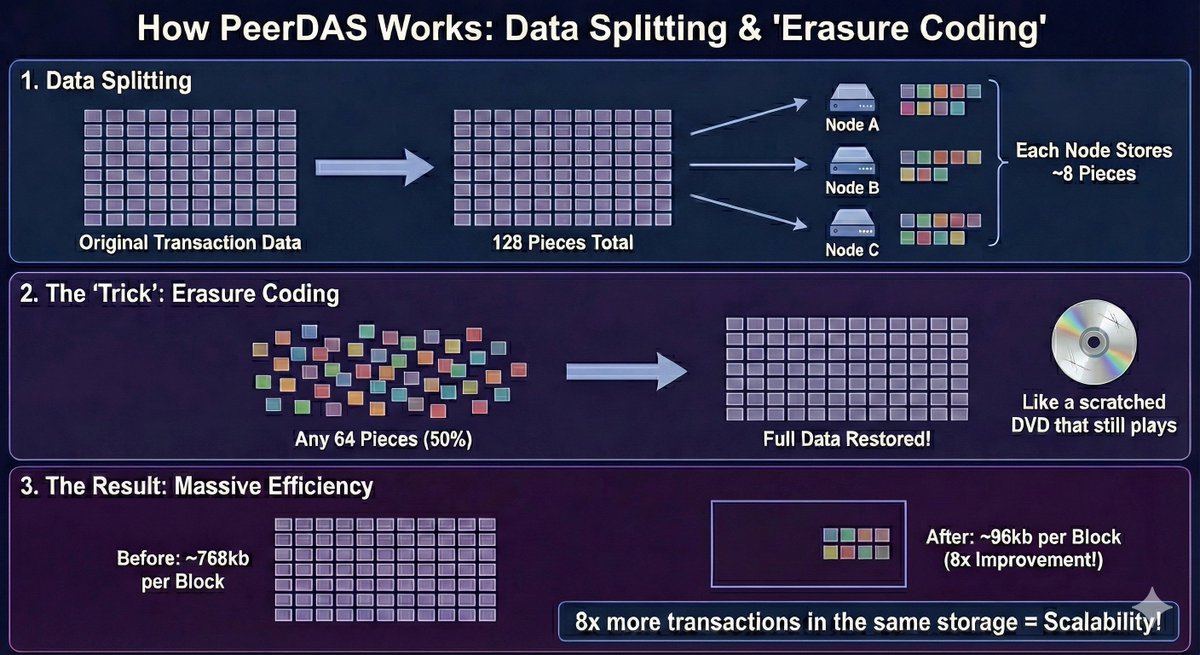
5. how it works: instead of sending the whole transaction data to every single node in the network, PeerDAS partitions it into 128 pieces and distributes a random sequence of at least 8 pieces to every node for verification and storage
6. the network is then split into 128 groups of nodes - “gossip networks” - each responsible for storing & verifying their own data piece. every node belongs to at least 8 of these groups. collectively, they store all the data, but individually, they store & process significantly less, eliminating resource constraints as a bottleneck to scalability improvements
7. it's like breaking down the verification & storage of the whole data into smaller chunks that can be done independently and in parallel, with results then pooled together, reducing the effort required from each participant
8. the trick is that as long as >=50% of the pieces have been verified and stored by different nodes, the original data can be restored in full from these fragments, like a scratched DVD that would still play the movie if not too badly damaged.
9. the name of this trick is “erasure coding”. kinda like a multisig approval requires k/N threshold to push a transaction, erasure coding allows to split data into N pieces and choose the threshold k that’s required to restore the original data. in PeerDAS, N pieces is 128 and k is 64 - a 50% threshold
10. so while every node gets to participate in verification & storage, the network actually needs only 50% of the data to recover the original, with some caveats. this is a high enough hurdle to withstand coordinated attacks on the chain, and low enough to enable efficiency improvements.
11. mechanically, every block, the minimum number of data pieces a single validator node must download, store and serve to peers is 8 out of 128
12. with every data piece weighing only ~12kb (16kb at most), total storage needed is 12 x 8 = ~96kb - a whopping 8x improvement over the 768kb before PeerDAS!
that's where the 8x scale comes from: nodes can pack 8x more transactions into the same storage, dramatically increasing Ethereum's throughout without requiring operators to upgrade their hardware
technology like PeerDAS is why Ethereum will keep winning:
instead of taking the easy road, we cook up innovation that grants 8x more network throughput on the same hardware, keeps all data available for reconstruction & verification, and defends decentralization as a core principle. a win-win-win!
all credit to Danny Ryan @dannyryan, Dankrad Feist @dankrad, Francesco D’Amato @fradamt, Hsiao-Wei Wang @hwwonx, Alex Stokes @ralexstokes as authors of PeerDAS
Note: PeerDAS applies only to Layer-2 transaction data - known as "blobs" - for a further 8x amplification to how many L2 transactions a typical home node can handle as part of Ethereum’s L2-centric roadmap. separate EIPs targeting gas limit increases per block - e.g. EIP-7935 - further promote Ethereum’s scalability
Just half an hour earlier, StakeWise DAO emergency multisig has executed a series of transactions, recovering ~5,041 osETH (~$19M) and 13,495 osGNO (~$1.7M) tokens from the Balancer exploiter.
On Ethereum mainnet, this represents 73.5% of the ~6,851 osETH stolen earlier today, and is as much as we could recover due to the attacker promptly converting the missing portion of the stolen assets into ETH. Stolen osGNO were recovered in full.
The recovered funds will be returned to the users affected in the Balancer V2 exploit, distributed pro-rata according to their pre-exploit balances.
The full post-mortem of the operation and the next steps will be available shortly.
Thank you to the @Balancer & @gnosischain teams, and personally to @rimeissner and SEALs c0ffeebabe_eth and @pcaversaccio for their prompt advice on the execution of the recovery.
Six months ago, a production-ready Vero v1 was released.
Today, it’s protecting tens of thousands of validators from client bugs across Ethereum and Gnosis Chain. 🐛
Next step: protect the whole network 🛡️
We are proud to present Vaults v4.0 - our most advanced and secure staking product to date.
Vaults v4 introduce 0x02 validators, faster withdrawals, consolidations, sophisticated stake distribution via the new MetaVaults layer, additional customization options, and more.
in 3 days StakeWise Vaults are going turbo:
→ faster staking & unstaking with 0x02 validators
→ stake in multiple top Vaults at once with MetaVaults
→ customize more of your Vault setup than ever before
the full list of improvements 👇🏼
a quick snapshot of where we stand:
→ $1BN+ in TVL
→ $80M+ in liquidity for your stake
→ 50+ independent Vaults
→ 7 cracked devs
→ 1 mission
and 0 signs of stopping 🫡
Connecting an L2 bridge to smart contracts that are only a few months old and have not stood the test of time poses a significant risk to the entire network.
Please consider diversifying with StakeWise V3 Vaults, which are time-tested and meet all the requirements outlined.
Linea + Lido: Bringing Native Yield to L2s
With Native Yield, @LineaBuild will be integrating Lido V3 stVault infrastructure to help power its sustainable, non-custodial DeFi engine, enabling all bridged ETH to automatically earn staking rewards.
↓
Incredible Chad energy from @stakewise_io - ensuring their node operators weren’t adversely impacted by the sudden swing in rates this past week.
0.01 MCAP/TVL ratio btw
yes, institutions are onboarding to ethereum
but let's not lose sight of the bigger goal everyone
we're building an unstoppable system that doesn't bow to boardrooms
we're staking so that finance, ai, & internet can be incorruptible, open, and trustless
job's not finished 😤
Big shoutout to the @NodeOperators Vault that has amassed 25K+ staked ETH in a matter of weeks!
It is now up to the $SWISE holders whether to grant 100% LTV minting of osETH from the Vault - a feature that can supercharge its growth ⚡️
Links to the proposal & vote inside 👇
wow TVL in the Private @NodeOperators Vault on StakeWise is going parabolic
apr 26th: 100 ETH
may 8th: 13,500 ETH
probably the fastest-growing pool on Ethereum right now 🤔
Pleasure working with the @stakewise_io team. Their group keeps innovating in the staking space and have a lot of exciting features brewing on their side.
Choosing @Balancer as their flagship dex is the clear best choice in terms of capital efficiency for LPs and traders.