What Makes China’s Red Aristocracy Different
I have written extensively about China’s “red aristocracy” in my book. But the term can be misleading to readers outside China. We probably need a better term for it.
The recent passing of Zhu Rongji, premier in 1990s, revived the debate over whether he was genuinely the clean Party leader he insisted he was, or whether the careers of his family members made that claim hypocritical. His son became CEO of China’s largest state-owned investment bank while Zhu, as premier, was directing SOE reforms. His daughter worked for American investment banks serving Chinese SOEs in their financing. His son-in-law headed the overseas operations of China’s largest state-owned mining company. All three were already multimillionaires in USD decades ago, when most Chinese were earning only a few hundred yuan a month.
This debate illustrates a broader problem in understanding China’s elite.
The word aristocracy evokes a privileged class with inherited wealth, family names, estates, social prestige and elite networks. China’s Communist aristocracy may have all of those. But it is fundamentally different.
Its defining privilege is not wealth or access to networks. It is proximity to political power—and the ability that comes with it to OPERATE ABOVE THE LAW, MARKET RULES AND SOCIAL NORMS.
European aristocrats historically enjoyed immense legal privileges. But modern European aristocracy is largely the residue of that system. A British duke may inherit a fortune, a castle and powerful connections, but he still has to operate within a legal order. He cannot simply make a criminal case disappear, induce a regulator to punish a competitor, or decide that certain law does not apply to him.
His privilege exists within the system.
China’s red aristocracy emerged from a different structure.
The descendants of Communist revolutionaries did not inherit formal titles. They inherited something more valuable in a Leninist state: access to the Party-state.
Their family names open doors to senior officials, ministries, state-owned companies, banks and the enforcement apparatus. Connections can bring political sponsorship, regulatory approvals, financing, inside information and business opportunities unavailable to ordinary people.
More importantly, political protection can determine not merely how much opportunity you have, but which rules apply to you at all.
That is the distinction Western observers often miss.
A Chinese princeling is not simply the equivalent of an American billionaire or a European aristocrat.
The deeper privilege is arbitrariness in your favour.
In a rule-based society, the wealthy have greater resources to operate within the rules.
In China, political connections can influence how rules are written, interpreted and enforced—and sometimes whether they are enforced at all.
That is not merely inequality of wealth.
It is inequality before power.
There is also a profound historical irony. The Communist revolution destroyed China’s old landed and commercial elites in the name of abolishing inherited privilege, only to create a new hereditary elite of its own—as socialist systems so often do.
China’s red aristocracy is therefore not simply another privileged upper class. It is the product of a political system in which proximity to power can place a person above the rules governing everyone else.
Western aristocracy today is largely inherited status operating within a legal system. China’s red aristocracy is inherited access to power operating above it.
It is harder than ever to find good news in China's data release today. The economy continues to be structurally locked into increasing production at the expense of consumption, even though China suffers from many years of growing excess capacity.
China's industrial output, for example, increased by 5.4% year on year in the first five months of 2026, with a 4.5% year on year increase in the month of May. This was a little higher than April’s 4.1% increase, although lower than the 5.7% increase in March.
The uglier numbers were (as always) on the consumption side. For the first five months of 2026, total retail sales grew 2.8%, just over half the pace of industrial output. Although they were barely expected to grow in May, in fact they actually fell by 0.6%, well below the disappointing 0.2% increase in April and the first decline since the end of the Covid lockdown in 2022.
For all the excited claims about consumption spending during the important May holiday, in other words, it was more than offset by the decline in spending over the rest of the month, proving, once again, that what limits household consumption is the household budget, not spending opportunities.
Meanwhile China's fixed-asset investment declined 4.1% year on year in the first five months of 2026.
Last week's trade and debt numbers reinforce the claim that China is finding it harder than ever to restructure its economy. It is expending huge resources in growing output, especially manufacturing output, but Chinese producers rely more than ever on soaring exports to offset weak domestic demand.
So far this year's numbers show that China's economy has further increased its already-excessive dependence on surging debt and soaring trade surpluses to keep GDP growth from slowing. It is not clear how much longer this growth model can be sustained before China is forced into a very difficult economic adjustment, but it is almost impossible for China to exit this model without a sharp slowdown in near-term growth, which is why, for all its promises, Beijing has been unable to adjust.
The problem, of course, is that as long as this process continues, it will increase the final adjustment costs for the Chinese economy and will further undermine manufacturing in the rest of the world.
https://t.co/N6uiKiTPUy
A Fox News crew parked illegally in Beijing for two minutes. Before they could walk away, their driver received a $40 ticket on his phone. The camera had already seen it, processed it, and issued the fine. Nobody had to be there.
Fox News anchor Bret Baier said from Beijing this week describing what standing on a single street corner looks like: over 20 visible cameras at one intersection near Haidian Station. Beijing added 1,500 new cameras this year alone. Nobody jaywalks because the fine arrives on your phone before you finish crossing the street.
The scale behind that single street corner is staggering. China operates an estimated 700 million surveillance cameras nationally, roughly one for every two citizens. Eight of the ten most surveilled cities in the world are in China. The cameras do not just record. They feed into AI-powered facial recognition systems that can identify a person within seconds, cross-reference them against criminal and social credit databases, and flag them to authorities automatically. Chinese AI firm Watrix has already deployed gait-recognition software that identifies individuals from 50 meters away based on how they walk, even with their faces covered.
The system feeds into China's Social Credit framework, which aggregates legal violations into blacklists that can restrict travel, loans, and access to public services. Subway stations in cities like Guangzhou already sort passengers using facial recognition pulled from credit and criminal databases. Beijing plans to link facial IDs with healthcare and utility records.
None of this is hidden. The CCP calls it public safety. What it actually is: a government that has built the most comprehensive citizen-monitoring infrastructure in human history, tested it on its own population, and is now selling it to every authoritarian government willing to pay.
#China #CCP #Surveillance #BigBrother #FacialRecognition #SocialCredit #Geopolitics #Privacy #AI #Beijing
BREAKING: The NYT just reported that Iran accepted the ceasefire following a last-minute intervention by China asking Tehran to show some flexibility. Every headline framed this as Beijing playing peacemaker. Read it again through the lens of what China actually gets from the pause, and a different architecture emerges.
Before this ceasefire, 1.22 million barrels per day of Iranian crude were flowing to Chinese teapot refineries in Shandong province via 26 ghost fleet tankers operating with transponders dark, settling in yuan through CIPS, which hit 928 billion renminbi in daily volume by March 9th. Those teapot refineries, roughly 250 independent plants processing 25 percent of China’s total refining capacity, were buying Iranian crude at a discount that had flipped to a premium during the war but still arrived cheaper than spot Brent because the ghost fleet avoids Western insurance, Western brokers, and Western currency.
The ceasefire does not disrupt any of that. It preserves it.
Hormuz reopens for two weeks under Iranian military coordination. The ghost fleet continues to operate. The yuan toll infrastructure remains in place. The CIPS settlement architecture is not dismantled. The 206 million barrels of Iranian crude already stockpiled in Shandong onshore tanks are not returned. The teapot refineries that processed 80 to 90 percent of Iran’s wartime exports continue running at 54 percent utilization with no change in their supply chain.
What the ceasefire removes is the risk that President Trump’s Power Plant Day would escalate the war to a level where Iranian crude exports ceased entirely, Chinese ghost fleet tankers were interdicted, or the conflict spilled into a regional conflagration that disrupted Chinese trade routes across the Indian Ocean. China intervened not to save Iran. China intervened to save the infrastructure it spent two decades building inside the crisis.
Trump understood this dynamic. His ceasefire announcement credited Pakistani mediation explicitly, naming Prime Minister Sharif and Field Marshal Munir, while saying nothing about Beijing’s role. The omission is strategic. Acknowledging Chinese pressure would position Beijing as a co-equal broker in a war that America prosecuted and America is now settling. By crediting Pakistan, Trump preserves the frame that the United States drove the outcome while using a trusted intermediary, and keeps China’s role invisible to the domestic audience that would interpret it as weakness.
The molecule thesis clarifies what the ceasefire changes and what it does not. The ceasefire reopens the strait. It does not rebuild the crackers. The ceasefire eases oil prices. It does not restore petrochemical production. The ceasefire pauses the bombing. It does not reverse the 85 percent destruction of Iran’s weapons-chemistry capacity that the IDF confirmed. And the ceasefire does not touch the parallel infrastructure that China built during the war: the ghost fleet logistics, the yuan toll framework, the CIPS settlement volumes, or the teapot refinery supply chains that now operate as a permanent non-dollar energy corridor between the Persian Gulf and Shandong.
The war destroyed Iran’s petrochemical capacity. The ceasefire preserved China’s shadow energy architecture. The first outcome was the American objective. The second outcome was the Chinese objective. Both were achieved simultaneously, and the two-week pause is the mechanism that locks both in place while Islamabad negotiates the terms of what comes next.
Phase 2 begins Friday. The molecules begin whenever the last reactor is rebuilt. The ghost fleet sails tonight.
https://t.co/0fIdGsM5qH
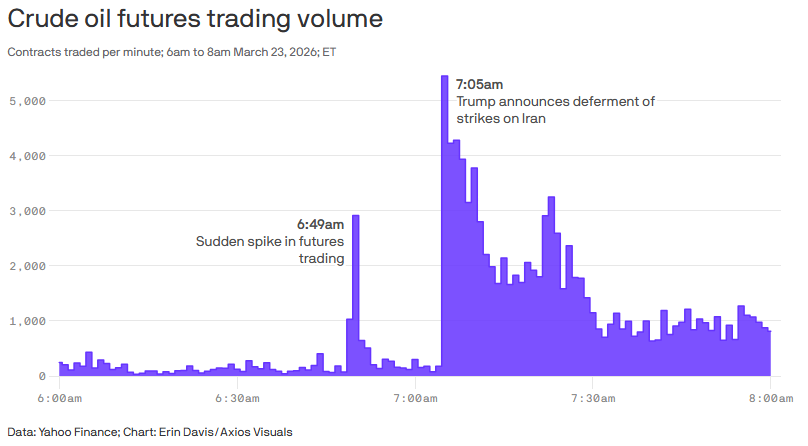
6:49am: sudden spike in oil futures trading. no news. no announcement. nothing public.
7:05am: trump announces a pause on iran strikes. markets move.
someone knew. 16 minutes early. $580 million in contracts. the corruption is staggering.