CHEMICAL TANK SITUATION IN GARDEN GROVE
Not yet confirmed, but it sounds like the tank cracked overnight and released pressure. This is great news if true, because the potential for an explosion is greatly reduced.
The ACHA’s Global Catholicism series continues! Join us for a discussion on how to integrate global perspectives on Catholicism in their research. The webinar will be held on November 5th from 7:00 a.m. to 8:30 a.m. CST; no registration is required. Just scan the QR code.
I was main editor of these online volumes, published by @ACTC5 and on teaching great books & core texts.
READING BY STARLIGHT: CORE TEXTS FROM CONFUCIUS TO ZADIE SMITH
https://t.co/LJUxGhxy4G
CRISIS AND CONSOLATION: LIBERAL ARTS IN THE TIME OF COVID-19
https://t.co/jOaYFErv8h
"Update your CV in July or August," said a dean during my first two years at Pepperdine. Having updated it on my website, I also created a page on my "big book" project. Any tips and assistance towards that book will be most appreciated!
https://t.co/WTa3fySDLv
My latest blog is about the first Vietnamese cover band in the U.S. It was formed in Hawaii and shortly after the fall of Saigon. In 1977 it did a tour playing rock, disco, etc. in clubs, lounges, hotels throughout the Midwest.
https://t.co/MuRHViv8dP
My latest musing is on David Marr's book Vietnamese Tradition on Trial. Is it a misnomer or, worse, a massive interpretative error? Was “tradition” really “on trial”? Indeed, was it even “tradition” by the 1920s and 1930s and the early 1940s?
https://t.co/F1oaX3FtAQ
My article has been published in The Historian on a topic never studied before: disabled veterans in the Republic of Vietnam in 1970-72. I examine their ideology, which was a mix of nationalism, anticommunism, anti-capitalism, and anti-Americanism.
https://t.co/yOABfxJBpG
My new posts on 3 classic Vietnamese bolero songs + English translations of lyrics. All have to do with Chế Linh but also Trường Vũ, Lệ Quyên, etc. This music peaked in the 1960s in SVN reflecting the ideals of first love and affectionate marriage.
https://t.co/iBgFfgYdlK
A nearly forgotten episode in the 1970s. I wonder how many of the Vietnamese (and the Americans involved in the training) are still alive and up for an interview?
https://t.co/aDYF3WuB1X
The ACHA’s Global Catholicism series returns with a deep dive into archival resources around the world—from Asia to Europe to the U.S. Learn from archivists and scholars about hidden gems in global collections and discover new directions for your research. No registration needed!
@CNMNguyen @YinQingfei@cambUP_History Comedian Joe Wong had this joke a few years ago. "Trump wants to build a wall [pause]. I am from China [pause]. So I know a lot about walls [audience cracking]. They don't work [laughter]." I hope he'd come up with a new joke about China and tariffs ending with "they don't work."
No invite to a review roundtable in my first 10 years at Pepperdine. Then 2 invites on the same day in Year 11, including on Van Nguyen-Marshall's very good history of the noncommunist civil society in South Vietnam. Intro + 6 reviews + author's response.
https://t.co/SdbZoacssr
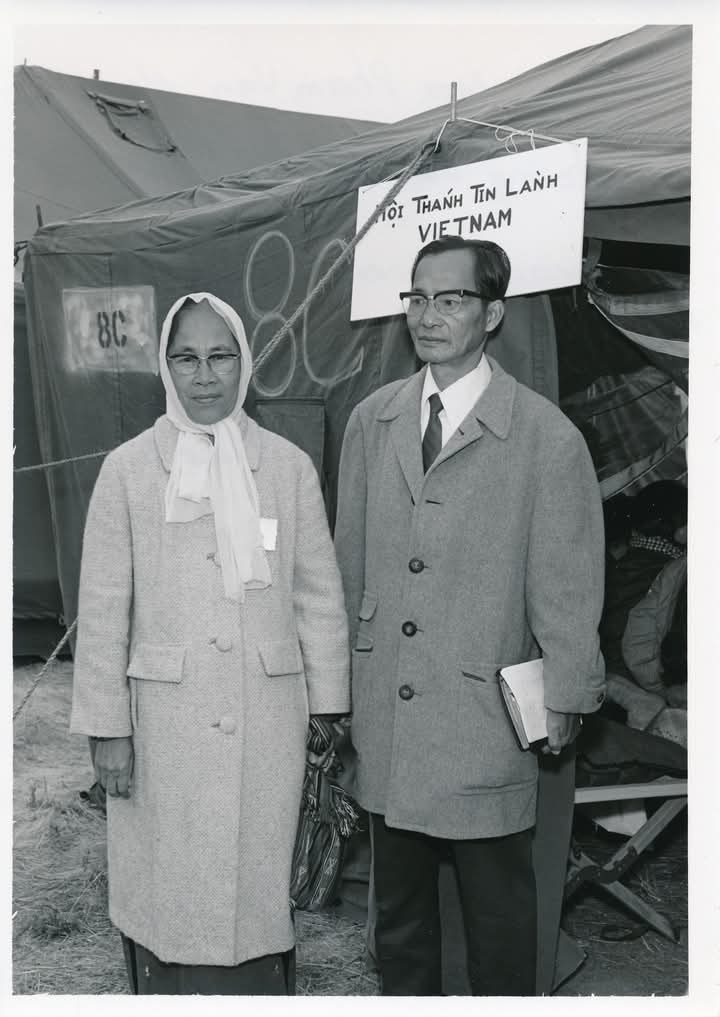
and the biggest change of their lives. I don't have evidence on what was being preached. But it wouldn't surprise me if the promises of the Resurrection were often evoked in the preaching of Phạm Văn Năm, Phạm Xuân Hiền, Trương Văn Tốt, and other ministers at Camp Pendleton.
Easter Sunday 1975 was March 30, a month before the fall of Saigon. It made for ugly news in the US as a man in Ohio killed 11 members of his family, an event known as the Easter Sunday Massacre. Many more deaths took place in Vietnam. NVN troops entered Da Nang the day before.
These photos of the Rev. and Mrs. Năm, which I found last summer at the archives of the Christian and Missionary Alliance, offer a glimpse into the stress and anxiety among the refugees, who now more than ever relied on their religious faith to get through the biggest shock
faculty at the Nha Trang Theology School in 1960. His wife became an important Protestant women in South Vietnam. Now refugees they and other Protestant leaders reconstituted religious practices while waiting for resettlement: Bible studies, Sunday services, preaching, singing...
Among them were the Rev. and Mrs. Phạm Văn Năm, members of the evangelical Tin Lành (Good News). They had lived at the Bible School in Đà Nẵng during 1935-1936 and 1939-1940. After 20 years of opening and administering churches, mostly in the Highlands, he was appointed to the
It was a series of rapid gains for the People's Army. Only the Battle of Xuân Lộc during April 9-21, could slow the advancement. Several weeks after Easter Sunday, a number of Vietnamese with close ties to Đà Nẵng and Nha Trang ended up at a refugee
processing center in the US.
They were aided by local communist forces who smelled blood and attacked an important airfield. The SVN military sent Air Force Colonel Le Van Thao, whose unit successfully executed an air raid but it was too little and too late. The South Vietnamese had to abandon the air field.