Pi App Studio backend support has been enabled!
Backend capabilities begin with persistent storage for newly created App Studio apps, allowing apps to save and retrieve user-specific data across sessions.
Creators can now build App Studio apps with user experiences that continue even after users leave and return.
For example:
- Game apps can remember a user’s high scores
- Productivity apps can remember a user’s to-do lists
- Note-taking apps can preserve notes automatically
Before, Pi App Studio apps were largely limited to frontend-only, single-session experiences, where app data such as preferences or progress would disappear if users left the app.
Adding backend support is a significant App Studio platform milestone because it expands what AI-created apps can practically do on Pi Network. Persistent storage is the first capability built on this foundation, enabling a broader range of useful, everyday applications.
Learn more and create apps with this new feature in Pi App Studio today!
https://t.co/UlKKz3ZcjG
Pi App Studio has released two updates to help creators build more engaging and useful app experiences.
1. Backend support enables persistent user experiences for newly created App Studio apps: Apps can save and retrieve user-specific data across sessions, enabling experiences that continue even after users leave and return.
2. AI-assisted App Planning Phase: Creators can develop their ideas with the help of AI before App Studio generates the app. This helps guide creators from an initial idea toward a more complete app concept in a more interactive and dynamic way.
Go to the Pi mining app to learn more, and create new apps with these features today!
Take on the Pi2Day Ecosystem Quest to celebrate new feature releases and receive a special in-app badge!
The Ecosystem Quest guides Pioneers to complete activities to discover new apps, test ecosystem features, and understand how Pi’s infrastructure supports utility creation across compute, AI, and identity.
Certain steps in the Quest require completing a quiz, so remember to pay attention to the updates! You can show-off your in-app badge in Pi Chats, Fireside Forum, and Pi Social Profiles.
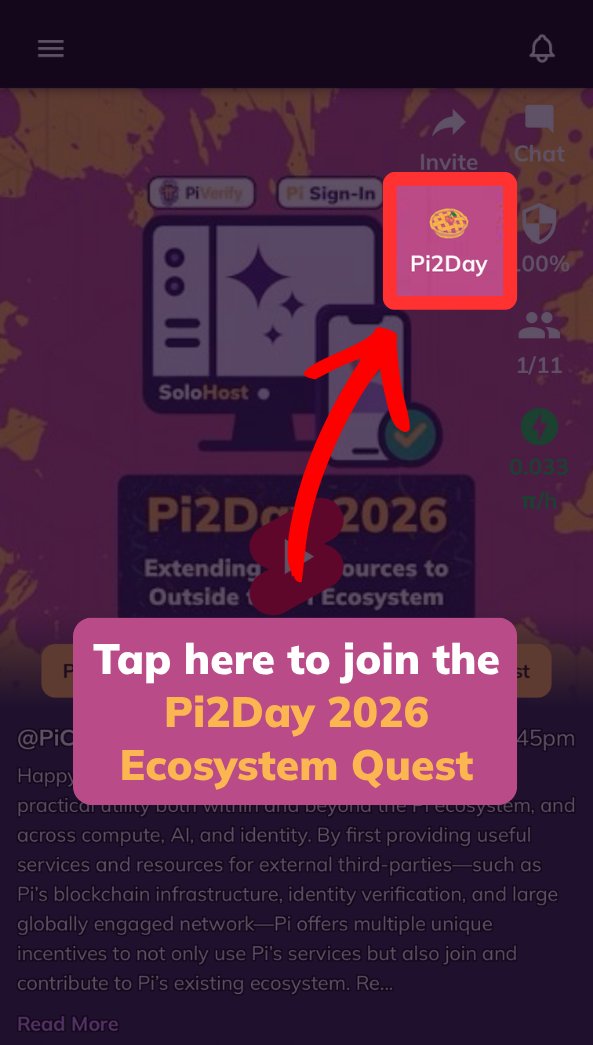
Participate in the Ecosystem Quest by tapping the “Pi2Day” icon on the top right of the Pi mining app home screen. The event will end on July 13.
New to Pi? Download the Pi mining app and get started here https://t.co/sHTvwa8Vt7
Pi2Day 2026 reflects how Pi’s utility continues to grow through infrastructure and participation.
- Through SoloHost, Pi Desktop and Nodes can support new local AI app and compute use cases
- Pi Sign-in can help connect those experiences across users, devices, and services
- PiVerify can extend Pi’s real-human verification capabilities to third-party clients.
Together, these releases point to a broader direction for the ecosystem: Pi products are built both for the Pi ecosystem and to extend Pi services and resources to the external world. This, in turn, enriches and strengthens the Pi ecosystem.
Pi’s practical utility is built not only by product releases but by the Pioneers, Node operators, developers, KYC validators, app teams, merchants, and third-party services that use them, test them, and build on them.
Read the Pi2Day 2026 blog to learn more
https://t.co/5hkl8TAxxQ
Pi Sign-in allows supported third-party websites and apps to offer Pi accounts as a sign-in or sign-up option.
It helps provide the infrastructure that allows applications and services to recognize, connect, and serve users across and outside the ecosystem.
This means Pioneers can access supported services with their Pi account instead of creating a new account or password for every app.
Why would third-party services or websites want to integrate Pi Sign-in? Pi Sign-in creates a simpler way to connect them with Pi’s large user base and bring Pi users into their own product experiences. It also gives Pi more presence in third-party contexts while offering a way to tap into the additional benefits and resources of Pi Network, besides user traffic.
Learn more about the Pi2Day 2026 release at https://t.co/lMgJBEMbYj
PiVerify is a KYC identity verification service available to third-party companies, making Pi’s real-human verification capabilities available outside the Pi ecosystem.
With PiVerify, external platforms can verify their users, reduce fake or duplicate accounts, and support compliance-related identity workflows.
For businesses and platforms, the need is straightforward: many digital services need to know whether users are real people. Verified identities are needed for any meaningful transactions, especially in real-world economies.
PiVerify services are also paid for in Pi, which increases Pi utility.
By making this infrastructure available to third parties, the Pi2Day 2026 PiVerify release extends the utility of Pi’s verified identity technology and resources beyond Pi’s own apps and services.
Learn more at https://t.co/azUeoeGENF
Pi2Day (June 28) has historically been a time for ecosystem milestones, updates, and feature releases.
Last year Pi released:
- Pi App Studio
- Pi’s vision and solution to address AI-era challenges
- Ecosystem Directory Staking
- Node updates and Node ranking page
- And more!
Stay tuned on June 28 for what’s to come!
Reminder for all Pi Mainnet Node operators: The majority of Mainnet node operators have already successfully upgraded to Protocol v25. If you have not yet upgraded your node, please do so at your earliest convenience to remain connected to the network.
As with previous upgrades, the process is straightforward and should take only a few minutes to complete.
Details: https://t.co/ENIm1nuEHz
Ecosystem Directory Staking just got a new look and improved user experience!
Originally launched on Pi2Day 2025, staking through this feature increases an app’s exposure to the Pi community, resulting in more impressions and potentially more user traffic. By staking Pi, Pioneers can collectively support apps and services while developers and creators can promote their apps and tap into Pi’s 60M+ engaged community to acquire users.
The update prepares the feature for further utilization by developers, creators, vibe coders and Pioneers as more apps onboard to the ecosystem.
Note there are no rewards at the protocol level for staking, and the original staked amount will be returned once the staked duration has ended.
Go to the Pi home screen to learn more about Ecosystem Directory Staking and check out the recent design updates to the Ecosystem Interface.
One of the purposes of the Pi Launchpad test token launches is to introduce Pioneers to new ecosystem token mechanics and educate the community on how to participate with DeFi mechanisms.
The first test token provided useful data and highlighted areas where the Launchpad experience needed improvement.
The updated participation flow is simpler and clearer. Participation is now centered around the commitment amount, which has the direct effect on token acquisition. A Pioneer chooses how much Test-Pi they want to commit, and the Launchpad automatically calculates the related “fair-access hold,” and then shows the commitment amount, hold amount, and total together before confirmation.
The goal is to make it easier to understand and use the Pi Launchpad, and preserve the intended fair-access effect of the hold.
Learn more and test the second SLICE token on Testnet today! The SLICE test token launch will be open for participation until Pi2Day, June 28, 2026.
https://t.co/iTiuc93uFq
Pi Launchpad has updated its participation flow and model, incorporating data and feedback from the first Testnet token that launched on Pi Day 2026!
The first Launchpad test token attracted over 478,000 participating Pioneers and generated valuable feedback on the Launchpad mechanism. That feedback has now been incorporated into a simpler participation flow, updated Launchpad mechanics, and an improved user experience.
A second test token “SLICE” is now live on Testnet to help evaluate if the updates can achieve these goals, and to give Pioneers another chance to learn the new ecosystem token mechanics. As a reminder, SLICE is a Testnet token and will never go onto Mainnet.
To participate:
• Open Pi Launchpad in Pi Browser
• Review the SLICE test token and project
• Choose a commitment amount in Test-Pi
• Confirm participation
• Engage with the Slice of Pi app and provide feedback
Participation will remain open until Pi2Day on June 28.
Learn more on the Pi home screen!