you can’t say i didn’t call the crypto spring
if you ever want to get good at this, you must study the retard coins
to reach the upper echelons of the true elite, you must first master the retardest of the retard coins
Correct. And when Pfizer data showed that natural immunity from a prior infection was as good or better than the shot, CDC and FDA covered that up too, so they could get more people to take the shot, exposing even more people to needless risk of serious side effects.
Why ETH Price Must Rise with TVL
(The following was my response to someone and I thought it was worth sharing more broadly.)
It's not that AUM doesn't map to TVS. Those terms are basically synonyms. The difference lies in the entities that hold the assets.
An asset manager, say BlackRock, can manage $14T in AUM with only a $170B market cap because the security of those assets isn't tied to the value of BlackRock.
On Ethereum, because of PoS, someone could take control of the network. I'm going to use an extreme example. Let's say the market cap of Ethereum is $1 and the TVS is $1 Trillion (stocks, bonds, stables etc.) It's economically profitable for an attacker to buy up enough ETH and stake it to take full control of the network. Could also just be a geopolitical attack at scale.
The more valuable Ethereum becomes as infrastructure, the more valuable ETH must become as collateral securing that infrastructure. So there's a reflexive security spiral at play. It's not so much a law forcing people to buy ETH but because if ETH stayed too cheap relative to value secured, the network would become economically vulnerable. So markets naturally pressure ETH upward toward a level where attacking the network becomes prohibitively expensive.
Some real world analogs for this dynamic.
-bank capital requirements scale with liabilities
-Military spending scales with value being protected
-gold historically backed empires partly because it represented trusted collateral
What's interesting is the very act of trying to attack the network strengthens it's security budget by forcing the price of ETH higher.
None of the above mentioned is at play for traditional asset managers and their AUM.
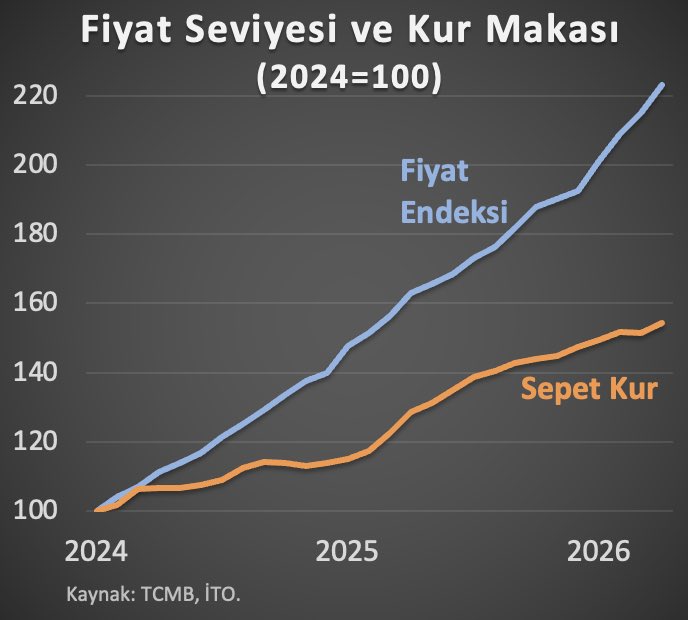
The above is why the chart below is so important.
In a PoS system, is $1 enough to secure $100T?
Obviously not.
That implies there must be some rational security collateral ratio between ETH and the value of the digital economy it secures.
So ETH’s value does not primarily come from “fees.”
It comes from ETH being the decentralized digital commodity that secures Ethereum’s native smart contract economy.
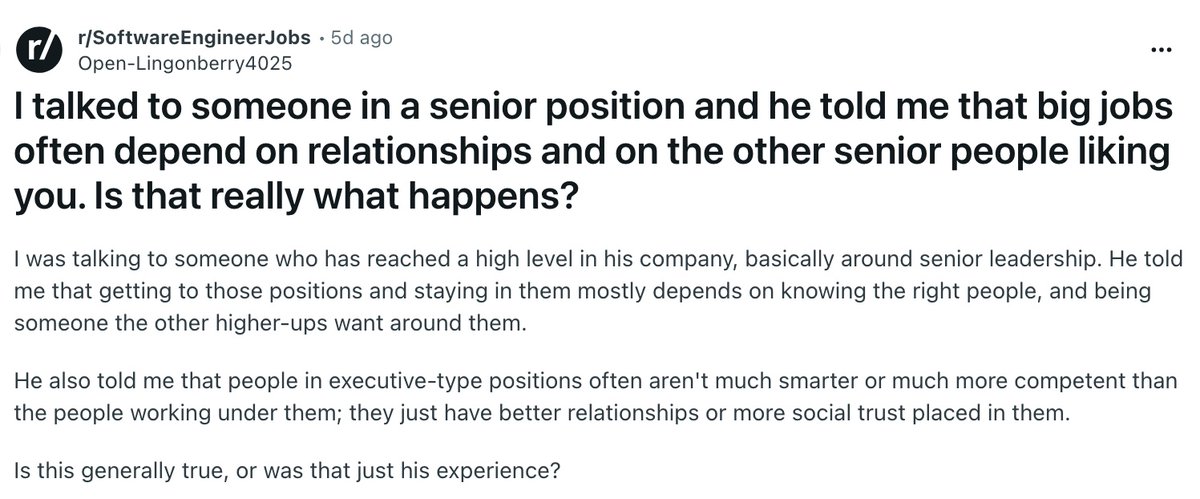
The higher you climb the corporate ladder, the more relationships matter.
At entry level, your output is visible. You do the work, it shows up. It gets seen and you get a raise and promotion.
At director and above, almost none of your work is visible. You're not doing the hands on dirty work, or at least in large amounts. You're making decisions in a room with a few people and the results show up 6 months later. Nobody can trace them back to you.
So how do they decide who belongs in those rooms?
They pick people they already know.
Not "know of." Know.
People they worked with and have seen operate under pressure. That person gets the call more times than not over the stranger with the better resume.
The stakes are higher, so the trust threshold is higher. A bad hire at $70K is annoying. A bad hire at $300K who controls a $50M budget is catastrophic.
And yeah, it's political. Not in the "office politics is a game" way. In the "if you make a mistake at this level, it doesn't just hit you, it hits your boss, your boss's boss, and so forth.
So people protect themselves by surrounding themselves with people whose body of work they've seen firsthand.
This is why "networking" advice misses the point. The goal isn't to collect contacts.
The goal is to do good work with good people so that when a seat opens at their next company, your name is the first one they think of.
when you go to sleep you have new knowledge stored in the context window of your day that needs to update your neural weights. as a final touch, the brain uses these new weights for synthetic data generation (dreams) to train on (with noise injection to prevent overfitting)
Legacy media and academics often argue for two incompatible claims against new technologies, especially as they begin to succeed:
1. It’s a bubble.
2. It will ruin society.
If it’s a bubble, then it’s fake and can’t ruin anything beyond speculator portfolios.
If it’s going to ruin society, it’s not fake, and not a bubble.
We saw this with bitcoin for years and years under various guises:
“It’s for criminals” and “it’s useless”
If it’s useless why would criminals … use it?
“It’s going to boil the oceans” and “it’s going to zero.”
If it’s going to boil the oceans then the block reward, priced in bitcoin, must be in the many millions, like very soon. Hard to do that when it’s also zero!
Anyway, these same kinds of argument patterns are popping up with AI. The people behind them aren’t really responsive to the evidence. They’re just throwing anything at the wall to see if it sticks because they’re elitist doom merchants fundamentally against technological progress. Unhappy people craving social points from a circle of people who just know better than anyone else despite never making or providing anything of true value.
A fun experiment: enter one of these social circles and argue the other way, and, as a bonus, compliment the founders. The reflexive condescension and contempt will be discernible.
Optimism and gratitude is so much better for your soul, and generally your portfolio.