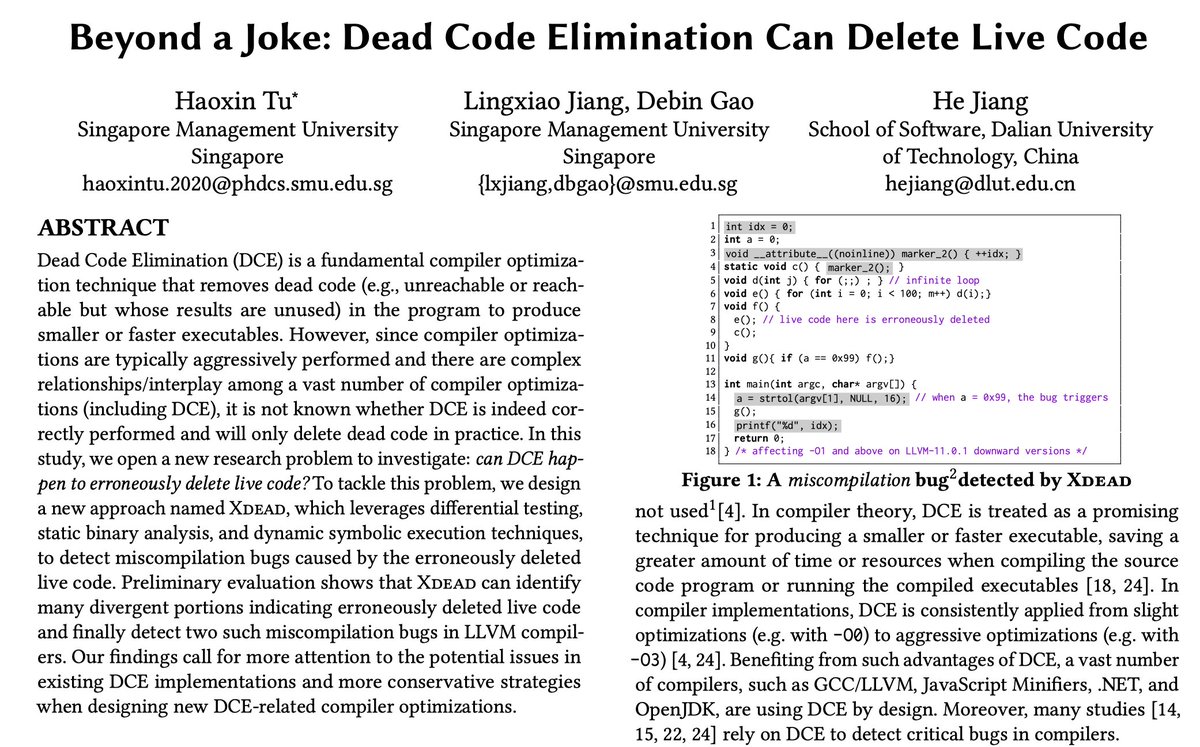
Can you believe Dead Code Elimination (DCE) can delete live code? Do check this example https://t.co/Dktjlfy7r8, and we proposed a new approach to detect such compiler miscompilation bugs in our just accepted ICSE-NIER 2024 paper. A preprint is being prepared. #ICSE2024#NIER
(3/3) This marks our first crucial step toward making formal verification more accessible for real-world software systems. We will continue advancing in this direction, with a broader vision for AI-based verification and validation (V&V) of AI-generated code.
How can we trust code written by either humans or AI agents? Verify it with formal methods!
We are excited to share our work on "Agentic Verification of Software Systems" has been accepted for FSE 2026. Check more:
Paper: https://t.co/jhfTmzdK5Z
Code: https://t.co/YJbleeHH41
(2/3)AutoRocq analyzes proof structure, retrieves relevant lemmas from the current context before tactic prediction, and generates tactics guided by tree-structured representations. It also leverages feedback from the prover and proof history to refine tactic generation.
KLEE 3.2 is released! Many thanks to all the contributors to the main codebase and subprojects!
During the development of this release, the number of projects and publications enabled by KLEE surpassed 300!
https://t.co/8KRDLdlVs1
https://t.co/QsxFtNqxnA
Many thanks @mboehme_ ! The work was initiated when I was an intern at Marcel's group last summer. I believe the group in Bochum is an exceptional place that encourages creative thinking and addresses impactful problems. I am truly grateful for the chance to work with the group♥️
Huge congrats to @TuHaoxin who got his paper accepted at @ACM_TOSEM where he suggested to guide symbolic execution towards memory-corruption-prone parts of the symbolic execution tree using a scalable optimization approach called Monte Carlo Tree Search: https://t.co/w2iq1pwVmf
Happy to share our work "Cottontail: LLM-Driven Concolic Execution for Structured Test Input Generation" will appear in S&P'26!
Paper: https://t.co/vIxZD5BGE2
Code: https://t.co/NxuD4wwNF4
Special thanks to @nim_gnoes_eel, @JNUYUXIAN, @spinpx, @LingxiaoJiang, and @mboehme_ ♥️
@nim_gnoes_eel@JNUYUXIAN@spinpx@LingxiaoJiang@mboehme_ (5/6) Our evaluation shows promising results in terms of code coverage and vulnerability detection capability (6 new CVEs assigned for the memory issues we reported).
@nim_gnoes_eel@JNUYUXIAN@spinpx@LingxiaoJiang@mboehme_ (4/6) Beyond that, we also propose (1) structure-aware path constraint selection to aviod redundant path constraint solving and (2) history-guided seed acquisition to alleviate the saturation issue.
@nim_gnoes_eel@JNUYUXIAN@spinpx@LingxiaoJiang@mboehme_ (3/6) Unlike traditional solvers that operate in a syntax-agnostic manner, we introduce a "Solve–Complete" paradigm that performs syntax-aware *solving* for hard constraints in path conditions, followed by smart *completion* to satisfy soft constraints imposed by syntactic rules.
@nim_gnoes_eel@JNUYUXIAN@spinpx@LingxiaoJiang@mboehme_ (2/6) Rather than relying on input grammars or specifications to guide concolic execution, our secret sauce is to harness an LLM that smartly solves constraints satisfying both path constraints and syntactic validity.
@nim_gnoes_eel@JNUYUXIAN@spinpx@LingxiaoJiang@mboehme_ (1/6) In this work, we investigated the problem of *how we can perform concolic execution to generate highly structured test inputs for systematically testing parsing programs*.
I am happy to share that I passed the dissertation defense at SMU today! I am now officially Dr. Tu! (Or Dr. Two🤣, as I finally completed the Dual-degree PhD program 🎓🎓 in 6 years!)
Special thanks to all committee members: Profs. Lingxiao, Xuhua, @davidlo2015, and @mboehme_!