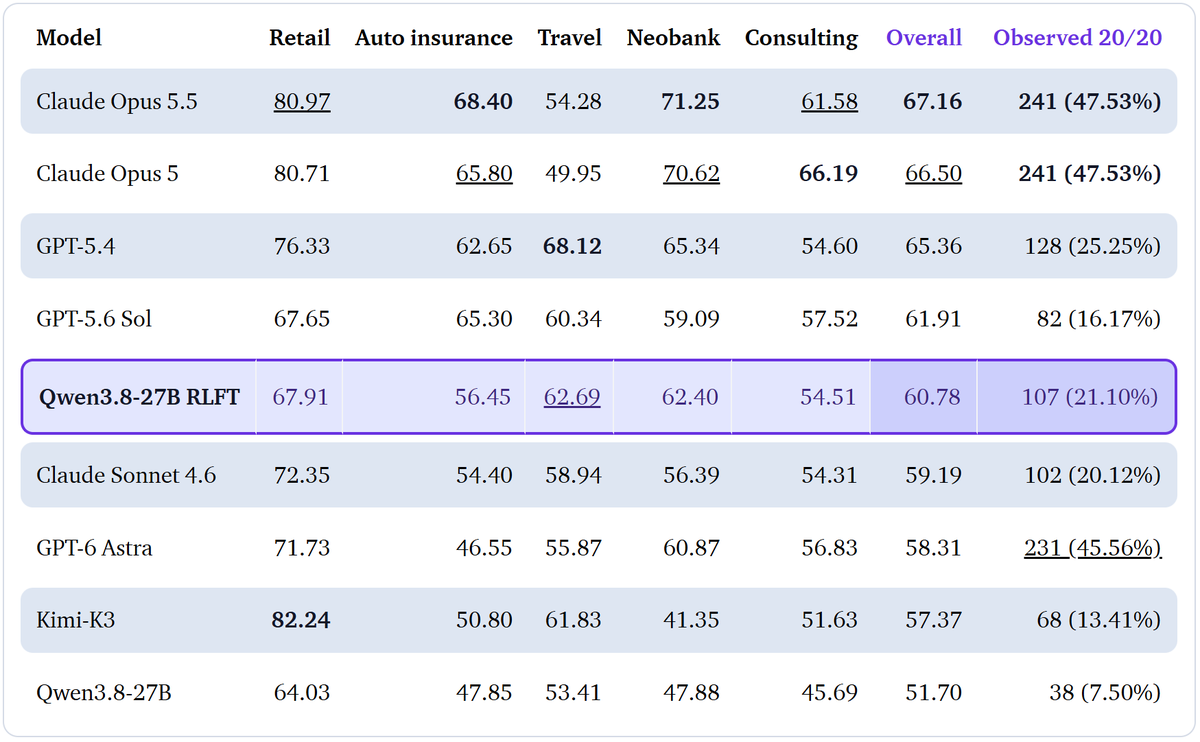
Second Hugging Face blog on Microsoft Thinkingbox is on post-training agents to improve their reliability on enterprise workflows, give it a read: https://t.co/pCcdSd71gM
We use a 27B Qwen3.8 and post train it to match the performance of much bigger closed source models.
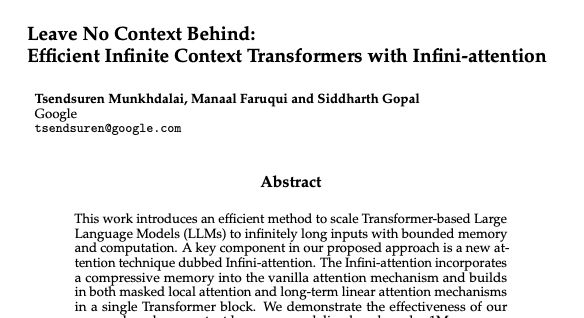
Google announces Leave No Context Behind
Efficient Infinite Context Transformers with Infini-attention
This work introduces an efficient method to scale Transformer-based Large Language Models (LLMs) to infinitely long inputs with bounded memory and computation. A key
To all "it's merit based" responders: if you reward skills before they are introduced in the public school system, the vast majority of rewardees will come from extremely privileged backgrounds that support and incentivize them to acquire those skills privately.
NeurIPS first author paper to get into highschool soon. This is a questionable move from NeurIPS
The number of emails I get from some of the highschools in Cali is insane. They're all from "top" highschools and most directly from parents who know the game.
We are devastated to learn of Matthew Perry’s passing. He was a true gift to us all. Our heart goes out to his family, loved ones, and all of his fans.
@prfsanjeevarora I'm an applied scientist at Amazon working with LLMs. I think I already applied, if not please let me know the application portal for research engineer position.
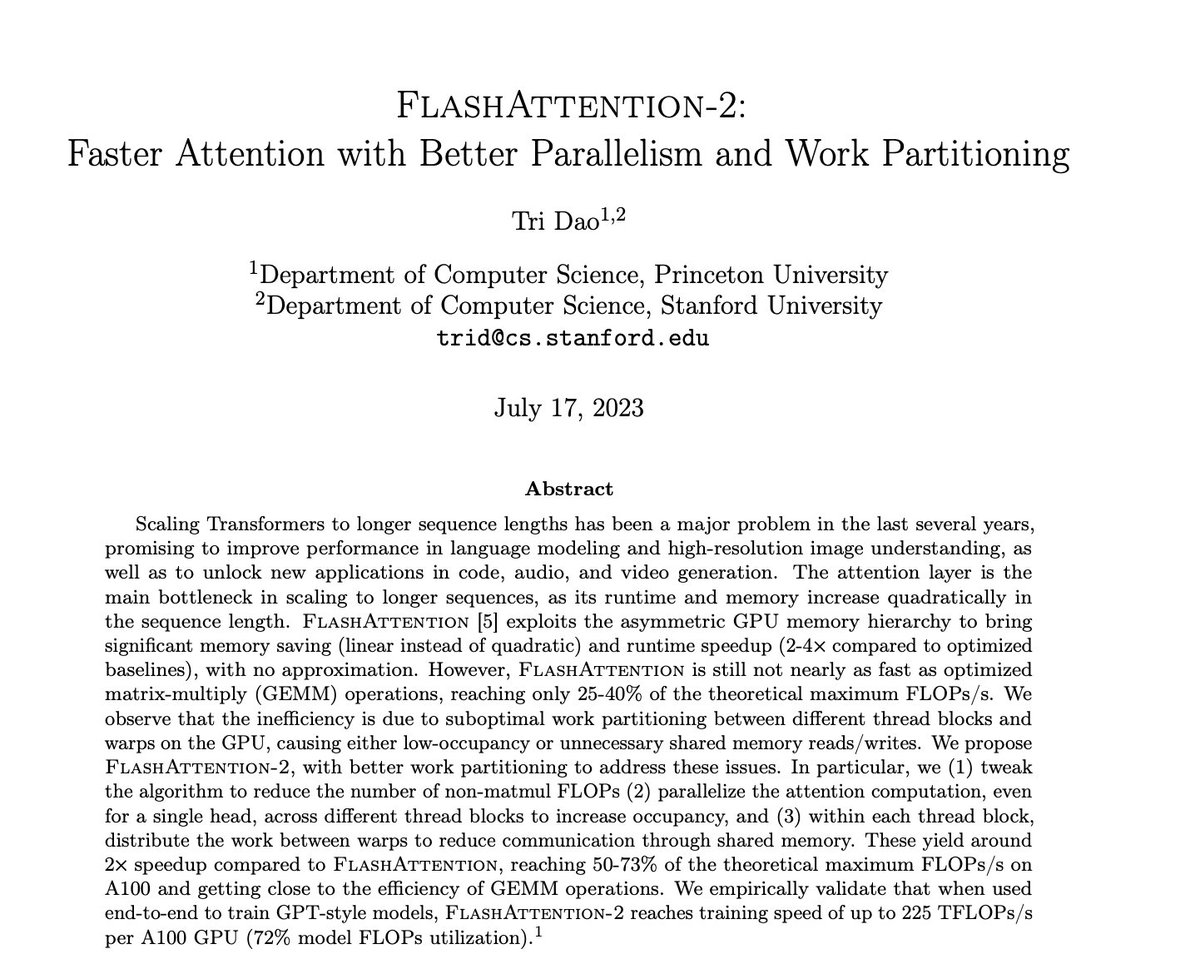
FlashAttention-2: Faster Attention with Better Parallelism and Work Partitioning
paper: https://t.co/V5PfgDiPPc
github: https://t.co/dM2vKEA0wu
Scaling Transformers to longer sequence lengths has been a major problem in the last several years, promising to improve performance in language modeling and high-resolution image understanding, as well as to unlock new applications in code, audio, and video generation. The attention layer is the main bottleneck in scaling to longer sequences, as its runtime and memory increase quadratically in the sequence length. FlashAttention [5] exploits the asymmetric GPU memory hierarchy to bring significant memory saving (linear instead of quadratic) and runtime speedup (2-4× compared to optimized baselines), with no approximation. However, FlashAttention is still not nearly as fast as optimized matrix-multiply (GEMM) operations, reaching only 25-40% of the theoretical maximum FLOPs/s. We observe that the inefficiency is due to suboptimal work partitioning between different thread blocks and warps on the GPU, causing either low-occupancy or unnecessary shared memory reads/writes. We propose FlashAttention-2, with better work partitioning to address these issues. In particular, we (1) tweak the algorithm to reduce the number of non-matmul FLOPs (2) parallelize the attention computation, even for a single head, across different thread blocks to increase occupancy, and (3) within each thread block, distribute the work between warps to reduce communication through shared memory. These yield around 2× speedup compared to FlashAttention, reaching 50-73% of the theoretical maximum FLOPs/s on A100 and getting close to the efficiency of GEMM operations. We empirically validate that when used end-to-end to train GPT-style models, FlashAttention-2 reaches training speed of up to 225 TFLOPs/s per A100 GPU (72% model FLOPs utilization).
I am happy to share that our paper won the Outstanding Paper Award of ACL.
We propose CAME to simultaneously achieve two goals: fast convergence as in traditional adaptive methods, and low memory usage as in LLM training.
https://t.co/kiu6jrJCSu
Introducing Objaverse-XL, an open dataset of over 10 million 3D objects!
With it, we train Zero123-XL, a foundation model for 3D, observing incredible 3D generalization abilities: 🧵👇
📝 Paper: https://t.co/2oNakoka7v