Researchers sent the same resume to an AI hiring tool twice. Same qualifications. Same experience. Same skills. One version was written by a real human. The other was rewritten by ChatGPT.
The AI picked the ChatGPT version 97.6% of the time.
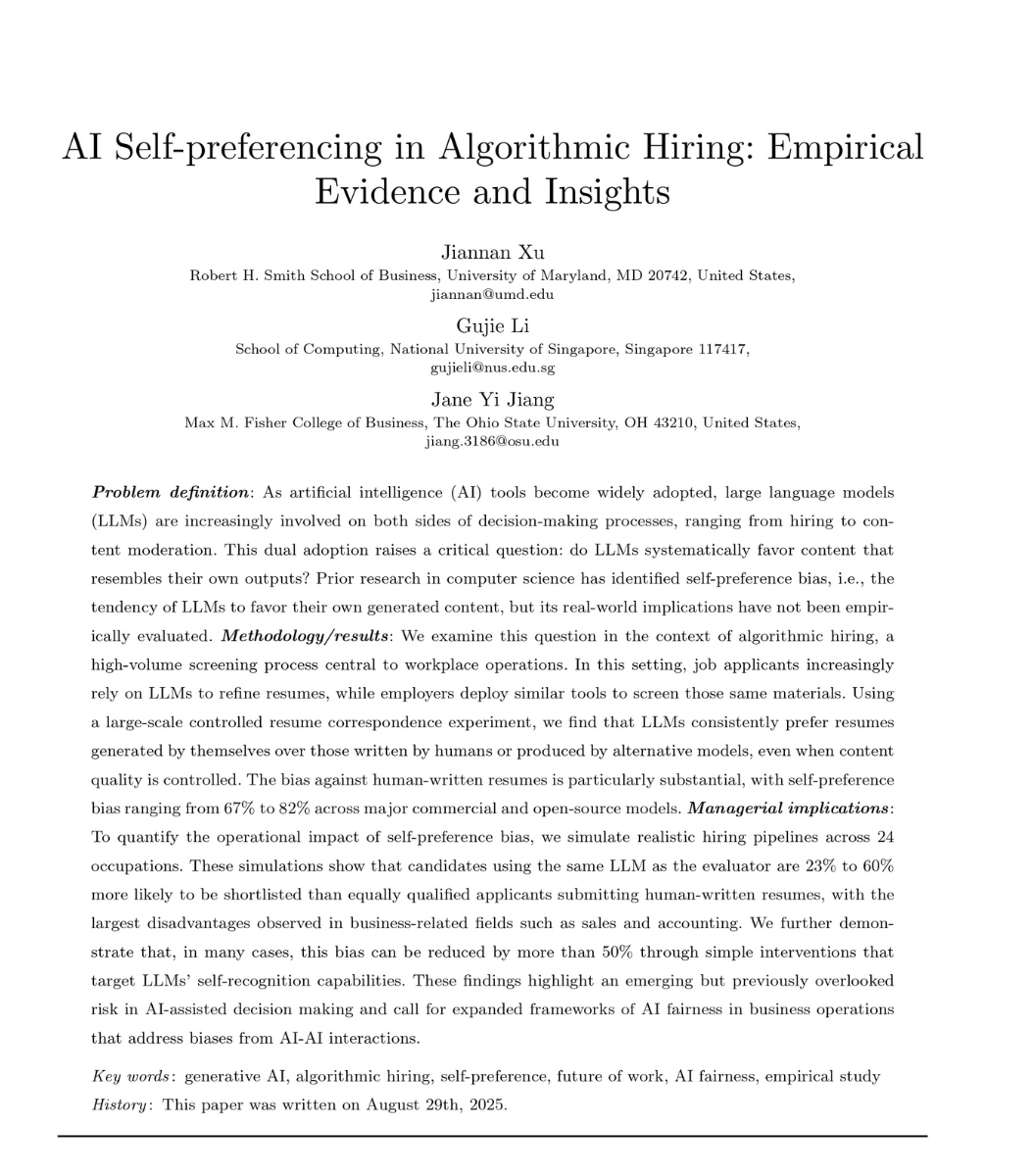
A team from the University of Maryland, the National University of Singapore, and Ohio State just published the receipt. They took 2,245 real human-written resumes pulled from a professional resume site from before ChatGPT existed, so the human writing was actually human. Then they had seven of the most-used AI models in the world rewrite each one. GPT-4o. GPT-4o-mini. GPT-4-turbo. LLaMA 3.3-70B. Qwen 2.5-72B. DeepSeek-V3. Mistral-7B.
Then they asked each AI to pick the better resume. Every model picked itself.
GPT-4o hit 97.6%. LLaMA-3.3-70B hit 96.3%. Qwen-2.5-72B hit 95.9%. DeepSeek-V3 hit 95.5%. The real human almost never won.
Then the researchers tried the obvious objection. Maybe the AI is just better at writing. So they had real humans grade the resumes for actual quality and ran the experiment again, controlling for it. The result was worse. Each AI kept picking itself even when human judges rated the human-written version as clearer, more coherent, and more effective.
It gets worse. The AIs do not just prefer AI over humans. They prefer themselves over other AIs. DeepSeek-V3 picked its own resumes 69% more often than LLaMA's. GPT-4o picked its own 45% more often than LLaMA's. Each model can recognize and reward its own dialect.
Then the researchers ran the simulation that ends careers. Same job. 24 occupations. Same qualifications. The only variable was whether the candidate used the same AI as the screening tool. Candidates using that AI were 23% to 60% more likely to be shortlisted. Worst gap was in sales, accounting, and finance.
99% of large companies now run AI on incoming resumes. Most of them use GPT-4o. The paper just proved GPT-4o picks GPT-4o 97.6% of the time.
If you wrote your own cover letter this week, you did not lose to a better candidate. You lost to a worse candidate who paid OpenAI 20 dollars.
Your qualifications do not matter if the AI prefers its own handwriting over yours.
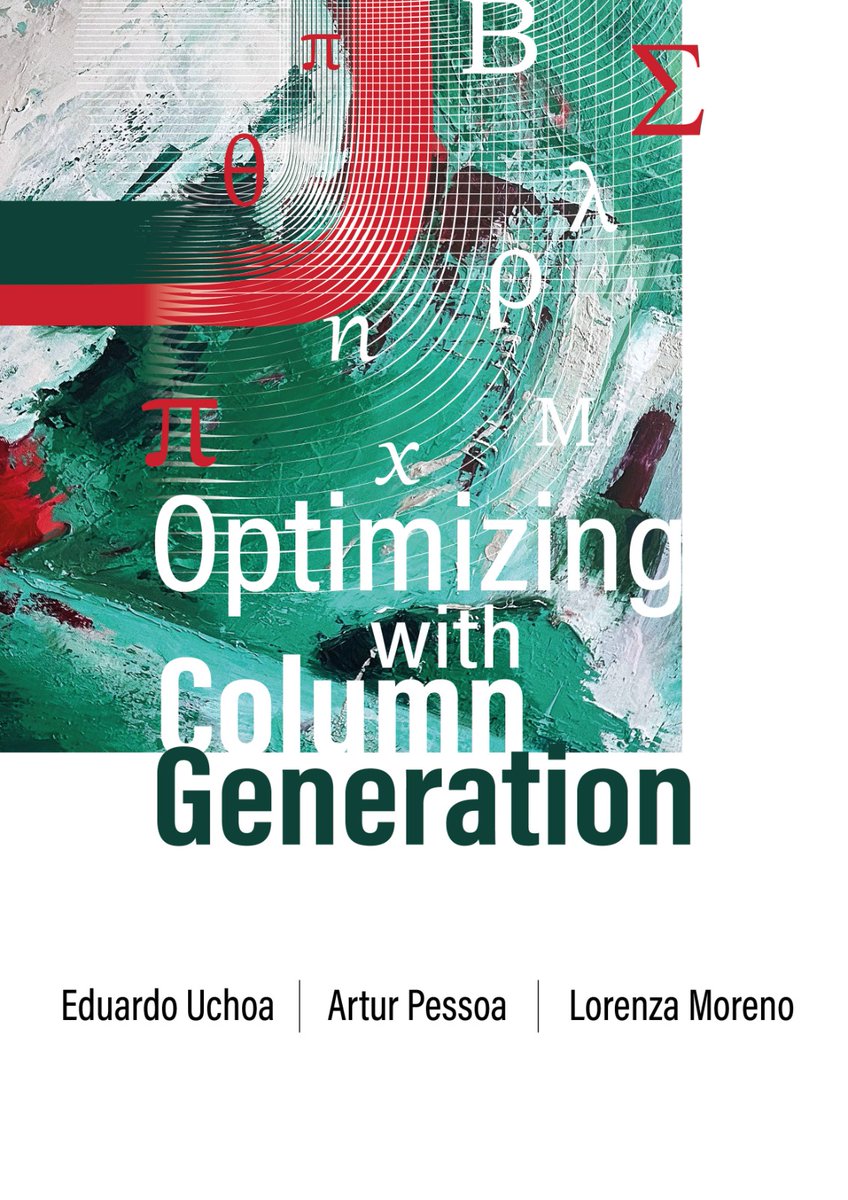
Excited to release Part I of Optimizing with Column Generation. Not a draft. Two years of hard work led to 300 pages covering CG principles in depth. Check https://t.co/njDTUaCJmf Your feedback will help us with the forthcoming Part II on advanced techniques!
The article highlights numerous critical problems plaguing the world of scientific publication, resulting in a flood of inferior papers. Alarmingly, some dubious practices once limited to less prestigious publishers are now becoming widespread. There's significant money at stake
s.t. guests Kate Smith-Miles, Greet Vanden Berghe and David Pisinger got together for a PhD examination committee at KU Leuven in Belgium and they kindly took the time to send me this very special photo. How cool is that? Great to see these three OR legends together 🤩.
Andy Philpott's New Scientist article on linear programming published in 1984. It was written just after Narendra Karmarkar's famous algorithm was made public.
"It is too early to say whether the new algorithm will displace the simplex method as the best for linear programming"
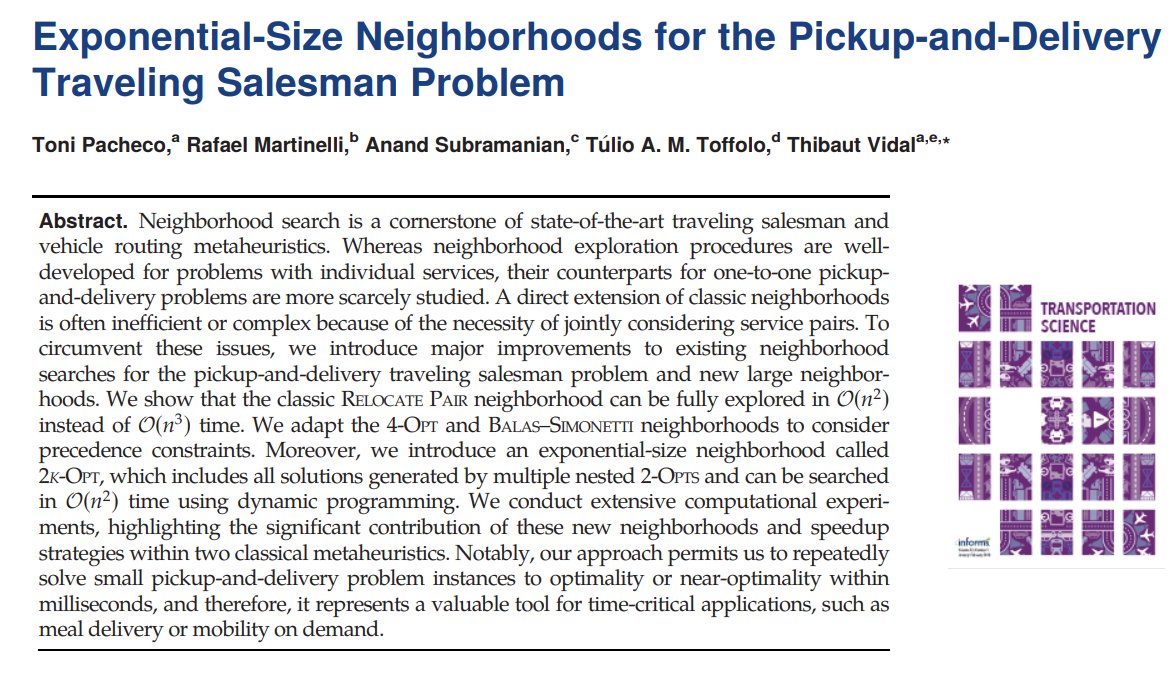
Fascinated by neighborhood search, dynamic programming, and computational complexity? Check our latest paper at @TranSciJournal on pickup-and-delivery problems. Surprisingly large neighborhoods can be explored in a surprisingly small time!
https://t.co/sgQgnF80Vw
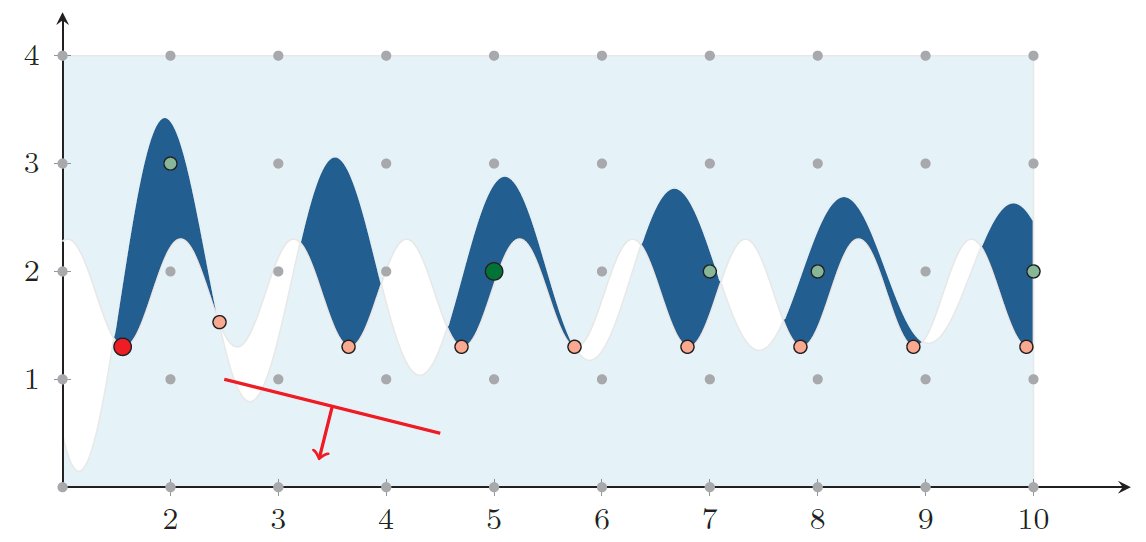
. @FICO_Xpress 9.0 will come with a global MINLP solver!
Learn about all details of this beta, and our new multi-objective optimization capabilities, and our MIP performance improvements, and so much more at #INFORMS2022, session MB42 #orms#optimization